AQA · GCSE · Physics
Course version: 8463 · Version from Sept 2016
Acceleration: distance, s, in metres, m
In the AQA GCSE Physics equations for acceleration, the symbol s stands for distance travelled, measured in metres (m).
Checked against the AQA 8463 specification (opens in a new tab) on .
- Point 7 of 23
- 4 key terms
Study notes
From the checked teaching notes for this specification point.
The idea
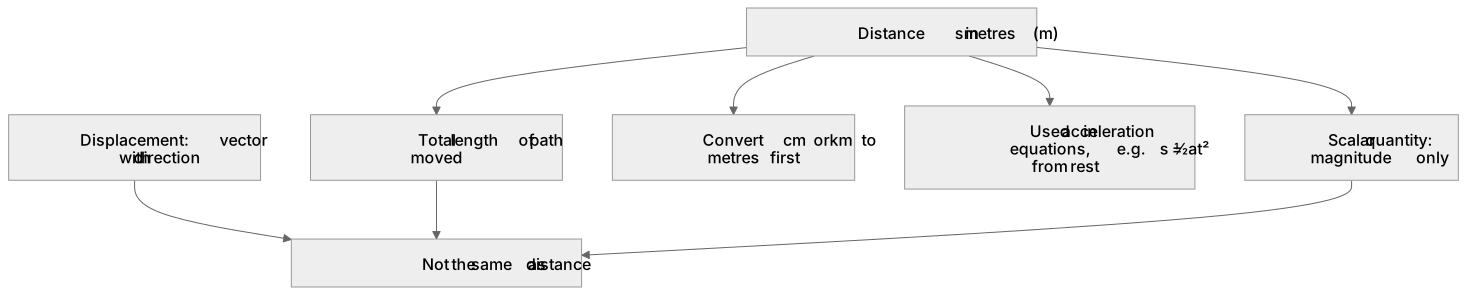
In the AQA GCSE Physics equations for acceleration, the symbol s stands for distance travelled, measured in metres (m). Distance is the total length of the path moved, a scalar quantity, so it has magnitude but no direction. When an object accelerates, its velocity changes, and the distance moved depends on initial velocity, acceleration and time. For example, a car accelerating from rest at 2 m/s² for 3 s travels s = ½ × 2 × 3² = 9 m. Always convert centimetres or kilometres to metres before substituting, and remember that distance is not the same as displacement, which is a vector measured in a stated direction.
What earns the marks
- State that s represents distance travelled, a scalar quantity measured in metres (m).
- Recognise that distance has magnitude only, whereas displacement includes direction.
- Convert lengths into metres before using them in an equation, for example 250 cm becomes 2.5 m.
- Use s consistently in the acceleration equations, such as s = ½at² when starting from rest.
- Distinguish distance from displacement when a journey changes direction.
Common mistakes and how to put them right
Treating distance and displacement as interchangeable.
Put it right by noting that distance is the total path length while displacement is a straight-line vector.
Substituting centimetres or kilometres directly into an equation expecting metres.
Put it right by converting all lengths to metres first.
Confusing the symbol s with speed.
Put it right by remembering that speed is usually v or u in these equations, while s is distance.
Exam tips
- Write the unit m after every distance value in your working to show the quantity is in metres.
- Underline the word distance in a question and check whether displacement is actually required.
- Show the conversion step when a length is given in cm, mm or km before substituting into an equation.
Try the lesson
The start of the Acceleration: distance, s, in metres, m lesson, made from checked teaching notes for this specification point.
Have a go first
In standard physics equations, what does the symbol s represent and what is its standard unit?
Listen
In the AQA GCSE Physics equations for acceleration, the symbol s stands for distance travelled, measured in metres (m). Distance is the total length of the path moved, a scalar quantity, so it has magnitude but no direction. When an object accelerates, its velocity changes, and the distance moved depends on initial velocity, acceleration and time. For example, a car accelerating from rest at 2 m/s² for 3 s travels s = ½ × 2 × 3² = 9 m. Always convert centimetres or kilometres to metres before substituting, and remember that distance is not the same as displacement, which is a vector measured in a stated direction. A strong answer earns marks for these points. State that s represents distance travelled, a scalar quantity measured in metres (m). Recognise that distance has magnitude only, whereas displacement includes direction. Convert lengths into metres before using them in an equation, for example 250 cm becomes 2.5 m. Use s consistently in the acceleration equations, such as s = ½at² when starting from rest. A common slip: Treating distance and displacement as interchangeable. Instead, noting that distance is the total path length while displacement is a straight-line vector. Exam tip: Write the unit m after every distance value in your working to show the quantity is in metres.
See it
Key words
Say what each word means before you turn the card.
Distance
Try answering aloud or in your head before turning the card.
Scalar quantity
Try answering aloud or in your head before turning the card.
Displacement
Try answering aloud or in your head before turning the card.
Metres
Try answering aloud or in your head before turning the card.
See every definition
- Distance
- The total length of the path moved, a scalar quantity measured in metres (m).
- Scalar quantity
- A quantity that has magnitude but no direction.
- Displacement
- A vector measured in a stated direction, which is not the same as distance.
- Metres
- The unit in which distance travelled is measured, written as m.
Label the diagram
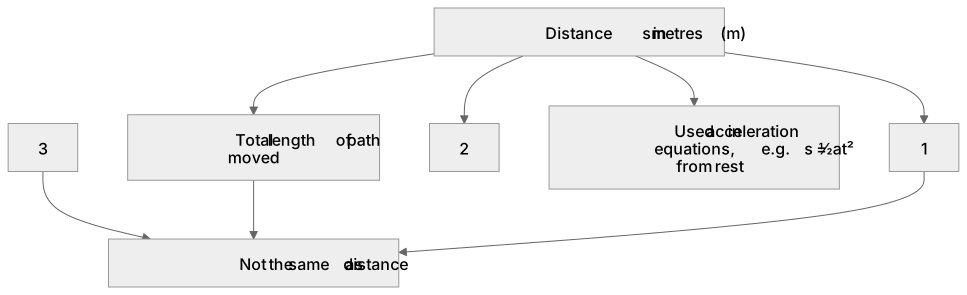
Some boxes have lost their names. Pick the right name for each number.
1Box 1
2Box 2
3Box 3
There is more to this lesson
The full lesson goes on to check your understanding and help you earn the marks. Create a free account to carry on, with your progress saved.
A week of Premium from your first lesson · Then the free plan continues · No card, no charge
Test your understanding of Acceleration: distance, s, in metres, m
Active recall beats re-reading. Take an instant quiz now to test what you’ve learned and lock it into long-term memory.
A week of Premium from your first lesson · Then the free plan continues · No card, no charge