AQA · GCSE · Physics
Course version: 8463 · Version from Sept 2016
Near the Earth’s surface any object falling freely under gravity has an…
Full specification wording
Acceleration: Near the Earth’s surface any object falling freely under gravity has an acceleration of about 9.8 m/s².
Near the Earth’s surface, an object falling freely under gravity accelerates downwards at about 9.8 m/s².
Checked against the AQA 8463 specification (opens in a new tab) on .
- Point 8 of 23
- 4 key terms
Study notes
From the checked teaching notes for this specification point.
The idea
Near the Earth’s surface, an object falling freely under gravity accelerates downwards at about 9.8 m/s². This value, often approximated as 10 m/s² in GCSE calculations, is called the acceleration due to gravity and is represented by g. It applies when air resistance is negligible, so all objects fall with the same acceleration regardless of mass. For example, a ball dropped from rest reaches about 9.8 m/s after 1 s and about 19.6 m/s after 2 s. The acceleration is directed towards the Earth’s centre. If air resistance becomes significant, the resultant downward force decreases and acceleration is less than 9.8 m/s².
What earns the marks
- State that free fall near the Earth’s surface has an acceleration of about 9.8 m/s² directed downwards.
- Explain that g is approximately 9.8 m/s² and may be approximated to 10 m/s² in calculations.
- Recognise that in the absence of air resistance all objects fall with the same acceleration regardless of mass.
- Describe how air resistance reduces the resultant force and therefore reduces acceleration below 9.8 m/s².
- Apply the value of g in equations such as v = u + at or s = ½gt² for falling objects.
Common mistakes and how to put them right
Believing heavier objects always fall faster.
Put it right by stating that without air resistance all objects have the same acceleration of about 9.8 m/s².
Using 9.8 m/s as an acceleration value.
Put it right by including the squared unit, 9.8 m/s².
Ignoring the direction of the acceleration.
Put it right by stating that g acts downwards towards the Earth’s centre.
Exam tips
- Check whether the question expects 9.8 m/s² or the approximation 10 m/s² before calculating.
- State the direction of the acceleration as downwards when describing free fall.
- Explain that air resistance is the reason a real falling object may accelerate at less than 9.8 m/s².
Try the lesson
The start of the Acceleration: Near the Earth’s surface any object falling freely under gravity has an acceleration of about 9.8 m/s². lesson, made from checked teaching notes for this specification point.
Have a go first
Near the Earth’s surface, what is the acceleration of any object falling freely under gravity?
Listen
Near the Earth’s surface, an object falling freely under gravity accelerates downwards at about 9.8 m/s². This value, often approximated as 10 m/s² in GCSE calculations, is called the acceleration due to gravity and is represented by g. It applies when air resistance is negligible, so all objects fall with the same acceleration regardless of mass. For example, a ball dropped from rest reaches about 9.8 m/s after 1 s and about 19.6 m/s after 2 s. The acceleration is directed towards the Earth’s centre. If air resistance becomes significant, the resultant downward force decreases and acceleration is less than 9.8 m/s². A strong answer earns marks for these points. State that free fall near the Earth’s surface has an acceleration of about 9.8 m/s² directed downwards. Explain that g is approximately 9.8 m/s² and may be approximated to 10 m/s² in calculations. Recognise that in the absence of air resistance all objects fall with the same acceleration regardless of mass. Describe how air resistance reduces the resultant force and therefore reduces acceleration below 9.8 m/s². A common slip: Believing heavier objects always fall faster. Instead, stating that without air resistance all objects have the same acceleration of about 9.8 m/s². Exam tip: Check whether the question expects 9.8 m/s² or the approximation 10 m/s² before calculating.
See it
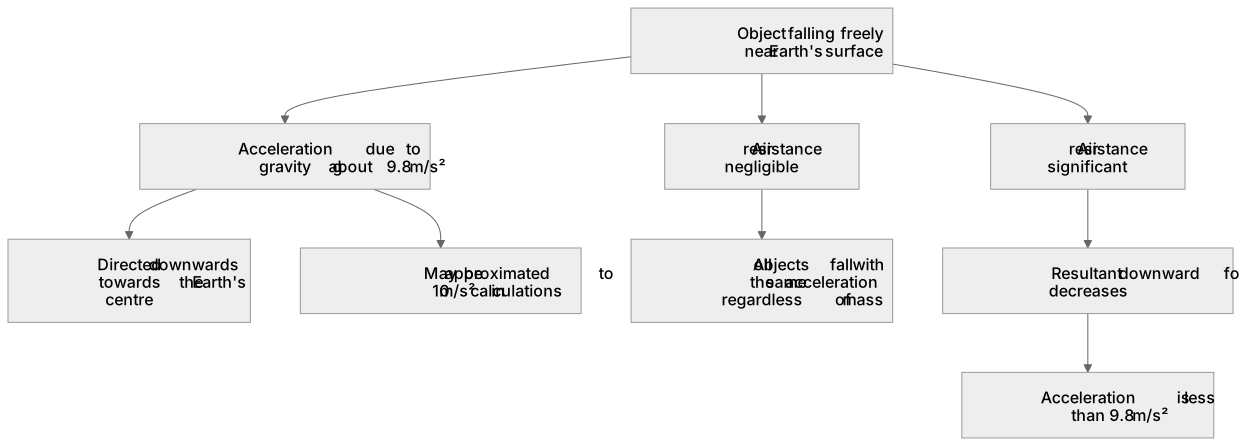
Key words
Say what each word means before you turn the card.
Gravity and free fall
Try answering aloud or in your head before turning the card.
Acceleration and units
Try answering aloud or in your head before turning the card.
Forces and motion
Try answering aloud or in your head before turning the card.
Air resistance and resultant force
Try answering aloud or in your head before turning the card.
See every definition
- Gravity and free fall
- Near the Earth's surface any object falling freely under gravity has an acceleration of about 9.8 m/s², directed towards the Earth's centre.
- Acceleration and units
- The acceleration due to gravity is represented by g, is approximately 9.8 m/s² and may be approximated to 10 m/s² in calculations.
- Forces and motion
- In the absence of air resistance all objects fall with the same acceleration regardless of mass.
- Air resistance and resultant force
- If air resistance becomes significant, the resultant downward force decreases and acceleration is less than 9.8 m/s².
Label the diagram
Some boxes have lost their names. Pick the right name for each number.
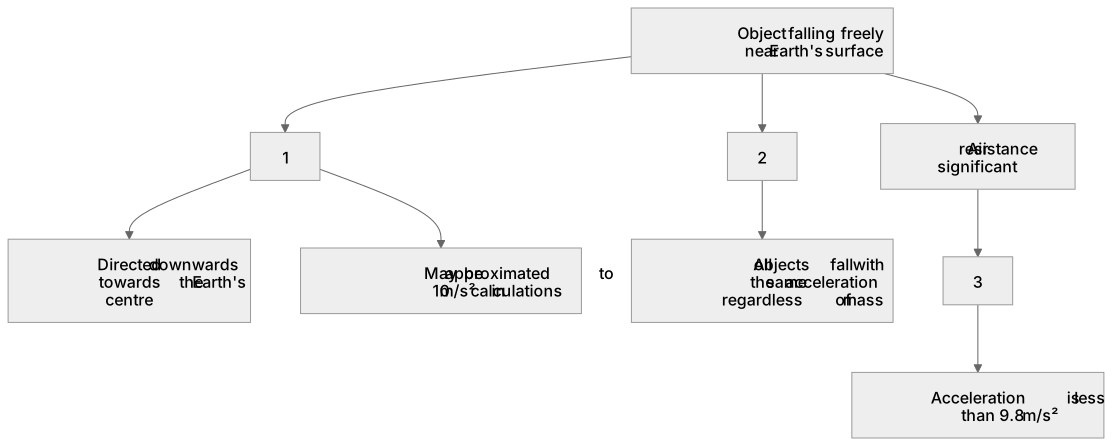
1Box 1
2Box 2
3Box 3
There is more to this lesson
The full lesson goes on to check your understanding and help you earn the marks. Create a free account to carry on, with your progress saved.
A week of Premium from your first lesson · Then the free plan continues · No card, no charge
Test your understanding of Acceleration: Near the Earth’s surface any object falling freely under gravity has an acceleration of about 9.8 m/s².
Active recall beats re-reading. Take an instant quiz now to test what you’ve learned and lock it into long-term memory.
A week of Premium from your first lesson · Then the free plan continues · No card, no charge