AQA · GCSE · Physics
Course version: 8463 · Version from Sept 2016
Students should be able to explain safety features such as: air bags, seat…
Full specification wording
Changes in momentum (physics only): Students should be able to explain safety features such as: air bags, seat belts, gymnasium crash mats, cycle helmets and cushioned surfaces for playgrounds with reference to the concept of rate of change of momentum.
Air bags, seat belts, crash mats, cycle helmets and cushioned playground surfaces all work the same way.
Checked against the AQA 8463 specification (opens in a new tab) on .
- Point 2 of 3
- 4 key terms
Study notes
From the checked teaching notes for this specification point.
The idea
Air bags, seat belts, crash mats, cycle helmets and cushioned playground surfaces all work the same way. In a crash the person's momentum has to fall to zero, and that change in momentum is fixed by their mass and how fast they were going: the safety feature cannot alter it. What the feature does is crumple, stretch or compress, so the person is brought to rest over a longer time. Since force is the rate of change of momentum, spreading the same change over more time makes the rate smaller, so the force on the body is smaller and the injury less serious. Examiners want the time, then the rate, then the force, in that order. The same physics works in reverse: a car striking a rigid concrete wall stops in a very short time, so the force on the occupants is enormous.
What earns the marks
- Stating that the change in momentum is the same with or without the safety feature.
- The feature increasing the time taken for the collision.
- The rate of change of momentum therefore being smaller.
- Concluding that the force on the person is smaller, so the risk of injury falls.
Common mistakes and how to put them right
Writing that an air bag 'slows down time', which mark schemes explicitly refuse.
Saying only that it 'reduces the impact', which examiners treat as insufficient.
Claiming the feature reduces the change in momentum rather than spreading it over a longer time.
Saying a seat belt stops the person instantly, which would increase the force.
Exam tips
- Use the exact phrase 'rate of change of momentum'; 'momentum changes more slowly' is weaker but often accepted.
- Name the feature and say what it physically does, such as stretching or compressing, before the physics.
- Three-mark questions here follow a three-step chain: longer time, smaller rate of change, smaller force.
Try the lesson
The start of the Changes in momentum (physics only): Students should be able to explain safety features such as: air bags, seat belts, gymnasium crash mats, cycle helmets and cushioned surfaces for playgrounds with reference to the concept of rate of change of momentum. lesson, made from checked teaching notes for this specification point.
Have a go first
A gymnast lands on a thick crash mat instead of a hard floor. Explain why the crash mat reduces the force on the gymnast.
Listen
Air bags, seat belts, crash mats, cycle helmets and cushioned playground surfaces all work the same way. In a crash the person's momentum has to fall to zero, and that change in momentum is fixed by their mass and how fast they were going: the safety feature cannot alter it. What the feature does is crumple, stretch or compress, so the person is brought to rest over a longer time. Since force is the rate of change of momentum, spreading the same change over more time makes the rate smaller, so the force on the body is smaller and the injury less serious. Examiners want the time, then the rate, then the force, in that order. The same physics works in reverse: a car striking a rigid concrete wall stops in a very short time, so the force on the occupants is enormous. A strong answer earns marks for these points. stating that the change in momentum is the same with or without the safety feature. the feature increasing the time taken for the collision. the rate of change of momentum therefore being smaller. concluding that the force on the person is smaller, so the risk of injury falls. Exam tip: Use the exact phrase 'rate of change of momentum'; 'momentum changes more slowly' is weaker but often accepted.
See it
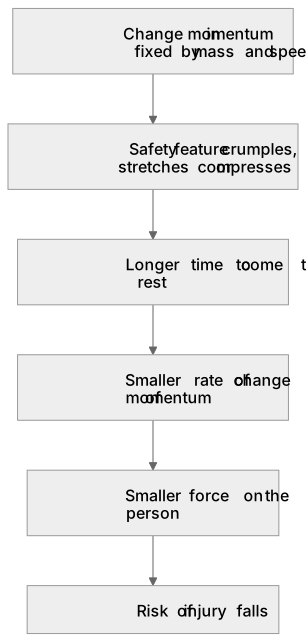
Put it in order
Put these steps in the order they happen.
- 1. Longer time to come to rest
- 2. Safety feature crumples, stretches or compresses
- 3. Change in momentum is fixed by mass and speed
- 4. Risk of injury falls
- 5. Smaller force on the person
- 6. Smaller rate of change of momentum
Key words
Say what each word means before you turn the card.
safety features
Try answering aloud or in your head before turning the card.
contact time
Try answering aloud or in your head before turning the card.
rate of change of momentum
Try answering aloud or in your head before turning the card.
injury risk
Try answering aloud or in your head before turning the card.
See every definition
- safety features
- Things such as air bags, seat belts, gymnasium crash mats, cycle helmets and cushioned surfaces for playgrounds, which crumple, stretch or compress so a person is brought to rest over a longer time.
- contact time
- The time over which a person is brought to rest, which a safety feature increases so that the same change in momentum is spread over more time.
- rate of change of momentum
- The quantity equal to the force, which is made smaller when the same change in momentum is spread over more time.
- injury risk
- The chance of injury, which falls because the force on the person is smaller.
Label the diagram
Some boxes have lost their names. Pick the right name for each number.
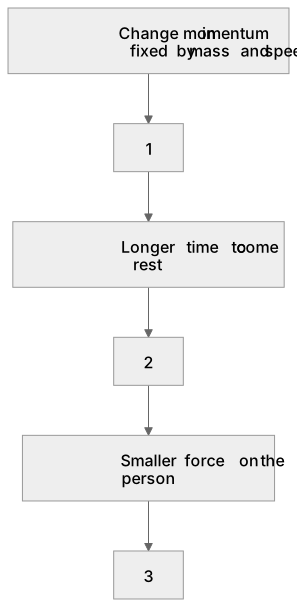
1Box 1
2Box 2
3Box 3
There is more to this lesson
The full lesson goes on to check your understanding and help you earn the marks. Create a free account to carry on, with your progress saved.
A week of Premium from your first lesson · Then the free plan continues · No card, no charge
Test your understanding of Changes in momentum (physics only): Students should be able to explain safety features such as: air bags, seat belts, gymnasium crash mats, cycle helmets and cushioned surfaces for playgrounds with reference to the concept of rate of change of momentum.
Active recall beats re-reading. Take an instant quiz now to test what you’ve learned and lock it into long-term memory.
A week of Premium from your first lesson · Then the free plan continues · No card, no charge