AQA · GCSE · Physics
Course version: 8463 · Version from Sept 2016
Questions will be set using the term potential difference. Students will…
Full specification wording
Current, resistance and potential difference: Questions will be set using the term potential difference. Students will gain credit for the correct use of either potential difference or voltage.
The board sets its questions using the term potential difference, but you may answer with either potential difference or voltage and gain full credit.
Checked against the AQA 8463 specification (opens in a new tab) on .
- Point 3 of 4
- 4 key terms
Study notes
From the checked teaching notes for this specification point.
The idea
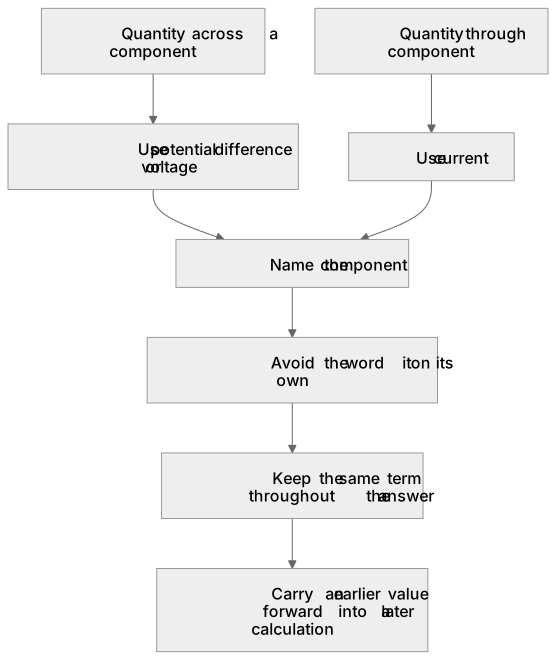
The board sets its questions using the term potential difference, but you may answer with either potential difference or voltage and gain full credit. What is not interchangeable is the preposition. Potential difference is always across a component, because it compares two points, while current is always through a component, because it passes along the path. An answer that says the voltage through the resistor or the current across the lamp risks the mark even when the physics behind it is right. The same care pays off in calculations: values carried forward from an earlier part are credited under the errors carried forward rule, so a wrong number early on does not automatically cost every mark that follows.
What earns the marks
- Using potential difference or voltage consistently for the quantity across a component.
- Using through for current and across for potential difference.
- A clear statement of which component the quantity refers to.
- Carrying an earlier value forward correctly into a later calculation.
Common mistakes and how to put them right
Writing voltage through a component or current across a component.
Using the word it without making clear which quantity or component is meant.
Switching between voltage and potential difference mid-answer so the meaning becomes unclear.
Abandoning later parts of a question after an early numerical slip, when errors carried forward would still earn marks.
Exam tips
- Name the component every time: the potential difference across the lamp, the current through the lamp.
- Answers using it are credited only when it clearly refers to the right subject, so repeat the noun.
- If an early answer feels wrong, still use it in the next part; the errors carried forward rule protects the later marks.
Try the lesson
The start of the Current, resistance and potential difference: Questions will be set using the term potential difference. Students will gain credit for the correct use of either potential difference or voltage. lesson, made from checked teaching notes for this specification point.
Have a go first
Which electrical quantity is also known as voltage?
Listen
The board sets its questions using the term potential difference, but you may answer with either potential difference or voltage and gain full credit. What is not interchangeable is the preposition. Potential difference is always across a component, because it compares two points, while current is always through a component, because it passes along the path. An answer that says the voltage through the resistor or the current across the lamp risks the mark even when the physics behind it is right. The same care pays off in calculations: values carried forward from an earlier part are credited under the errors carried forward rule, so a wrong number early on does not automatically cost every mark that follows. A strong answer earns marks for these points. using potential difference or voltage consistently for the quantity across a component. using through for current and across for potential difference. a clear statement of which component the quantity refers to. carrying an earlier value forward correctly into a later calculation. Exam tip: Name the component every time: the potential difference across the lamp, the current through the lamp.
See it
Key words
Say what each word means before you turn the card.
potential difference
Try answering aloud or in your head before turning the card.
voltage
Try answering aloud or in your head before turning the card.
across versus through
Try answering aloud or in your head before turning the card.
errors carried forward
Try answering aloud or in your head before turning the card.
See every definition
- potential difference
- The quantity that is always across a component, because it compares two points; questions are set using this term.
- voltage
- A term that may be used instead of potential difference and still gain full credit.
- across versus through
- Potential difference is always across a component, while current is always through a component because it passes along the path.
- errors carried forward
- A rule under which values carried forward from an earlier part are credited, so a wrong number early on does not automatically cost every mark that follows.
Label the diagram
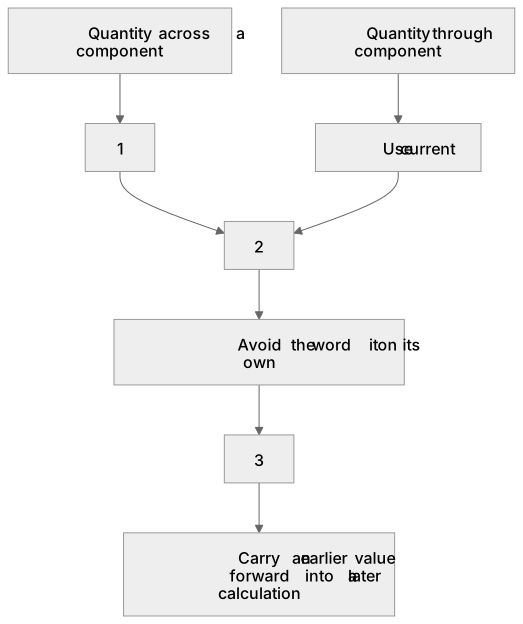
Some boxes have lost their names. Pick the right name for each number.
1Box 1
2Box 2
3Box 3
There is more to this lesson
The full lesson goes on to check your understanding and help you earn the marks. Create a free account to carry on, with your progress saved.
A week of Premium from your first lesson · Then the free plan continues · No card, no charge
Test your understanding of Current, resistance and potential difference: Questions will be set using the term potential difference. Students will gain credit for the correct use of either potential difference or voltage.
Active recall beats re-reading. Take an instant quiz now to test what you’ve learned and lock it into long-term memory.
A week of Premium from your first lesson · Then the free plan continues · No card, no charge