AQA · GCSE · Physics
Course version: 8463 · Version from Sept 2016
Students should be able to explain the difference between direct and…
Full specification wording
Direct and alternating potential difference: Students should be able to explain the difference between direct and alternating potential difference.
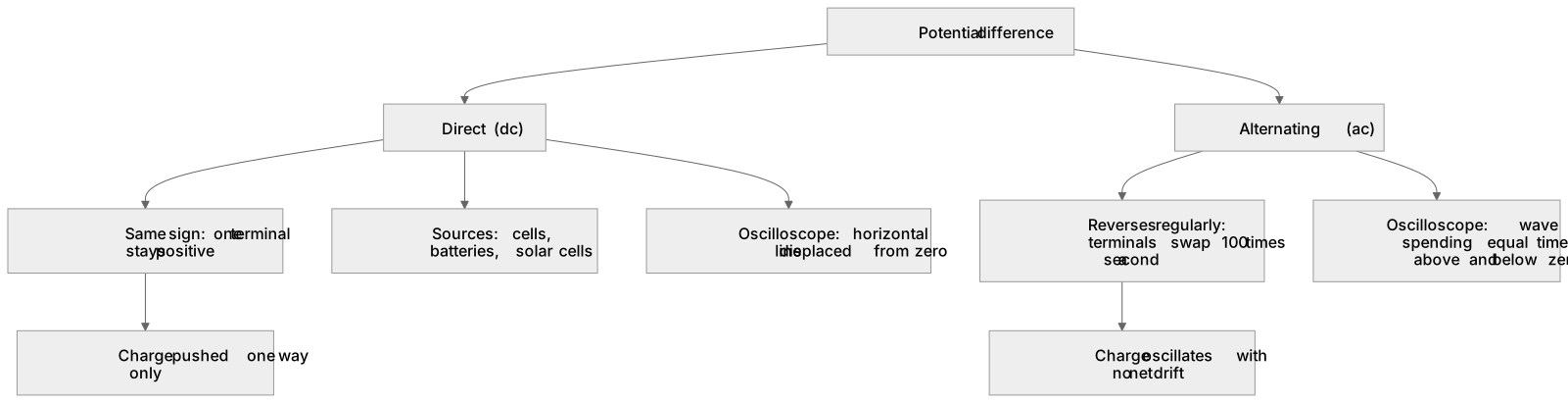
Direct potential difference keeps the same sign: one terminal stays positive, so charge in the circuit is pushed one way only.
Checked against the AQA 8463 specification (opens in a new tab) on .
- Point 2 of 2
- 4 key terms
Study notes
From the checked teaching notes for this specification point.
The idea
Direct potential difference keeps the same sign: one terminal stays positive, so charge in the circuit is pushed one way only. Cells, batteries and solar cells are dc sources, and on an oscilloscope a dc supply gives a horizontal line displaced from the zero line. Alternating potential difference reverses regularly: the terminals swap over 100 times a second, because the supply completes 50 full cycles each second, so the charge oscillates back and forth with no net drift. Its oscilloscope trace is a wave spending equal time above and below zero. The distinction matters because generators produce ac and transformers work only with ac, while chargers and electronic circuits need dc, which is why a laptop carries a power brick that converts one into the other.
What earns the marks
- Direct potential difference acting in one direction only, with unchanging polarity.
- Alternating potential difference repeatedly changing direction or reversing polarity.
- Naming a source of each, such as a cell for dc and the mains or a generator for ac.
- A dc oscilloscope trace as a horizontal line and an ac trace as a repeating wave.
Common mistakes and how to put them right
Saying ac 'goes up and down' without stating that the direction of the potential difference reverses.
Claiming dc is always smaller than ac, confusing size with direction.
Drawing an ac trace entirely above the zero line so that it never reverses.
Describing a battery as ac because its current can be switched on and off.
Exam tips
- Answer in terms of direction, not size; the mark scheme wants 'reverses' or 'changes direction'.
- If an oscilloscope screen is given, mark the zero line first and then decide whether the trace crosses it.
- Name a real source of each type, a cell and the mains, to secure the example mark.
Try the lesson
The start of the Direct and alternating potential difference: Students should be able to explain the difference between direct and alternating potential difference. lesson, made from checked teaching notes for this specification point.
Have a go first
Which description matches a direct potential difference?
Listen
Direct potential difference keeps the same sign: one terminal stays positive, so charge in the circuit is pushed one way only. Cells, batteries and solar cells are dc sources, and on an oscilloscope a dc supply gives a horizontal line displaced from the zero line. Alternating potential difference reverses regularly: the terminals swap over 100 times a second, because the supply completes 50 full cycles each second, so the charge oscillates back and forth with no net drift. Its oscilloscope trace is a wave spending equal time above and below zero. The distinction matters because generators produce ac and transformers work only with ac, while chargers and electronic circuits need dc, which is why a laptop carries a power brick that converts one into the other. A strong answer earns marks for these points. direct potential difference acting in one direction only, with unchanging polarity. alternating potential difference repeatedly changing direction or reversing polarity. naming a source of each, such as a cell for dc and the mains or a generator for ac. a dc oscilloscope trace as a horizontal line and an ac trace as a repeating wave. Exam tip: Answer in terms of direction, not size; the mark scheme wants 'reverses' or 'changes direction'.
See it
Key words
Say what each word means before you turn the card.
direct potential difference
Try answering aloud or in your head before turning the card.
alternating potential difference
Try answering aloud or in your head before turning the card.
oscilloscope trace
Try answering aloud or in your head before turning the card.
sources of ac and dc
Try answering aloud or in your head before turning the card.
See every definition
- direct potential difference
- Keeps the same sign, with one terminal staying positive, so charge in the circuit is pushed one way only.
- alternating potential difference
- Reverses regularly, with the terminals swapping over 100 times a second, so the charge oscillates back and forth with no net drift.
- oscilloscope trace
- For a dc supply it is a horizontal line displaced from the zero line, while for ac it is a wave spending equal time above and below zero.
- sources of ac and dc
- Cells, batteries and solar cells are dc sources, while generators produce ac and transformers work only with ac.
Label the diagram
Some boxes have lost their names. Pick the right name for each number.
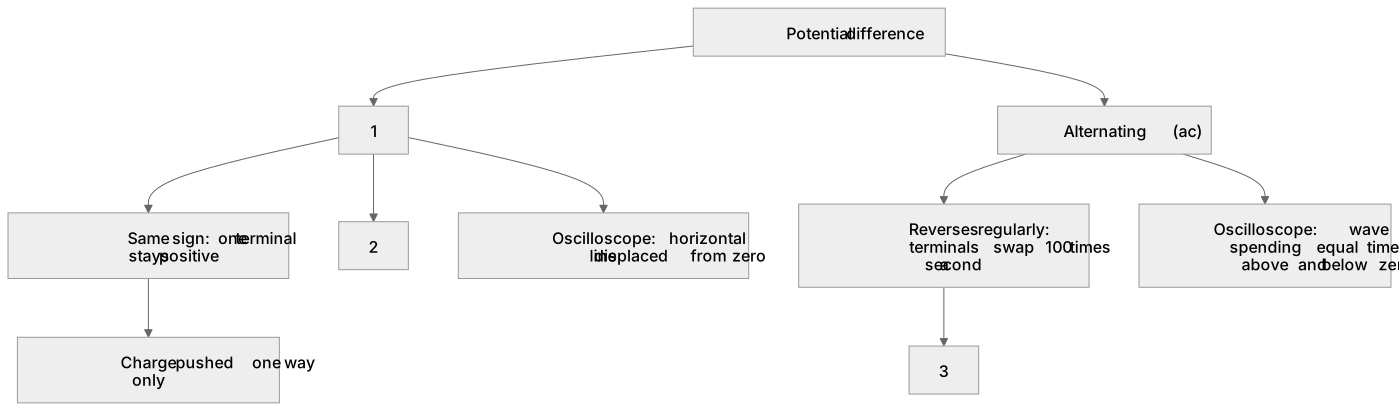
1Box 1
2Box 2
3Box 3
There is more to this lesson
The full lesson goes on to check your understanding and help you earn the marks. Create a free account to carry on, with your progress saved.
A week of Premium from your first lesson · Then the free plan continues · No card, no charge
Test your understanding of Direct and alternating potential difference: Students should be able to explain the difference between direct and alternating potential difference.
Active recall beats re-reading. Take an instant quiz now to test what you’ve learned and lock it into long-term memory.
A week of Premium from your first lesson · Then the free plan continues · No card, no charge