AQA · GCSE · Physics
Course version: 8463 · Version from Sept 2016
Efficiency: Efficiency may also be calculated using the equation:
Efficiency compares the useful energy or power transferred by a device with the total energy or power supplied to it.
Checked against the AQA 8463 specification (opens in a new tab) on .
- Point 3 of 7
- 3 key terms
Study notes
From the checked teaching notes for this specification point.
The idea
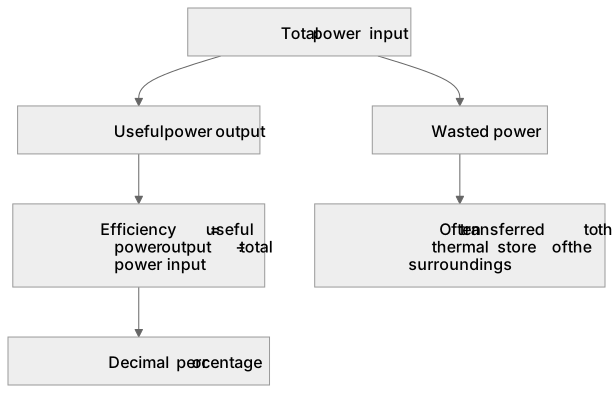
Efficiency compares the useful energy or power transferred by a device with the total energy or power supplied to it. The word 'also' signals that this is an alternative route: you can calculate efficiency from power values instead of energy values. Power is the rate of energy transfer, so dividing useful power output by total power input gives the same fraction as dividing useful energy output by total energy input, provided the device operates steadily. For example, a motor drawing 500 W from the mains and delivering 350 W of useful mechanical power has efficiency 350 ÷ 500 = 0.70, or 70%. The remaining 150 W is wasted, mainly by heating the surroundings. Because the useful output can never exceed the total input, efficiency is always between 0 and 1, or between 0% and 100%.
What earns the marks
- State that efficiency compares useful output with total input and can be found from power values as well as energy values.
- Identify the useful power output and the total power input from the information given, in watts or consistent power units.
- Substitute correctly into efficiency = useful power output ÷ total power input and evaluate the fraction.
- Express the result as a decimal or as a percentage, and recognise that a value above 1 or 100% is impossible.
- Explain that wasted power is the difference between total power input and useful power output, often transferred to the thermal store of the surroundings.
Common mistakes and how to put them right
Dividing total power input by useful power output instead of the other way round.
Put it right by keeping the useful output on top of the fraction.
Forgetting to convert a percentage answer to a decimal, or a decimal to a percentage.
Put it right by checking whether the question asks for a fraction or a percentage and converting by multiplying or dividing by 100.
Adding wasted power to the useful output and treating the sum as the input when the input is already given.
Put it right by using the stated total power input directly.
Exam tips
- Underline the useful power output and the total power input in the question before substituting, so the fraction is set up correctly.
- Write the equation, then substitute with units, then evaluate; this makes method marks easier to award even if the final value slips.
- Check the size of your answer: an efficiency greater than 1 or 100% means the fraction has been inverted or the wrong values used.
Try the lesson
The start of the Efficiency: Efficiency may also be calculated using the equation: lesson, made from checked teaching notes for this specification point.
Have a go first
Which equation can also be used to calculate the efficiency of an energy transfer?
Listen
Efficiency compares the useful energy or power transferred by a device with the total energy or power supplied to it. The word 'also' signals that this is an alternative route: you can calculate efficiency from power values instead of energy values. Power is the rate of energy transfer, so dividing useful power output by total power input gives the same fraction as dividing useful energy output by total energy input, provided the device operates steadily. For example, a motor drawing 500 W from the mains and delivering 350 W of useful mechanical power has efficiency 350 ÷ 500 = 0.70, or 70%. The remaining 150 W is wasted, mainly by heating the surroundings. Because the useful output can never exceed the total input, efficiency is always between 0 and 1, or between 0% and 100%. A strong answer earns marks for these points. State that efficiency compares useful output with total input and can be found from power values as well as energy values. Identify the useful power output and the total power input from the information given, in watts or consistent power units. Substitute correctly into efficiency = useful power output ÷ total power input and evaluate the fraction. Express the result as a decimal or as a percentage, and recognise that a value above 1 or 100% is impossible. A common slip: Dividing total power input by useful power output instead of the other way round. Instead, keeping the useful output on top of the fraction. Exam tip: Underline the useful power output and the total power input in the question before substituting, so the fraction is set up correctly.
See it
Key words
Say what each word means before you turn the card.
Efficiency
Try answering aloud or in your head before turning the card.
Power
Try answering aloud or in your head before turning the card.
Wasted power
Try answering aloud or in your head before turning the card.
See every definition
- Efficiency
- Compares the useful energy or power transferred by a device with the total energy or power supplied to it, and is always between 0 and 1, or between 0% and 100%.
- Power
- The rate of energy transfer, so dividing useful power output by total power input gives the same fraction as dividing useful energy output by total energy input.
- Wasted power
- The difference between total power input and useful power output, often transferred to the thermal store of the surroundings.
Label the diagram
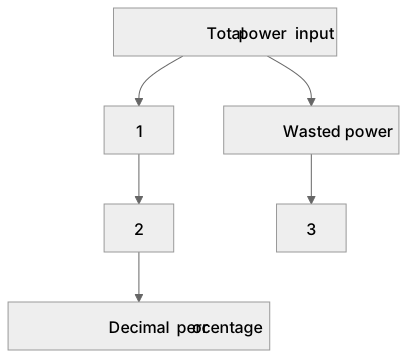
Some boxes have lost their names. Pick the right name for each number.
1Box 1
2Box 2
3Box 3
There is more to this lesson
The full lesson goes on to check your understanding and help you earn the marks. Create a free account to carry on, with your progress saved.
A week of Premium from your first lesson · Then the free plan continues · No card, no charge
Test your understanding of Efficiency: Efficiency may also be calculated using the equation:
Active recall beats re-reading. Take an instant quiz now to test what you’ve learned and lock it into long-term memory.
A week of Premium from your first lesson · Then the free plan continues · No card, no charge