AQA · GCSE · Physics
Course version: 8463 · Version from Sept 2016
(Physics only) Students should be able to interpret diagrams of…
Full specification wording
Electromagnetism: (Physics only) Students should be able to interpret diagrams of electromagnetic devices in order to explain how they work.
This is physics only, and it rewards reading the diagram rather than reciting a device.
Checked against the AQA 8463 specification (opens in a new tab) on .
- Point 9 of 9
- 3 key terms
Study notes
From the checked teaching notes for this specification point.
The idea
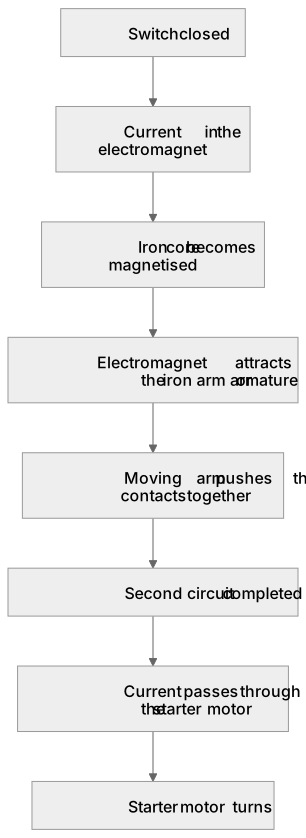
This is physics only, and it rewards reading the diagram rather than reciting a device. Relays, electric bells and circuit breakers all use the same chain: closing the switch drives a current through the electromagnet, the iron core becomes magnetised, the electromagnet attracts an iron arm or armature, and the moving arm does something mechanical. In a car ignition circuit the arm pushes contacts together, completing the starter motor circuit so that a current passes through the starter motor and it turns, which lets a small current switch a very large one. Write the steps in the order the diagram shows, because each linked step earns credit.
What earns the marks
- Stating that closing the switch causes a current in the electromagnet.
- Stating that the iron core of the electromagnet becomes magnetised.
- Stating that the electromagnet attracts the iron arm or armature.
- Stating what the moving arm does, such as pushing the contacts together to complete the second circuit.
- The consequence, such as a current passing through the starter motor so that it turns.
Common mistakes and how to put them right
Describing what the device is for instead of following the sequence shown in the diagram.
Saying the electromagnet attracts the contacts directly rather than attracting the iron arm.
Leaving out the magnetisation of the iron core.
Failing to say that a small current in one circuit is switching a much larger current in another.
Exam tips
- Annotate the diagram as you read it, then write the steps as a numbered chain.
- Start at the switch and follow the current; every linked step is worth a mark.
- If asked how to increase the force on the armature, reduce the distance or increase the current.
Try the lesson
The start of the Electromagnetism: (Physics only) Students should be able to interpret diagrams of electromagnetic devices in order to explain how they work. lesson, made from checked teaching notes for this specification point.
Have a go first
A diagram of an electromagnetic relay shows a coil of wire wrapped around an iron core in a low-current circuit. An iron armature is placed near the core and is attached to a pivot. The other end of the armature is positioned next to the contacts of a high-current circuit. Based on this arrangement, what happens when the low-current circuit is switched on?
Listen
This is physics only, and it rewards reading the diagram rather than reciting a device. Relays, electric bells and circuit breakers all use the same chain: closing the switch drives a current through the electromagnet, the iron core becomes magnetised, the electromagnet attracts an iron arm or armature, and the moving arm does something mechanical. In a car ignition circuit the arm pushes contacts together, completing the starter motor circuit so that a current passes through the starter motor and it turns, which lets a small current switch a very large one. Write the steps in the order the diagram shows, because each linked step earns credit. A strong answer earns marks for these points. stating that closing the switch causes a current in the electromagnet. stating that the iron core of the electromagnet becomes magnetised. stating that the electromagnet attracts the iron arm or armature. stating what the moving arm does, such as pushing the contacts together to complete the second circuit. Exam tip: Annotate the diagram as you read it, then write the steps as a numbered chain.
See it
Put it in order
Put these steps in the order they happen.
- 1. Moving arm pushes the contacts together
- 2. Starter motor turns
- 3. Second circuit completed
- 4. Switch closed
- 5. Current in the electromagnet
- 6. Current passes through the starter motor
- 7. Iron core becomes magnetised
- 8. Electromagnet attracts the iron arm or armature
Key words
Say what each word means before you turn the card.
relays and electromagnetic switches
Try answering aloud or in your head before turning the card.
armature and contacts
Try answering aloud or in your head before turning the card.
reading circuit diagrams
Try answering aloud or in your head before turning the card.
See every definition
- relays and electromagnetic switches
- Devices in which closing the switch drives a current through the electromagnet, and the moving arm does something mechanical, letting a small current switch a very large one.
- armature and contacts
- The iron arm that the electromagnet attracts, and the parts the moving arm pushes together to complete the second circuit.
- reading circuit diagrams
- Following the steps in the order the diagram shows, starting at the switch and following the current, because each linked step earns credit.
Label the diagram
Some boxes have lost their names. Pick the right name for each number.
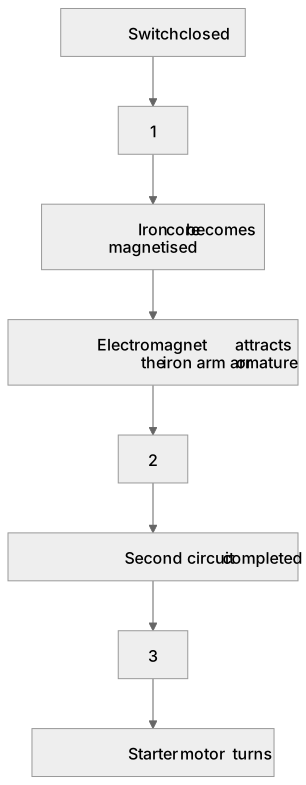
1Box 1
2Box 2
3Box 3
There is more to this lesson
The full lesson goes on to check your understanding and help you earn the marks. Create a free account to carry on, with your progress saved.
A week of Premium from your first lesson · Then the free plan continues · No card, no charge
Test your understanding of Electromagnetism: (Physics only) Students should be able to interpret diagrams of electromagnetic devices in order to explain how they work.
Active recall beats re-reading. Take an instant quiz now to test what you’ve learned and lock it into long-term memory.
A week of Premium from your first lesson · Then the free plan continues · No card, no charge