AQA · GCSE · Physics
Course version: 8463 · Version from Sept 2016
Students should be able to: describe how the magnetic effect of a current…
Full specification wording
Electromagnetism: Students should be able to: describe how the magnetic effect of a current can be demonstrated draw the magnetic field pattern for a straight wire carrying a current and for a solenoid (showing the direction of the field) explain how a solenoid arrangement can increase the magnetic effect of the current.
Three skills are examined together here.
Checked against the AQA 8463 specification (opens in a new tab) on .
- Point 8 of 9
- 3 key terms
Study notes
From the checked teaching notes for this specification point.
The idea
Three skills are examined together here. To demonstrate the magnetic effect of a current, pass the wire through a card and either move a plotting compass around it, watching the needle change direction, or sprinkle iron filings and tap the card so they form circles. To draw the patterns, show concentric circles round a straight wire, widening with distance, and parallel evenly spaced lines inside a solenoid that loop round outside like a bar magnet's; put an arrowhead on every line and mark the current direction. To explain the solenoid, say that each turn contributes a field and that the contributions add inside the coil, so the same current produces a much greater magnetic effect.
What earns the marks
- A demonstration that names the apparatus, such as a plotting compass moved around the wire or iron filings on card.
- Stating the observation that shows the field is there, such as the needle changing direction.
- A straight wire field drawn as concentric circles with the direction shown.
- A solenoid field drawn with parallel lines inside and a bar magnet pattern outside.
- Explaining that the fields of the individual turns add, so the magnetic effect is greater.
Common mistakes and how to put them right
Drawing field patterns without marking the direction of the current.
Drawing the lines inside a solenoid as loops rather than straight and parallel.
Describing the iron filings method without the tapping step.
Explaining the solenoid by saying there is simply more wire.
Exam tips
- Mark the current direction on every field diagram you draw.
- Give the observation as well as the apparatus in any demonstration answer.
- Draw the solenoid pattern in two stages, inside then outside, so the lines join up.
Try the lesson
The start of the Electromagnetism: Students should be able to: describe how the magnetic effect of a current can be demonstrated draw the magnetic field pattern for a straight wire carrying a current and for a solenoid (showing the direction of the field) explain how a solenoid arrangement can increase the magnetic effect of the current. lesson, made from checked teaching notes for this specification point.
Have a go first
A straight wire carries a current. Which description matches the magnetic field pattern around the wire?
Listen
Three skills are examined together here. To demonstrate the magnetic effect of a current, pass the wire through a card and either move a plotting compass around it, watching the needle change direction, or sprinkle iron filings and tap the card so they form circles. To draw the patterns, show concentric circles round a straight wire, widening with distance, and parallel evenly spaced lines inside a solenoid that loop round outside like a bar magnet's; put an arrowhead on every line and mark the current direction. To explain the solenoid, say that each turn contributes a field and that the contributions add inside the coil, so the same current produces a much greater magnetic effect. A strong answer earns marks for these points. a demonstration that names the apparatus, such as a plotting compass moved around the wire or iron filings on card. stating the observation that shows the field is there, such as the needle changing direction. a straight wire field drawn as concentric circles with the direction shown. a solenoid field drawn with parallel lines inside and a bar magnet pattern outside. Exam tip: Mark the current direction on every field diagram you draw.
See it
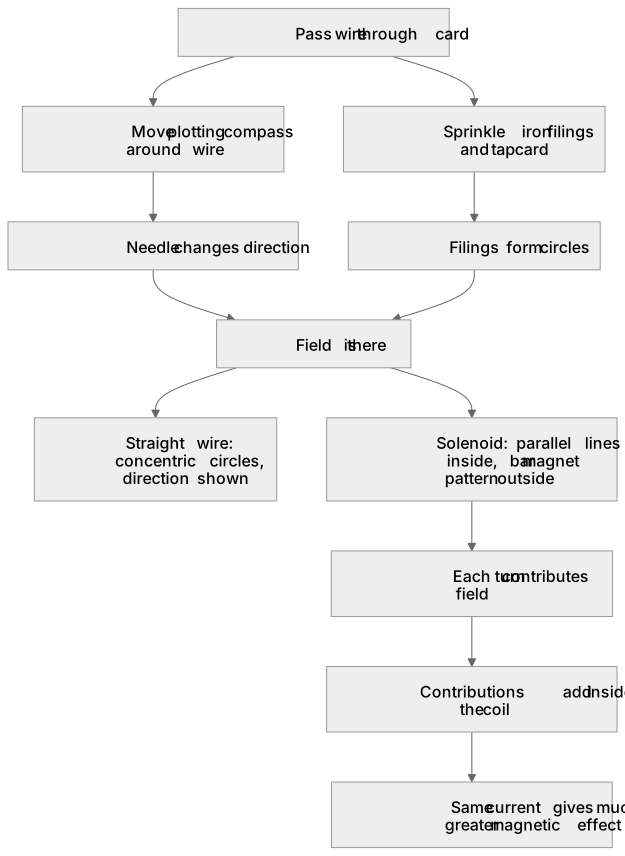
Key words
Say what each word means before you turn the card.
field pattern of a straight wire
Try answering aloud or in your head before turning the card.
field pattern of a solenoid
Try answering aloud or in your head before turning the card.
adding fields of turns
Try answering aloud or in your head before turning the card.
See every definition
- field pattern of a straight wire
- Concentric circles round the wire, widening with distance, with an arrowhead on every line and the current direction marked.
- field pattern of a solenoid
- Parallel evenly spaced lines inside that loop round outside like a bar magnet's, with an arrowhead on every line and the current direction marked.
- adding fields of turns
- Each turn contributes a field and the contributions add inside the coil, so the same current produces a much greater magnetic effect.
Label the diagram
Some boxes have lost their names. Pick the right name for each number.
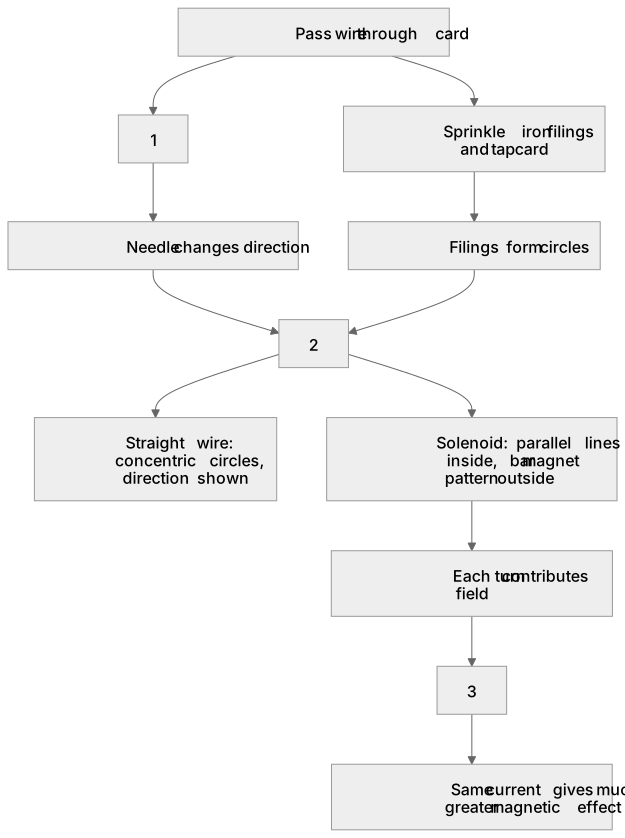
1Box 1
2Box 2
3Box 3
There is more to this lesson
The full lesson goes on to check your understanding and help you earn the marks. Create a free account to carry on, with your progress saved.
A week of Premium from your first lesson · Then the free plan continues · No card, no charge
Test your understanding of Electromagnetism: Students should be able to: describe how the magnetic effect of a current can be demonstrated draw the magnetic field pattern for a straight wire carrying a current and for a solenoid (showing the direction of the field) explain how a solenoid arrangement can increase the magnetic effect of the current.
Active recall beats re-reading. Take an instant quiz now to test what you’ve learned and lock it into long-term memory.
A week of Premium from your first lesson · Then the free plan continues · No card, no charge