AQA · GCSE · Physics
Course version: 8463 · Version from Sept 2016
Energy can be transferred usefully, stored or dissipated, but cannot be…
Full specification wording
Energy transfers in a system: Energy can be transferred usefully, stored or dissipated, but cannot be created or destroyed.
Conservation of energy is the rule underneath the whole topic: energy can be transferred usefully, stored for later or dissipated to the surroundings, but the total never changes.
Checked against the AQA 8463 specification (opens in a new tab) on .
- Point 1 of 8
- 4 key terms
Study notes
From the checked teaching notes for this specification point.
The idea
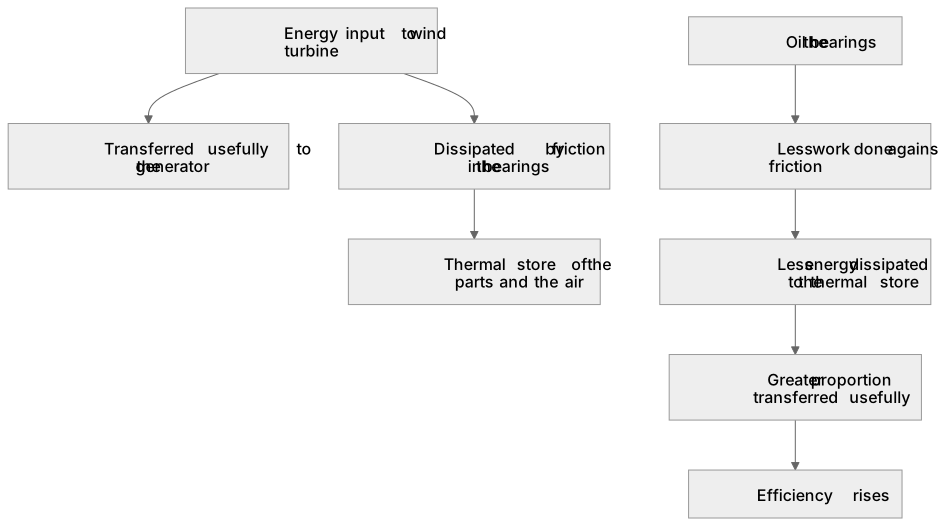
Conservation of energy is the rule underneath the whole topic: energy can be transferred usefully, stored for later or dissipated to the surroundings, but the total never changes. Nothing is created and nothing is destroyed. That is why the word wasted is only ever shorthand. When a wind turbine turns, most energy goes usefully to the generator, but some is dissipated by friction in the bearings into the thermal store of the parts and the air. Oil the bearings and less work is done against friction, so a greater proportion is transferred usefully and the efficiency rises. The energy that was wasted has not disappeared; it has simply spread out, too thinly spread to be recovered.
What earns the marks
- Stating that energy is transferred rather than created or destroyed.
- Naming the useful transfer and the dissipated transfer in the example given.
- Linking reduced friction to less energy dissipated to the thermal store.
- Concluding that the proportion of energy transferred usefully, and so the efficiency, increases.
Common mistakes and how to put them right
Writing that energy is lost or destroyed instead of dissipated to the surroundings.
Saying oiling the bearings creates more electricity rather than increasing the proportion usefully transferred.
Naming friction on its own without saying that less work is done against it.
Claiming a device can be made 100% efficient by removing friction entirely.
Exam tips
- Use the word dissipated rather than lost; the mark schemes accept wasted but never lost energy as an explanation.
- For an explain mark, give the chain: less friction, less energy dissipated, higher proportion transferred usefully.
- Do not answer with more electricity is generated on its own, as it is ignored without the efficiency link.
Try the lesson
The start of the Energy transfers in a system: Energy can be transferred usefully, stored or dissipated, but cannot be created or destroyed. lesson, made from checked teaching notes for this specification point.
Have a go first
A ball is dropped and falls to the ground. Which statement about the energy of the ball is correct?
Listen
Conservation of energy is the rule underneath the whole topic: energy can be transferred usefully, stored for later or dissipated to the surroundings, but the total never changes. Nothing is created and nothing is destroyed. That is why the word wasted is only ever shorthand. When a wind turbine turns, most energy goes usefully to the generator, but some is dissipated by friction in the bearings into the thermal store of the parts and the air. Oil the bearings and less work is done against friction, so a greater proportion is transferred usefully and the efficiency rises. The energy that was wasted has not disappeared; it has simply spread out, too thinly spread to be recovered. A strong answer earns marks for these points. stating that energy is transferred rather than created or destroyed. naming the useful transfer and the dissipated transfer in the example given. linking reduced friction to less energy dissipated to the thermal store. concluding that the proportion of energy transferred usefully, and so the efficiency, increases. Exam tip: Use the word dissipated rather than lost; the mark schemes accept wasted but never lost energy as an explanation.
See it
Key words
Say what each word means before you turn the card.
conservation of energy
Try answering aloud or in your head before turning the card.
dissipation
Try answering aloud or in your head before turning the card.
friction and lubrication
Try answering aloud or in your head before turning the card.
efficiency
Try answering aloud or in your head before turning the card.
See every definition
- conservation of energy
- Energy can be transferred usefully, stored or dissipated, but cannot be created or destroyed.
- dissipation
- Energy is spread out to the surroundings, too thinly spread to be recovered, as when friction in the bearings transfers energy into the thermal store of the parts and the air.
- friction and lubrication
- Oil the bearings and less work is done against friction, so a greater proportion of energy is transferred usefully.
- efficiency
- The proportion of energy transferred usefully, which rises when less work is done against friction.
Label the diagram
Some boxes have lost their names. Pick the right name for each number.
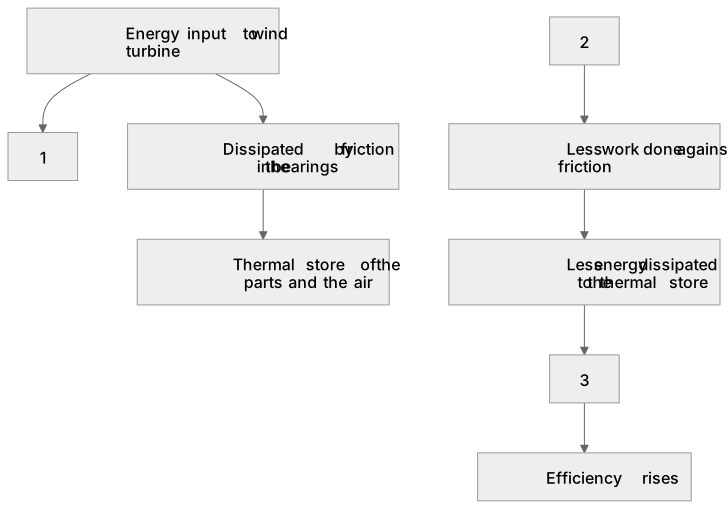
1Box 1
2Box 2
3Box 3
There is more to this lesson
The full lesson goes on to check your understanding and help you earn the marks. Create a free account to carry on, with your progress saved.
A week of Premium from your first lesson · Then the free plan continues · No card, no charge
Test your understanding of Energy transfers in a system: Energy can be transferred usefully, stored or dissipated, but cannot be created or destroyed.
Active recall beats re-reading. Take an instant quiz now to test what you’ve learned and lock it into long-term memory.
A week of Premium from your first lesson · Then the free plan continues · No card, no charge