AQA · GCSE · Physics
Course version: 8463 · Version from Sept 2016
Students should be able to describe with examples where there are energy…
Full specification wording
Energy transfers in a system: Students should be able to describe with examples where there are energy transfers in a closed system, that there is no net change to the total energy.
A closed system is one where no matter or energy can enter or leave.
Checked against the AQA 8463 specification (opens in a new tab) on .
- Point 2 of 8
Study notes
From the checked teaching notes for this specification point.
The idea
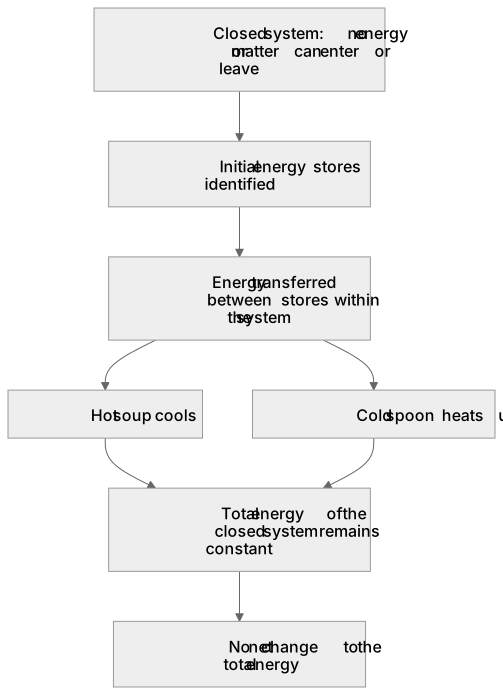
A closed system is one where no matter or energy can enter or leave. Consequently, while energy can be transferred between different stores within the system, there is no net change to the total energy. For example, consider a cold spoon dropped into an insulated flask of hot soup. The flask acts as a closed system. Thermal energy is transferred from the hot soup to the cold spoon, causing the soup to cool and the spoon to heat up. However, the total thermal energy within the flask remains constant. If energy appears to vanish in a calculation, the system boundary has likely been drawn too tightly and must be widened to capture all transfers.
What earns the marks
- Identifying the initial energy stores before the change occurs.
- Describing the pathways of energy transfer between stores within the system.
- Stating that no energy or matter can enter or leave the defined system boundary.
- Concluding that the total energy of the closed system remains constant with no net change.
Common mistakes and how to put them right
Defining a closed system solely as one with constant energy, rather than one where no matter or energy enters or leaves.
Describing a closed system as one where no energy transfers happen at all, rather than transfers occurring with no net change.
Treating a system that is heating the room around it as closed, instead of widening the boundary to include the surroundings.
Exam tips
- Always define a closed system by stating that no energy or matter can enter or leave it.
- When asked to explain energy changes, explicitly state that the total energy remains constant to secure the final mark.
Try the lesson
The start of the Energy transfers in a system: Students should be able to describe with examples where there are energy transfers in a closed system, that there is no net change to the total energy. lesson, made from checked teaching notes for this specification point.
Have a go first
A hot cup of tea is placed inside a perfectly insulated, sealed flask. Over time, the tea cools down. Which statement describes the energy transfers and the total energy of this closed system?
Listen
A closed system is one where no matter or energy can enter or leave. Consequently, while energy can be transferred between different stores within the system, there is no net change to the total energy. For example, consider a cold spoon dropped into an insulated flask of hot soup. The flask acts as a closed system. Thermal energy is transferred from the hot soup to the cold spoon, causing the soup to cool and the spoon to heat up. However, the total thermal energy within the flask remains constant. If energy appears to vanish in a calculation, the system boundary has likely been drawn too tightly and must be widened to capture all transfers. A strong answer earns marks for these points. identifying the initial energy stores before the change occurs. describing the pathways of energy transfer between stores within the system. stating that no energy or matter can enter or leave the defined system boundary. concluding that the total energy of the closed system remains constant with no net change. Exam tip: Always define a closed system by stating that no energy or matter can enter or leave it.
See it
Label the diagram
Some boxes have lost their names. Pick the right name for each number.
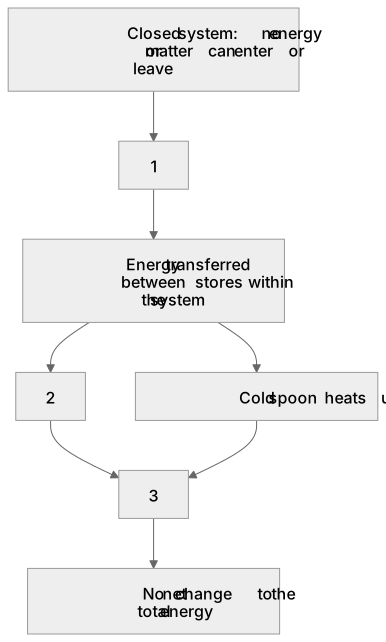
1Box 1
2Box 2
3Box 3
There is more to this lesson
The full lesson goes on to check your understanding and help you earn the marks. Create a free account to carry on, with your progress saved.
A week of Premium from your first lesson · Then the free plan continues · No card, no charge
Test your understanding of Energy transfers in a system: Students should be able to describe with examples where there are energy transfers in a closed system, that there is no net change to the total energy.
Active recall beats re-reading. Take an instant quiz now to test what you’ve learned and lock it into long-term memory.
A week of Premium from your first lesson · Then the free plan continues · No card, no charge