AQA · GCSE · Physics
Course version: 8463 · Version from Sept 2016
Students should be able to describe, with examples, how in all system…
Full specification wording
Energy transfers in a system: Students should be able to describe, with examples, how in all system changes energy is dissipated, so that it is stored in less useful ways.
Energy dissipation occurs when energy spreads out into less useful stores during a system change.
Checked against the AQA 8463 specification (opens in a new tab) on .
- Point 3 of 8
- 3 key terms
Study notes
From the checked teaching notes for this specification point.
The idea
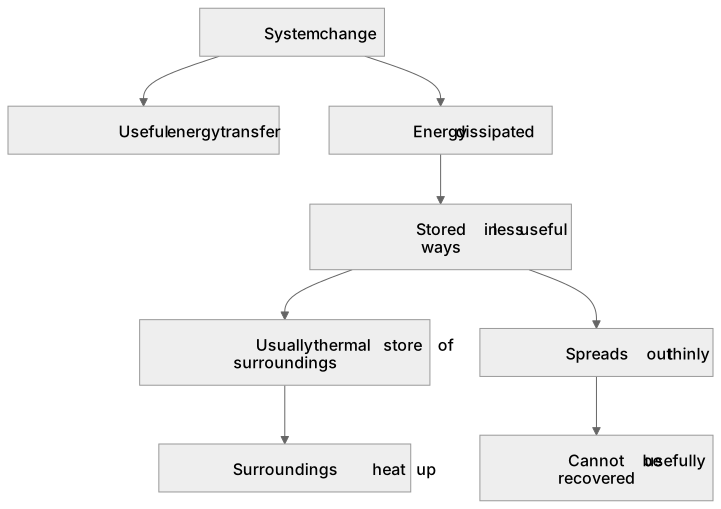
Energy dissipation occurs when energy spreads out into less useful stores during a system change. Every real physical change dissipates some energy, usually into the thermal store of the surroundings, causing them to heat up. For example, when a filament lamp operates, it usefully transfers energy by light, but it also dissipates energy by heating the surroundings. This dissipated energy is not destroyed, but it becomes so thinly spread that it cannot be usefully recovered or gathered back by any device. This explains why mechanical systems require lubrication to reduce friction and why homes need thermal insulation to minimise the rate at which energy dissipates into the environment.
What earns the marks
- Identifying the useful energy transfer in the specific device or system described.
- Identifying the wasted energy transfer, typically heating the surroundings.
- Explaining that the wasted energy is dissipated and stored in less useful ways.
- Stating that the dissipated energy spreads out and cannot be usefully recovered.
Common mistakes and how to put them right
Saying dissipated energy is destroyed rather than spread out into the surroundings.
Naming sound or light as wasted energy without specifying which store or surroundings eventually receive it.
Assuming that highly efficient devices do not dissipate any energy at all, whereas all real system changes involve some dissipation.
Exam tips
- Use the term 'dissipated' in your answer and explicitly state that it transfers to the thermal store of the surroundings.
- Remember that 'wasted' energy is still conserved; it has just become too spread out to be useful.
Try the lesson
The start of the Energy transfers in a system: Students should be able to describe, with examples, how in all system changes energy is dissipated, so that it is stored in less useful ways. lesson, made from checked teaching notes for this specification point.
Have a go first
A ball is dropped and bounces a few times before stopping. Which statement describes what happens to the energy in this system change?
Listen
Energy dissipation occurs when energy spreads out into less useful stores during a system change. Every real physical change dissipates some energy, usually into the thermal store of the surroundings, causing them to heat up. For example, when a filament lamp operates, it usefully transfers energy by light, but it also dissipates energy by heating the surroundings. This dissipated energy is not destroyed, but it becomes so thinly spread that it cannot be usefully recovered or gathered back by any device. This explains why mechanical systems require lubrication to reduce friction and why homes need thermal insulation to minimise the rate at which energy dissipates into the environment. A strong answer earns marks for these points. identifying the useful energy transfer in the specific device or system described. identifying the wasted energy transfer, typically heating the surroundings. explaining that the wasted energy is dissipated and stored in less useful ways. stating that the dissipated energy spreads out and cannot be usefully recovered. Exam tip: Use the term 'dissipated' in your answer and explicitly state that it transfers to the thermal store of the surroundings.
See it
Key words
Say what each word means before you turn the card.
dissipation
Try answering aloud or in your head before turning the card.
thermal store of the surroundings
Try answering aloud or in your head before turning the card.
wasted energy
Try answering aloud or in your head before turning the card.
See every definition
- dissipation
- In all system changes, energy is dissipated so that it is stored in less useful ways.
- thermal store of the surroundings
- Energy is usually dissipated into this store, causing the surroundings to heat up.
- wasted energy
- Energy that is dissipated and stored in less useful ways, becoming so thinly spread that it cannot be usefully recovered.
Label the diagram
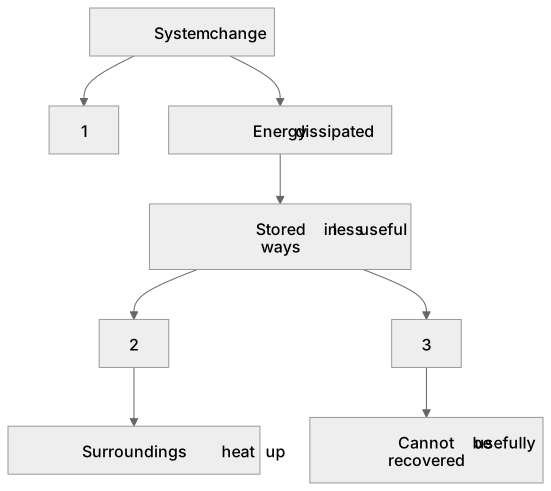
Some boxes have lost their names. Pick the right name for each number.
1Box 1
2Box 2
3Box 3
There is more to this lesson
The full lesson goes on to check your understanding and help you earn the marks. Create a free account to carry on, with your progress saved.
A week of Premium from your first lesson · Then the free plan continues · No card, no charge
Test your understanding of Energy transfers in a system: Students should be able to describe, with examples, how in all system changes energy is dissipated, so that it is stored in less useful ways.
Active recall beats re-reading. Take an instant quiz now to test what you’ve learned and lock it into long-term memory.
A week of Premium from your first lesson · Then the free plan continues · No card, no charge