AQA · GCSE · Physics
Course version: 8463 · Version from Sept 2016
Students should be able to explain ways of reducing unwanted energy…
Full specification wording
Energy transfers in a system: Students should be able to explain ways of reducing unwanted energy transfers, for example through lubrication and the use of thermal insulation.
Unwanted energy transfers can be significantly reduced, though never entirely eliminated, using methods such as lubrication and thermal insulation.
Checked against the AQA 8463 specification (opens in a new tab) on .
- Point 5 of 8
- 4 key terms
Study notes
From the checked teaching notes for this specification point.
The idea
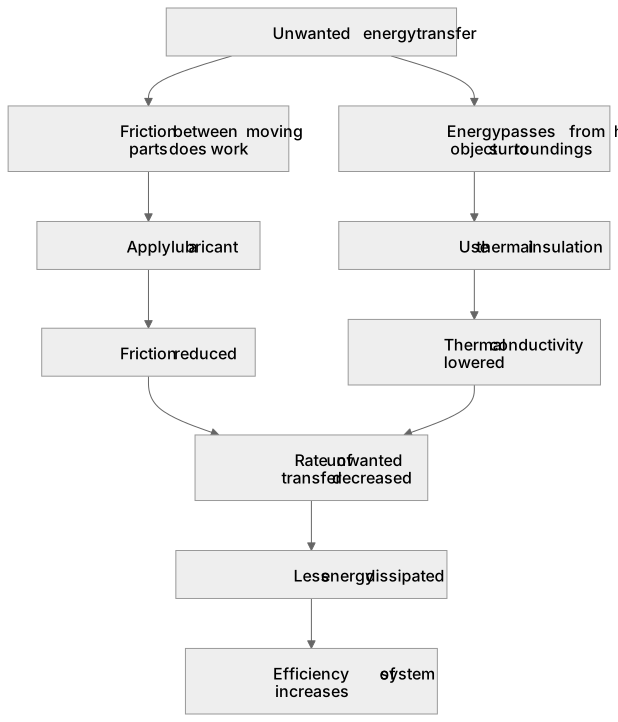
Unwanted energy transfers can be significantly reduced, though never entirely eliminated, using methods such as lubrication and thermal insulation. Friction between moving mechanical parts does work that transfers energy to thermal stores, causing dissipation. Applying a lubricant, like oil to bicycle gears, reduces this friction and decreases the rate of unwanted energy transfer. Similarly, thermal insulation, such as a fibreglass jacket around a hot water tank, lowers the thermal conductivity and cuts the rate at which energy passes to the surroundings. By reducing these unwanted transfers, a greater proportion of the input energy is transferred usefully, thereby increasing the overall efficiency of the system.
What earns the marks
- Identifying the specific unwanted energy transfer and the store it fills.
- Describing a suitable method to reduce the unwanted transfer, such as lubrication or insulation.
- Explaining the mechanism, such as oil reducing friction or insulation lowering thermal conductivity.
- Stating the consequence, which is that less energy is dissipated and the system's efficiency increases.
Common mistakes and how to put them right
Naming oil or insulation without explaining the physical mechanism of how it changes the energy transfer.
Claiming that lubrication removes friction completely, rather than just reducing it.
Confusing the applications of insulation and lubrication, such as suggesting insulation reduces mechanical friction.
Exam tips
- Always match the reduction measure to the correct mechanism; use lubrication for moving parts and insulation for heating issues.
- When explaining insulation, mention that it reduces the rate of energy transfer, not just that it 'stops heat escaping'.
Try the lesson
The start of the Energy transfers in a system: Students should be able to explain ways of reducing unwanted energy transfers, for example through lubrication and the use of thermal insulation. lesson, made from checked teaching notes for this specification point.
Have a go first
A bicycle chain becomes warm as the bicycle is pedalled because friction between the moving parts transfers energy. Which action reduces this unwanted energy transfer?
Listen
Unwanted energy transfers can be significantly reduced, though never entirely eliminated, using methods such as lubrication and thermal insulation. Friction between moving mechanical parts does work that transfers energy to thermal stores, causing dissipation. Applying a lubricant, like oil to bicycle gears, reduces this friction and decreases the rate of unwanted energy transfer. Similarly, thermal insulation, such as a fibreglass jacket around a hot water tank, lowers the thermal conductivity and cuts the rate at which energy passes to the surroundings. By reducing these unwanted transfers, a greater proportion of the input energy is transferred usefully, thereby increasing the overall efficiency of the system. A strong answer earns marks for these points. identifying the specific unwanted energy transfer and the store it fills. describing a suitable method to reduce the unwanted transfer, such as lubrication or insulation. explaining the mechanism, such as oil reducing friction or insulation lowering thermal conductivity. stating the consequence, which is that less energy is dissipated and the system's efficiency increases. Exam tip: Always match the reduction measure to the correct mechanism; use lubrication for moving parts and insulation for heating issues.
See it
Key words
Say what each word means before you turn the card.
lubrication
Try answering aloud or in your head before turning the card.
thermal insulation
Try answering aloud or in your head before turning the card.
reducing unwanted transfers
Try answering aloud or in your head before turning the card.
efficiency
Try answering aloud or in your head before turning the card.
See every definition
- lubrication
- Applying a lubricant, like oil to bicycle gears, reduces friction and decreases the rate of unwanted energy transfer.
- thermal insulation
- A material such as a fibreglass jacket around a hot water tank lowers the thermal conductivity and cuts the rate at which energy passes to the surroundings.
- reducing unwanted transfers
- Unwanted energy transfers can be significantly reduced, though never entirely eliminated, using methods such as lubrication and thermal insulation.
- efficiency
- By reducing unwanted transfers, a greater proportion of the input energy is transferred usefully, thereby increasing the overall efficiency of the system.
Label the diagram
Some boxes have lost their names. Pick the right name for each number.
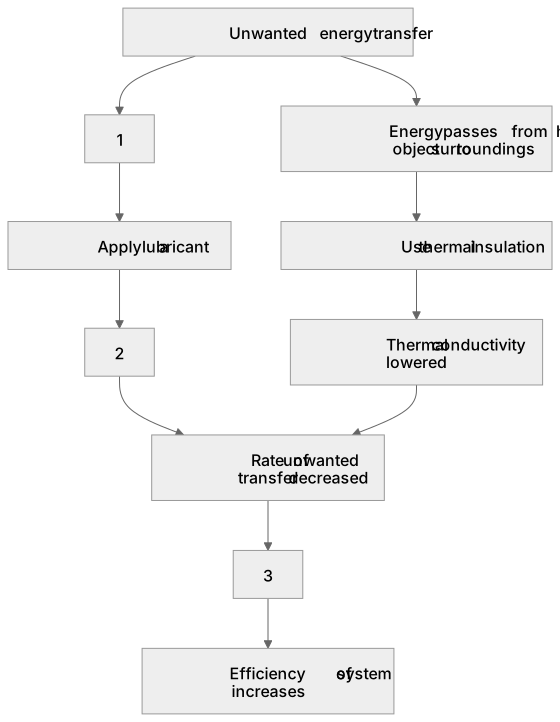
1Box 1
2Box 2
3Box 3
There is more to this lesson
The full lesson goes on to check your understanding and help you earn the marks. Create a free account to carry on, with your progress saved.
A week of Premium from your first lesson · Then the free plan continues · No card, no charge
Test your understanding of Energy transfers in a system: Students should be able to explain ways of reducing unwanted energy transfers, for example through lubrication and the use of thermal insulation.
Active recall beats re-reading. Take an instant quiz now to test what you’ve learned and lock it into long-term memory.
A week of Premium from your first lesson · Then the free plan continues · No card, no charge