AQA · GCSE · Physics
Course version: 8463 · Version from Sept 2016
The higher the thermal conductivity of a material the higher the rate of…
Full specification wording
Energy transfers in a system: The higher the thermal conductivity of a material the higher the rate of energy transfer by conduction across the material.
Conduction carries energy through a material as vibrating particles jostle their neighbours and, in metals, as free electrons move through the structure.
Checked against the AQA 8463 specification (opens in a new tab) on .
- Point 6 of 8
- 4 key terms
Study notes
From the checked teaching notes for this specification point.
The idea
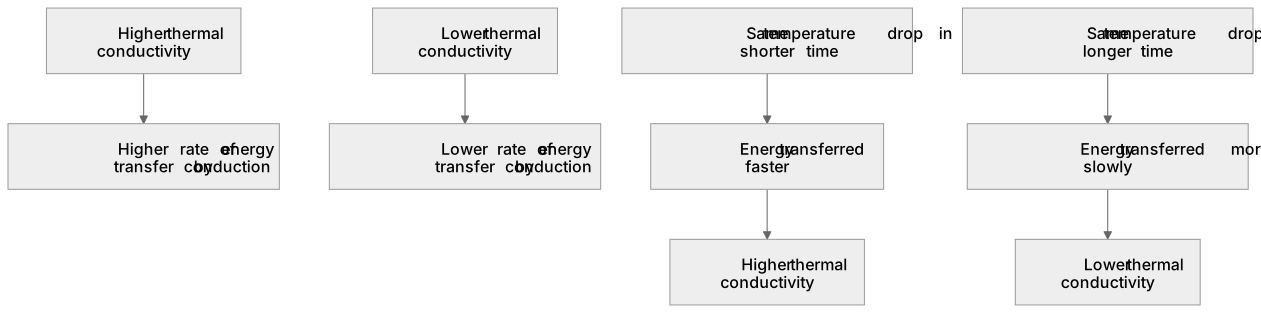
Conduction carries energy through a material as vibrating particles jostle their neighbours and, in metals, as free electrons move through the structure. Thermal conductivity is the property that says how readily a material does this. A high thermal conductivity means a high rate of energy transfer for the same temperature difference and thickness, which is why a metal saucepan handle feels hot quickly. A low thermal conductivity means a low rate, which is what makes wool, foam and trapped air good insulators. In a comparison experiment the material that lets a beaker of water cool by 20 °C in 450 s has a higher thermal conductivity than one that takes 745 s, because the same temperature drop in a shorter time means energy is being transferred faster.
What earns the marks
- Stating that a higher thermal conductivity gives a higher rate of energy transfer.
- Comparing the times for the same temperature change in the two materials.
- Concluding which material has the higher thermal conductivity.
- Referring to conduction across the material rather than energy transfer in general.
Common mistakes and how to put them right
Confusing a faster fall in temperature with a lower thermal conductivity, so reading the data backwards.
Comparing times without checking that both materials cooled through the same temperature difference.
Describing thermal conductivity as the amount of energy transferred rather than the rate.
Using the word conduction for energy carried away by moving air, which is convection.
Exam tips
- Anchor every comparison to the same temperature change, then talk about the time taken.
- The converse answer is accepted, so arguing from the slower material is equally valid.
- Say rate of energy transfer explicitly, since the word rate is usually the marking point.
Try the lesson
The start of the Energy transfers in a system: The higher the thermal conductivity of a material the higher the rate of energy transfer by conduction across the material. lesson, made from checked teaching notes for this specification point.
Have a go first
Two rods of the same size are heated at one end. Rod X is made of copper and rod Y is made of wood. Copper has a much higher thermal conductivity than wood. Which rod transfers energy by conduction along its length at the higher rate?
Listen
Conduction carries energy through a material as vibrating particles jostle their neighbours and, in metals, as free electrons move through the structure. Thermal conductivity is the property that says how readily a material does this. A high thermal conductivity means a high rate of energy transfer for the same temperature difference and thickness, which is why a metal saucepan handle feels hot quickly. A low thermal conductivity means a low rate, which is what makes wool, foam and trapped air good insulators. In a comparison experiment the material that lets a beaker of water cool by 20 °C in 450 s has a higher thermal conductivity than one that takes 745 s, because the same temperature drop in a shorter time means energy is being transferred faster. A strong answer earns marks for these points. stating that a higher thermal conductivity gives a higher rate of energy transfer. comparing the times for the same temperature change in the two materials. concluding which material has the higher thermal conductivity. referring to conduction across the material rather than energy transfer in general. Exam tip: Anchor every comparison to the same temperature change, then talk about the time taken.
See it
Key words
Say what each word means before you turn the card.
thermal conductivity
Try answering aloud or in your head before turning the card.
rate of energy transfer
Try answering aloud or in your head before turning the card.
conduction
Try answering aloud or in your head before turning the card.
comparing insulators
Try answering aloud or in your head before turning the card.
See every definition
- thermal conductivity
- The property that says how readily a material transfers energy by conduction, so a higher value gives a higher rate of energy transfer.
- rate of energy transfer
- How quickly energy passes across a material; a high thermal conductivity means a high rate for the same temperature difference and thickness.
- conduction
- Energy carried through a material as vibrating particles jostle their neighbours and, in metals, as free electrons move through the structure.
- comparing insulators
- Judging which material has the higher thermal conductivity from the times taken to cool through the same temperature difference, where a shorter time means energy is transferred faster.
There is more to this lesson
The full lesson goes on to check your understanding and help you earn the marks. Create a free account to carry on, with your progress saved.
A week of Premium from your first lesson · Then the free plan continues · No card, no charge
Test your understanding of Energy transfers in a system: The higher the thermal conductivity of a material the higher the rate of energy transfer by conduction across the material.
Active recall beats re-reading. Take an instant quiz now to test what you’ve learned and lock it into long-term memory.
A week of Premium from your first lesson · Then the free plan continues · No card, no charge