AQA · GCSE · Physics
Course version: 8463 · Version from Sept 2016
Students should be able to describe how different domestic appliances…
Full specification wording
Energy transfers in everyday appliances: Students should be able to describe how different domestic appliances transfer energy from batteries or ac mains to the kinetic energy of electric motors or the energy of heating devices.
Domestic appliances fall into two families.
Checked against the AQA 8463 specification (opens in a new tab) on .
- Point 3 of 6
- 4 key terms
Study notes
From the checked teaching notes for this specification point.
The idea
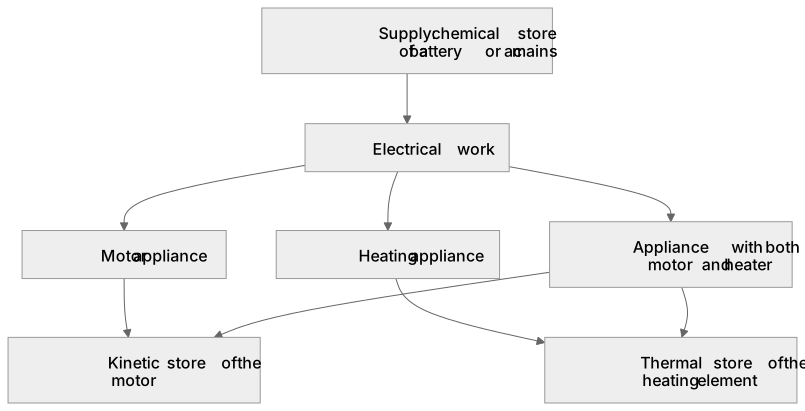
Domestic appliances fall into two families. In a motor appliance, such as a fan, a drill or a washing machine drum, a current in a coil sitting in a magnetic field makes the coil turn, so energy is transferred electrically to the kinetic store of the moving part. In a heating appliance, such as a kettle, a toaster or an iron, the current passes through a high resistance element and collisions between the moving charges and the metal ions transfer energy to the thermal store of the element, and then to the food, water or air. Some appliances do both: a hairdryer holds a motor driving a fan and a heating element in one casing. The supply is either the chemical store of a battery, giving a few volts of dc, or the 230 V ac mains.
What earns the marks
- Naming the supply as the chemical store of a battery or as the ac mains.
- Electrical work as the pathway from the supply to the appliance.
- The kinetic store of the motor as the useful end store in a motor appliance.
- The thermal store of the heating element as the useful end store in a heater.
Common mistakes and how to put them right
Saying a heating element works because electricity turns into heat, without naming resistance or the thermal store.
Treating a hairdryer as only a heater and ignoring its motor.
Describing the mains as a store of energy in the same way as a battery.
Naming the useful store of a washing machine as thermal when the question is about the drum turning.
Exam tips
- Decide first whether the appliance is a motor device, a heating device or both, then name the store to match.
- Keep 'chemical store' for the battery and 'electrical work' for the transfer; the two are not interchangeable.
- A three-mark description usually wants supply, pathway and useful store, one mark each.
Try the lesson
The start of the Energy transfers in everyday appliances: Students should be able to describe how different domestic appliances transfer energy from batteries or ac mains to the kinetic energy of electric motors or the energy of heating devices. lesson, made from checked teaching notes for this specification point.
Have a go first
Which domestic appliance transfers energy mainly to the kinetic energy of an electric motor?
Listen
Domestic appliances fall into two families. In a motor appliance, such as a fan, a drill or a washing machine drum, a current in a coil sitting in a magnetic field makes the coil turn, so energy is transferred electrically to the kinetic store of the moving part. In a heating appliance, such as a kettle, a toaster or an iron, the current passes through a high resistance element and collisions between the moving charges and the metal ions transfer energy to the thermal store of the element, and then to the food, water or air. Some appliances do both: a hairdryer holds a motor driving a fan and a heating element in one casing. The supply is either the chemical store of a battery, giving a few volts of dc, or the 230 V ac mains. A strong answer earns marks for these points. naming the supply as the chemical store of a battery or as the ac mains. electrical work as the pathway from the supply to the appliance. the kinetic store of the motor as the useful end store in a motor appliance. the thermal store of the heating element as the useful end store in a heater. Exam tip: Decide first whether the appliance is a motor device, a heating device or both, then name the store to match.
See it
Key words
Say what each word means before you turn the card.
motor appliances
Try answering aloud or in your head before turning the card.
heating elements
Try answering aloud or in your head before turning the card.
kinetic store
Try answering aloud or in your head before turning the card.
thermal store
Try answering aloud or in your head before turning the card.
See every definition
- motor appliances
- Appliances in which a current in a coil sitting in a magnetic field makes the coil turn, so energy is transferred electrically to the kinetic store of the moving part.
- heating elements
- A high resistance element through which the current passes, with collisions between the moving charges and the metal ions transferring energy to its thermal store.
- kinetic store
- The useful end store of the moving part in a motor appliance, such as a fan, a drill or a washing machine drum.
- thermal store
- The useful end store of the heating element, and then of the food, water or air.
Label the diagram
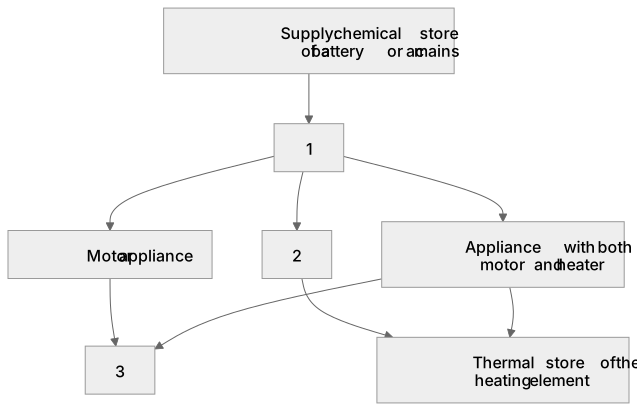
Some boxes have lost their names. Pick the right name for each number.
1Box 1
2Box 2
3Box 3
There is more to this lesson
The full lesson goes on to check your understanding and help you earn the marks. Create a free account to carry on, with your progress saved.
A week of Premium from your first lesson · Then the free plan continues · No card, no charge
Test your understanding of Energy transfers in everyday appliances: Students should be able to describe how different domestic appliances transfer energy from batteries or ac mains to the kinetic energy of electric motors or the energy of heating devices.
Active recall beats re-reading. Take an instant quiz now to test what you’ve learned and lock it into long-term memory.
A week of Premium from your first lesson · Then the free plan continues · No card, no charge