AQA · GCSE · Physics
Course version: 8463 · Version from Sept 2016
Work is done when charge flows in a circuit.
Full specification wording
Energy transfers in everyday appliances: Work is done when charge flows in a circuit.
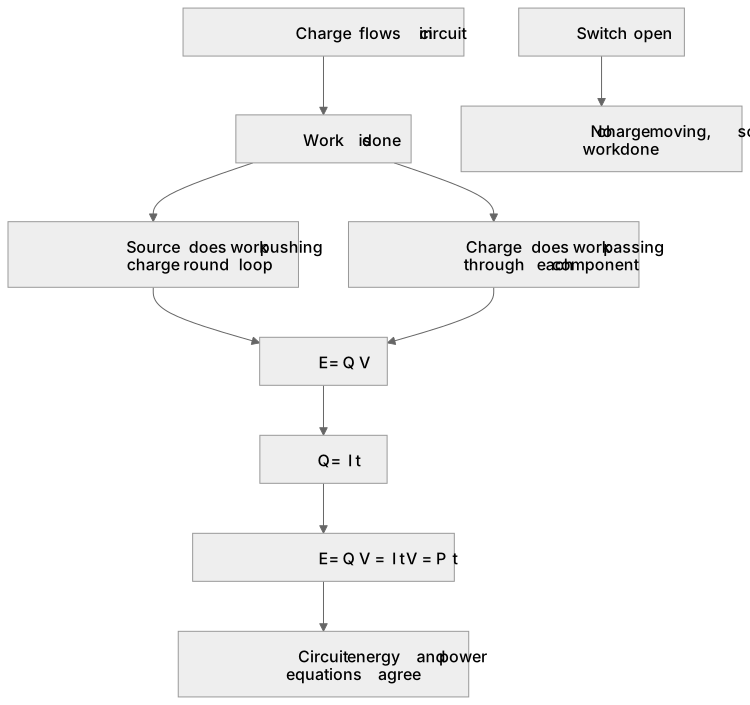
Work done means energy transferred by a force, and in a circuit the source does work pushing charge round the loop while the charge does work as it passes through each component.
Checked against the AQA 8463 specification (opens in a new tab) on .
- Point 4 of 6
- 4 key terms
Study notes
From the checked teaching notes for this specification point.
The idea
Work done means energy transferred by a force, and in a circuit the source does work pushing charge round the loop while the charge does work as it passes through each component. The bookkeeping is E = Q V, where the potential difference is the energy transferred per coulomb: a 1 V potential difference means 1 joule is transferred for every coulomb that passes. Moving 2 C through a 6 V lamp therefore transfers 2 × 6 = 12 J. Because charge flow is Q = I t, the equations combine: E = Q V = I t V = P t, which is why the circuit energy and power equations always agree. Work is only done while charge is actually moving, which is why an appliance transfers nothing while its switch is open.
What earns the marks
- Selecting E = Q V, energy transferred equals charge flow multiplied by potential difference.
- Using Q = I t to find the charge when the current and time are given.
- Correct substitution into the chosen equation.
- The energy transferred with the unit joules, J.
Common mistakes and how to put them right
Treating potential difference as an energy rather than as energy per coulomb.
Putting the time into the wrong equation, for example writing E = Q V t.
Leaving the current in the final answer because Q = I t was never applied.
Saying no work is done in a resistor because nothing visibly moves.
Exam tips
- If the question gives current and time but the equation needs charge, do Q = I t on its own line first.
- Define a volt as a joule per coulomb when asked to explain what potential difference means.
- Check that both routes agree, since E = Q V and E = P t must give the same number for the same situation.
Try the lesson
The start of the Energy transfers in everyday appliances: Work is done when charge flows in a circuit. lesson, made from checked teaching notes for this specification point.
Have a go first
Which process transfers energy to a component when charge flows through it?
Listen
Work done means energy transferred by a force, and in a circuit the source does work pushing charge round the loop while the charge does work as it passes through each component. The bookkeeping is E = Q V, where the potential difference is the energy transferred per coulomb: a 1 V potential difference means 1 joule is transferred for every coulomb that passes. Moving 2 C through a 6 V lamp therefore transfers 2 × 6 = 12 J. Because charge flow is Q = I t, the equations combine: E = Q V = I t V = P t, which is why the circuit energy and power equations always agree. Work is only done while charge is actually moving, which is why an appliance transfers nothing while its switch is open. A strong answer earns marks for these points. selecting E = Q V, energy transferred equals charge flow multiplied by potential difference. using Q = I t to find the charge when the current and time are given. correct substitution into the chosen equation. the energy transferred with the unit joules, J. Exam tip: If the question gives current and time but the equation needs charge, do Q = I t on its own line first.
See it
Key words
Say what each word means before you turn the card.
work done
Try answering aloud or in your head before turning the card.
E = Q V
Try answering aloud or in your head before turning the card.
charge flow
Try answering aloud or in your head before turning the card.
joules per coulomb
Try answering aloud or in your head before turning the card.
See every definition
- work done
- Energy transferred by a force, and in a circuit the source does it pushing charge round the loop while the charge does it passing through each component.
- E = Q V
- The bookkeeping equation in which energy transferred equals charge flow multiplied by potential difference.
- charge flow
- Given by Q = I t, and it combines with E = Q V so that E = Q V = I t V = P t.
- joules per coulomb
- The energy transferred per coulomb, so a 1 V potential difference means 1 joule is transferred for every coulomb that passes.
Label the diagram
Some boxes have lost their names. Pick the right name for each number.
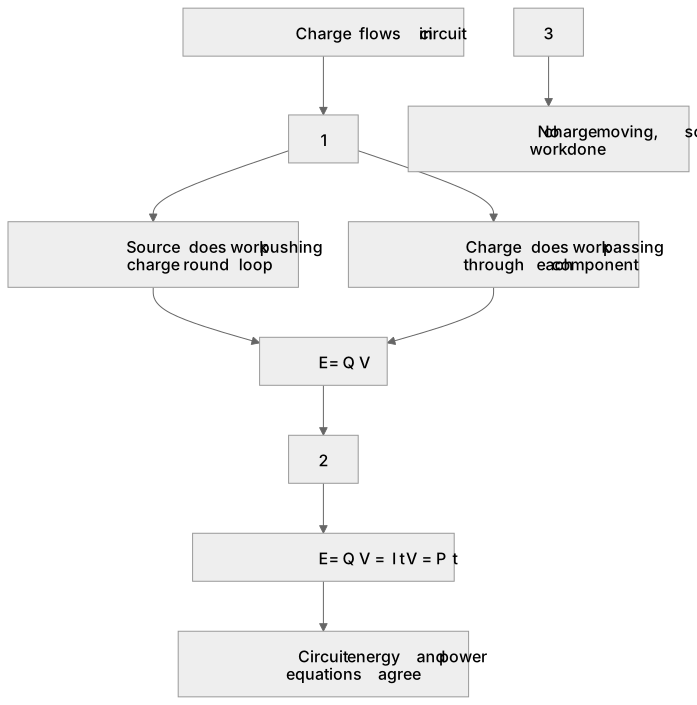
1Box 1
2Box 2
3Box 3
There is more to this lesson
The full lesson goes on to check your understanding and help you earn the marks. Create a free account to carry on, with your progress saved.
A week of Premium from your first lesson · Then the free plan continues · No card, no charge
Test your understanding of Energy transfers in everyday appliances: Work is done when charge flows in a circuit.
Active recall beats re-reading. Take an instant quiz now to test what you’ve learned and lock it into long-term memory.
A week of Premium from your first lesson · Then the free plan continues · No card, no charge