AQA · GCSE · Physics
Course version: 8463 · Version from Sept 2016
Students should be able to: explain the factors which affect the distance…
Full specification wording
Factors affecting braking distance 1: Students should be able to: explain the factors which affect the distance required for road transport vehicles to come to rest in emergencies, and the implications for safety estimate how the distance required for road vehicles to stop in an emergency varies over a range of typical speeds.
An emergency stop question usually wants factors, mechanisms and a safety conclusion.
Checked against the AQA 8463 specification (opens in a new tab) on .
- Point 3 of 3
- 4 key terms
Study notes
From the checked teaching notes for this specification point.
The idea
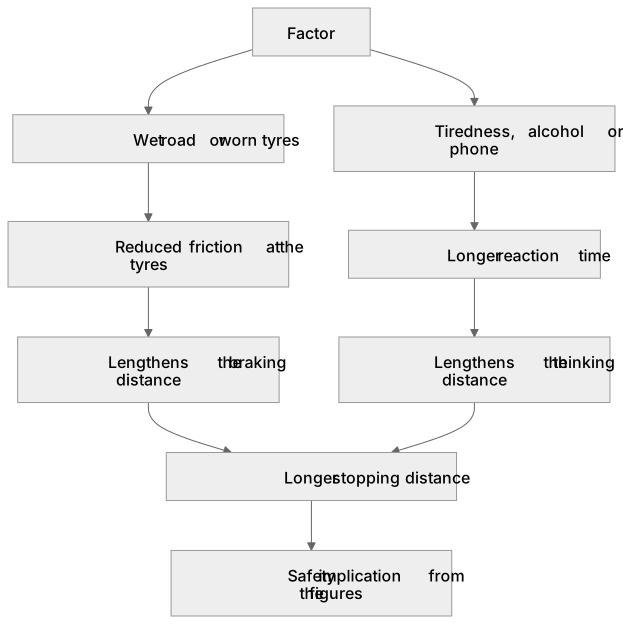
An emergency stop question usually wants factors, mechanisms and a safety conclusion. Deal with each factor by saying which distance it changes and why: a wet road or worn tyres reduce friction and lengthen the braking distance; tiredness, alcohol or a phone lengthen the reaction time and so the thinking distance. Then estimate, using thinking distance = speed × reaction time and scaling the braking distance with the square of the speed. The safety implication follows from the numbers rather than from advice: because stopping from 30 m/s takes roughly six times the distance needed from 10 m/s, speed limits and larger gaps in poor conditions matter far more than drivers expect.
What earns the marks
- Naming a factor and stating whether it changes the thinking or the braking distance.
- The mechanism, reduced friction at the tyres or a longer reaction time.
- An estimate using thinking distance = speed × reaction time.
- Scaling the braking distance with the square of the speed.
- A safety implication that follows from the figures, such as leaving a longer gap in the wet.
Common mistakes and how to put them right
Listing factors with no mechanism attached to any of them.
Applying the reaction time argument to a wet road.
Offering advice such as 'drive carefully' in place of a physical reason.
Estimating with a reaction time or a vehicle mass far outside typical values.
Exam tips
- Structure a long answer as factor, mechanism, distance affected; repeat for each factor.
- Quote at least one number in a safety discussion; comparisons of distances earn credit.
- Say explicitly which distance you are changing each time you name a factor.
Try the lesson
The start of the Factors affecting braking distance 1: Students should be able to: explain the factors which affect the distance required for road transport vehicles to come to rest in emergencies, and the implications for safety estimate how the distance required for road vehicles to stop in an emergency varies over a range of typical speeds. lesson, made from checked teaching notes for this specification point.
Have a go first
A driver is tired and has a slower reaction time than usual. State the effect on the thinking distance and explain the safety implication.
Listen
An emergency stop question usually wants factors, mechanisms and a safety conclusion. Deal with each factor by saying which distance it changes and why: a wet road or worn tyres reduce friction and lengthen the braking distance; tiredness, alcohol or a phone lengthen the reaction time and so the thinking distance. Then estimate, using thinking distance = speed × reaction time and scaling the braking distance with the square of the speed. The safety implication follows from the numbers rather than from advice: because stopping from 30 m/s takes roughly six times the distance needed from 10 m/s, speed limits and larger gaps in poor conditions matter far more than drivers expect. A strong answer earns marks for these points. naming a factor and stating whether it changes the thinking or the braking distance. the mechanism, reduced friction at the tyres or a longer reaction time. an estimate using thinking distance = speed × reaction time. scaling the braking distance with the square of the speed. Exam tip: Structure a long answer as factor, mechanism, distance affected; repeat for each factor.
See it
Key words
Say what each word means before you turn the card.
emergency stopping
Try answering aloud or in your head before turning the card.
friction
Try answering aloud or in your head before turning the card.
reaction time
Try answering aloud or in your head before turning the card.
safety implications
Try answering aloud or in your head before turning the card.
See every definition
- emergency stopping
- Bringing a road transport vehicle to rest in an emergency, where the distance required depends on factors that affect the thinking distance and the braking distance.
- friction
- Reduced at the tyres on a wet road or with worn tyres, which lengthens the braking distance.
- reaction time
- Lengthened by tiredness, alcohol or a phone, and so the thinking distance is lengthened too.
- safety implications
- Conclusions that follow from the figures, such as leaving a longer gap in the wet because speed limits and larger gaps in poor conditions matter far more than drivers expect.
Label the diagram
Some boxes have lost their names. Pick the right name for each number.
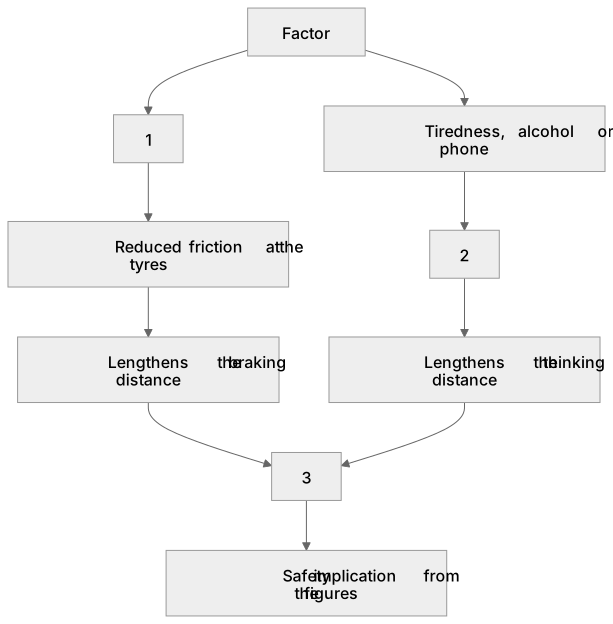
1Box 1
2Box 2
3Box 3
There is more to this lesson
The full lesson goes on to check your understanding and help you earn the marks. Create a free account to carry on, with your progress saved.
A week of Premium from your first lesson · Then the free plan continues · No card, no charge
Test your understanding of Factors affecting braking distance 1: Students should be able to: explain the factors which affect the distance required for road transport vehicles to come to rest in emergencies, and the implications for safety estimate how the distance required for road vehicles to stop in an emergency varies over a range of typical speeds.
Active recall beats re-reading. Take an instant quiz now to test what you’ve learned and lock it into long-term memory.
A week of Premium from your first lesson · Then the free plan continues · No card, no charge