AQA · GCSE · Physics
Course version: 8463 · Version from Sept 2016
When a force is applied to the brakes of a vehicle, work done by the…
Full specification wording
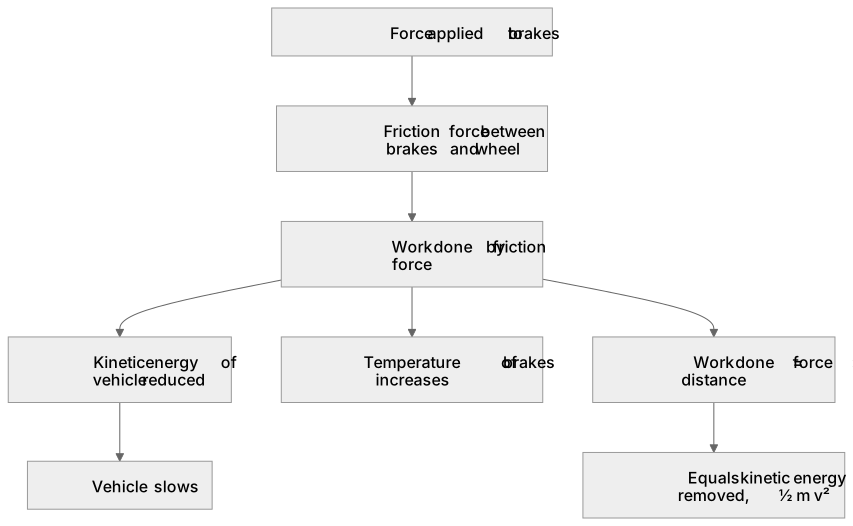
Factors affecting braking distance 2: When a force is applied to the brakes of a vehicle, work done by the friction force between the brakes and the wheel reduces the kinetic energy of the vehicle and the temperature of the brakes increases.
Pressing the brake pedal forces the pads against the discs or drums attached to the wheels.
Checked against the AQA 8463 specification (opens in a new tab) on .
- Point 1 of 5
- 4 key terms
Study notes
From the checked teaching notes for this specification point.
The idea
Pressing the brake pedal forces the pads against the discs or drums attached to the wheels. As the wheel turns against the pads, a friction force acts and work is done. That work transfers energy out of the kinetic energy store of the vehicle and into the thermal energy store of the brakes, so the vehicle slows and the brakes get hot. The amount is given by work done = force × distance, and it equals the kinetic energy removed, ½ m v². This is why brake discs glow after a long descent and why repeated heavy braking can overheat them. Saying only 'friction' is not enough in an examination: you must say that work is done. For a 1200 kg car at 20 m/s the brakes must do 240 000 J of work, which is why brake discs can reach several hundred degrees Celsius.
What earns the marks
- Stating that work is done against friction between the brake pads and the wheel or disc.
- Stating that the kinetic energy store of the vehicle decreases.
- Stating that the internal, or thermal, energy of the brakes increases so their temperature rises.
- Using work done = force × distance.
- Equating the work done to the kinetic energy ½ m v².
Common mistakes and how to put them right
Writing only the word friction, which the mark scheme explicitly says is insufficient.
Saying heat is created rather than energy being transferred to a thermal store.
Describing the kinetic energy as lost or used up.
Substituting the whole stopping distance into work done = force × distance rather than the braking distance.
Exam tips
- Use the phrase 'work is done against friction' rather than 'friction slows it down'.
- Name both stores in the transfer: kinetic store down, thermal store of the brakes up.
- Two-mark questions here usually want one mark for the work done and one for the temperature rise, so give both.
Try the lesson
The start of the Factors affecting braking distance 2: When a force is applied to the brakes of a vehicle, work done by the friction force between the brakes and the wheel reduces the kinetic energy of the vehicle and the temperature of the brakes increases. lesson, made from checked teaching notes for this specification point.
Have a go first
A car is moving along a road. The driver presses the brake pedal, so a friction force acts between the brakes and the wheels. What happens to the kinetic energy of the car and to the temperature of the brakes?
Listen
Pressing the brake pedal forces the pads against the discs or drums attached to the wheels. As the wheel turns against the pads, a friction force acts and work is done. That work transfers energy out of the kinetic energy store of the vehicle and into the thermal energy store of the brakes, so the vehicle slows and the brakes get hot. The amount is given by work done = force × distance, and it equals the kinetic energy removed, ½ m v². This is why brake discs glow after a long descent and why repeated heavy braking can overheat them. Saying only 'friction' is not enough in an examination: you must say that work is done. For a 1200 kg car at 20 m/s the brakes must do 240 000 J of work, which is why brake discs can reach several hundred degrees Celsius. A strong answer earns marks for these points. stating that work is done against friction between the brake pads and the wheel or disc. stating that the kinetic energy store of the vehicle decreases. stating that the internal, or thermal, energy of the brakes increases so their temperature rises. using work done = force × distance. Exam tip: Use the phrase 'work is done against friction' rather than 'friction slows it down'.
See it
Key words
Say what each word means before you turn the card.
work done against friction
Try answering aloud or in your head before turning the card.
kinetic energy store
Try answering aloud or in your head before turning the card.
thermal energy store
Try answering aloud or in your head before turning the card.
brake temperature
Try answering aloud or in your head before turning the card.
See every definition
- work done against friction
- The work done by the friction force between the brakes and the wheel, which reduces the kinetic energy of the vehicle.
- kinetic energy store
- The store from which energy is transferred out when the brakes are applied, so that the vehicle slows.
- thermal energy store
- The store into which the work done by the brakes transfers energy, so that the brakes get hot.
- brake temperature
- A quantity that increases as the brakes get hot when work is done against friction between the brakes and the wheel.
Label the diagram
Some boxes have lost their names. Pick the right name for each number.
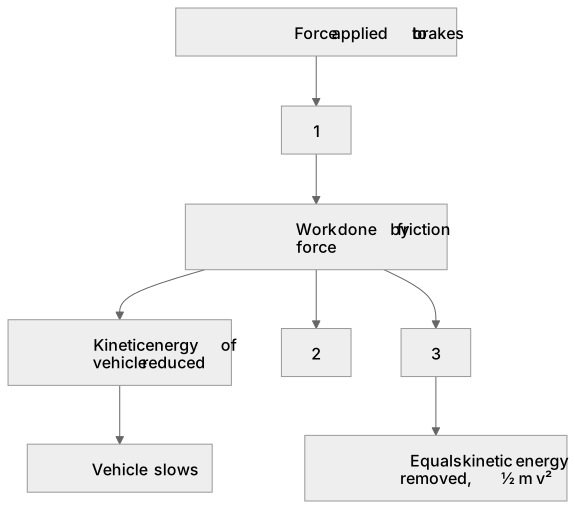
1Box 1
2Box 2
3Box 3
There is more to this lesson
The full lesson goes on to check your understanding and help you earn the marks. Create a free account to carry on, with your progress saved.
A week of Premium from your first lesson · Then the free plan continues · No card, no charge
Test your understanding of Factors affecting braking distance 2: When a force is applied to the brakes of a vehicle, work done by the friction force between the brakes and the wheel reduces the kinetic energy of the vehicle and the temperature of the brakes increases.
Active recall beats re-reading. Take an instant quiz now to test what you’ve learned and lock it into long-term memory.
A week of Premium from your first lesson · Then the free plan continues · No card, no charge