AQA · GCSE · Physics
Course version: 8463 · Version from Sept 2016
The greater the speed of a vehicle the greater the braking force needed to…
Full specification wording
Factors affecting braking distance 2: The greater the speed of a vehicle the greater the braking force needed to stop the vehicle in a certain distance.
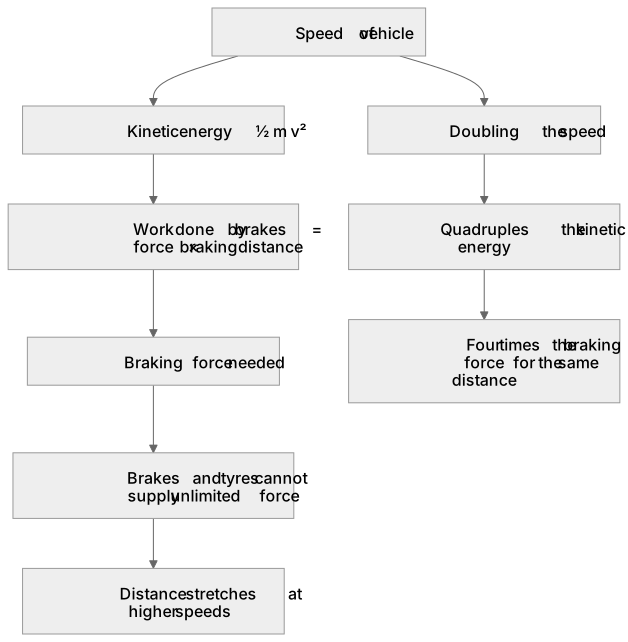
A vehicle's kinetic energy is ½ m v², so speed matters far more than anything else in the equation.
Checked against the AQA 8463 specification (opens in a new tab) on .
- Point 2 of 5
- 3 key terms
Study notes
From the checked teaching notes for this specification point.
The idea
A vehicle's kinetic energy is ½ m v², so speed matters far more than anything else in the equation. The brakes must do work equal to that energy: braking force × braking distance = ½ m v². Fixing the distance and rearranging gives F = ½ m v² ÷ d, which shows the force needed rises with the square of the speed. A 1200 kg car stopping in 30 m from 15 m/s needs 1200 × 15² ÷ (2 × 30) = 4500 N; from 30 m/s in the same 30 m it needs 18 000 N, four times as much. Real brakes and tyres cannot supply an unlimited force, which is why the distance stretches instead at higher speeds. It is also why a modest speed limit matters: dropping from 30 m/s to 20 m/s removes more than half the kinetic energy the brakes must deal with.
What earns the marks
- Stating that the kinetic energy is greater at the greater speed.
- Using ½ m v² to show that doubling the speed quadruples the kinetic energy.
- Equating work done, force × distance, to the kinetic energy.
- Concluding that the braking force must be four times larger for the same braking distance.
Common mistakes and how to put them right
Saying the required force doubles when the speed doubles.
Leaving the mass out of the kinetic energy calculation.
Substituting the stopping distance rather than the braking distance.
Rearranging F = ½ m v² ÷ d incorrectly and dividing by the speed instead.
Exam tips
- Square the speed before you multiply by the mass; doing it in the other order invites slips.
- Quote the ratio as well as the number: 'four times the force' makes the physics visible.
- Check the distance in the question is the braking distance, not the total stopping distance.
Try the lesson
The start of the Factors affecting braking distance 2: The greater the speed of a vehicle the greater the braking force needed to stop the vehicle in a certain distance. lesson, made from checked teaching notes for this specification point.
Have a go first
A lorry and a car have the same mass. The lorry is travelling at twice the speed of the car. Both are stopped in the same distance. The braking force on the car is F. What is the braking force needed on the lorry?
Listen
A vehicle's kinetic energy is ½ m v², so speed matters far more than anything else in the equation. The brakes must do work equal to that energy: braking force × braking distance = ½ m v². Fixing the distance and rearranging gives F = ½ m v² ÷ d, which shows the force needed rises with the square of the speed. A 1200 kg car stopping in 30 m from 15 m/s needs 1200 × 15² ÷ (2 × 30) = 4500 N; from 30 m/s in the same 30 m it needs 18 000 N, four times as much. Real brakes and tyres cannot supply an unlimited force, which is why the distance stretches instead at higher speeds. It is also why a modest speed limit matters: dropping from 30 m/s to 20 m/s removes more than half the kinetic energy the brakes must deal with. A strong answer earns marks for these points. stating that the kinetic energy is greater at the greater speed. using ½ m v² to show that doubling the speed quadruples the kinetic energy. equating work done, force × distance, to the kinetic energy. concluding that the braking force must be four times larger for the same braking distance. Exam tip: Square the speed before you multiply by the mass; doing it in the other order invites slips.
See it
Key words
Say what each word means before you turn the card.
kinetic energy
Try answering aloud or in your head before turning the card.
braking force
Try answering aloud or in your head before turning the card.
work done
Try answering aloud or in your head before turning the card.
See every definition
- kinetic energy
- Given by ½ m v², so the greater the speed of a vehicle the greater this is.
- braking force
- The force the brakes must supply, equal to the work done divided by the braking distance.
- work done
- Equal to braking force × braking distance, and must equal the kinetic energy of the vehicle.
Label the diagram
Some boxes have lost their names. Pick the right name for each number.
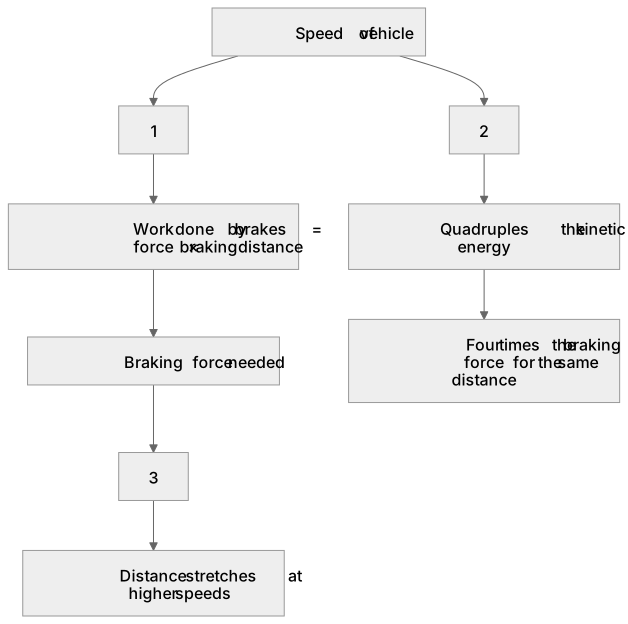
1Box 1
2Box 2
3Box 3
There is more to this lesson
The full lesson goes on to check your understanding and help you earn the marks. Create a free account to carry on, with your progress saved.
A week of Premium from your first lesson · Then the free plan continues · No card, no charge
Test your understanding of Factors affecting braking distance 2: The greater the speed of a vehicle the greater the braking force needed to stop the vehicle in a certain distance.
Active recall beats re-reading. Take an instant quiz now to test what you’ve learned and lock it into long-term memory.
A week of Premium from your first lesson · Then the free plan continues · No card, no charge