AQA · GCSE · Physics
Course version: 8463 · Version from Sept 2016
For a conductor at right angles to a magnetic field and carrying a…
Full specification wording
Fleming's left-hand rule (HT only): For a conductor at right angles to a magnetic field and carrying a current: f orce = magnetic f lux density × current × length F = B I l force, F, in newtons, N magnetic flux density, B, in tesla, T current, I, in amperes, A (amp is acceptable for ampere) length, l, in metres, m
This is Higher tier only.
Checked against the AQA 8463 specification (opens in a new tab) on .
- Point 5 of 5
- 4 key terms
Study notes
From the checked teaching notes for this specification point.
The idea
This is Higher tier only. For a conductor at right angles to a magnetic field, force = magnetic flux density × current × length, written F = B I l, with F in newtons (N), B in tesla (T), I in amperes (A) and l in metres (m). Rearranged it gives B = F / (I l), I = F / (B l) and l = F / (B I). Most marks are lost on units, so convert centimetres to metres and milliamperes to amperes before substituting, and use only the length of conductor that lies inside the field. The equation carries assumptions that examiners ask you to state: the conductor is straight and at right angles to the field, the field is uniform and the current is constant.
What earns the marks
- The equation F = B I l, quoted or correctly rearranged for the quantity required.
- A correct substitution with every quantity in SI units, lengths converted to metres.
- The answer given with the correct unit, newtons.
- Stating an assumption, such as the conductor being at right angles to the field or the field being uniform.
Common mistakes and how to put them right
Substituting a length in centimetres without converting it to metres.
Using the whole length of the wire when only part of it lies in the field.
Confusing magnetic flux density in tesla with force in newtons.
Rearranging incorrectly and dividing by B when the force is what is required.
Exam tips
- Write the equation, then the substitution, then the answer with its unit, on separate lines.
- Check the right angle condition before using the equation at all.
- This content is Higher tier only, and assumption questions are worth a mark on their own.
Try the lesson
The start of the Fleming's left-hand rule (HT only): For a conductor at right angles to a magnetic field and carrying a current: f orce = magnetic f lux density × current × length F = B I l force, F, in newtons, N magnetic flux density, B, in tesla, T current, I, in amperes, A (amp is acceptable for ampere) length, l, in metres, m lesson, made from checked teaching notes for this specification point.
Have a go first
A straight wire of length 0.50 m carries a current of 4.0 A at right angles to a uniform magnetic field of flux density 0.20 T. Calculate the force on the wire.
Listen
This is Higher tier only. For a conductor at right angles to a magnetic field, force = magnetic flux density × current × length, written F = B I l, with F in newtons (N), B in tesla (T), I in amperes (A) and l in metres (m). Rearranged it gives B = F / (I l), I = F / (B l) and l = F / (B I). Most marks are lost on units, so convert centimetres to metres and milliamperes to amperes before substituting, and use only the length of conductor that lies inside the field. The equation carries assumptions that examiners ask you to state: the conductor is straight and at right angles to the field, the field is uniform and the current is constant. A strong answer earns marks for these points. the equation F = B I l, quoted or correctly rearranged for the quantity required. a correct substitution with every quantity in SI units, lengths converted to metres. the answer given with the correct unit, newtons. stating an assumption, such as the conductor being at right angles to the field or the field being uniform. Exam tip: Write the equation, then the substitution, then the answer with its unit, on separate lines.
See it
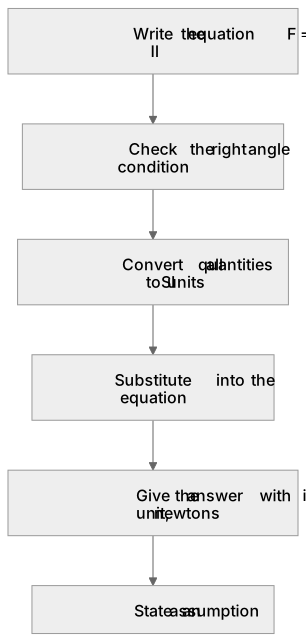
Put it in order
Put these steps in the order they happen.
- 1. Convert all quantities to SI units
- 2. Check the right angle condition
- 3. Write the equation F = B I l
- 4. State an assumption
- 5. Give the answer with its unit, newtons
- 6. Substitute into the equation
Key words
Say what each word means before you turn the card.
F = B I l
Try answering aloud or in your head before turning the card.
magnetic flux density in tesla
Try answering aloud or in your head before turning the card.
unit conversion
Try answering aloud or in your head before turning the card.
stating assumptions
Try answering aloud or in your head before turning the card.
See every definition
- F = B I l
- The equation for a conductor at right angles to a magnetic field and carrying a current, where force = magnetic flux density × current × length.
- magnetic flux density in tesla
- The quantity B, measured in tesla, T, multiplied by current and length to give the force.
- unit conversion
- Converting centimetres to metres and milliamperes to amperes before substituting, since most marks are lost on units.
- stating assumptions
- Giving an assumption such as the conductor being at right angles to the field or the field being uniform, which examiners ask you to state.
Label the diagram
Some boxes have lost their names. Pick the right name for each number.
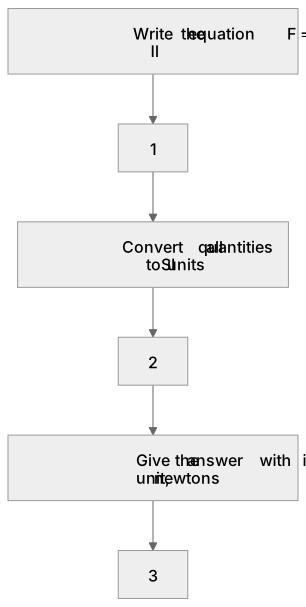
1Box 1
2Box 2
3Box 3
There is more to this lesson
The full lesson goes on to check your understanding and help you earn the marks. Create a free account to carry on, with your progress saved.
A week of Premium from your first lesson · Then the free plan continues · No card, no charge
Test your understanding of Fleming's left-hand rule (HT only): For a conductor at right angles to a magnetic field and carrying a current: f orce = magnetic f lux density × current × length F = B I l force, F, in newtons, N magnetic flux density, B, in tesla, T current, I, in amperes, A (amp is acceptable for ampere) length, l, in metres, m
Active recall beats re-reading. Take an instant quiz now to test what you’ve learned and lock it into long-term memory.
A week of Premium from your first lesson · Then the free plan continues · No card, no charge