AQA · GCSE · Physics
Course version: 8463 · Version from Sept 2016
Students should be able to recall the factors that affect the size of the…
Full specification wording
Fleming's left-hand rule (HT only): Students should be able to recall the factors that affect the size of the force on the conductor.
This is Higher tier only.
Checked against the AQA 8463 specification (opens in a new tab) on .
- Point 4 of 5
- 3 key terms
Study notes
From the checked teaching notes for this specification point.
The idea
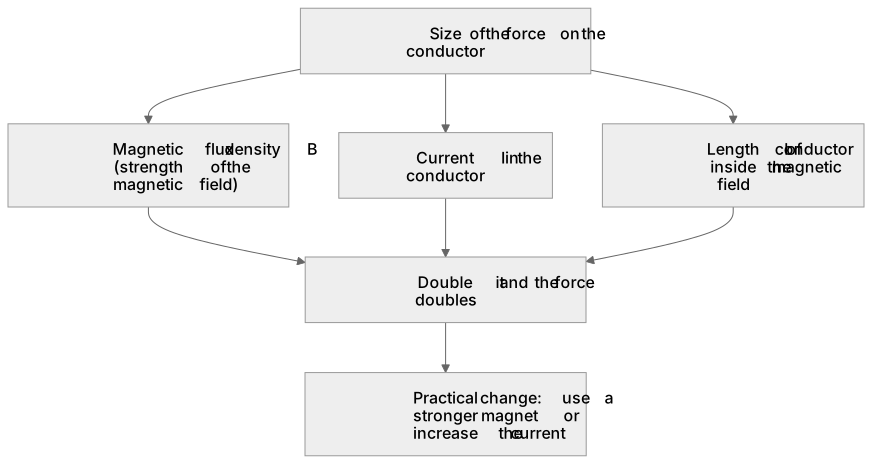
This is Higher tier only. The size of the force follows from F = B I l, so it depends on three things: the magnetic flux density B, which is how strong the magnet's field is, the current I in the conductor, and the length l of the conductor that is inside the field. Double any one of them and the force doubles. That is why a current balance question asking how to increase the force on the wire is answered by using a stronger magnet or by increasing the current. Orientation is a condition rather than a factor: the relationship holds when the conductor is at right angles to the field, and the force falls to zero when the wire lies along the field.
What earns the marks
- Naming the strength of the magnetic field, or the magnetic flux density, as a factor.
- Naming the size of the current in the conductor as a factor.
- Naming the length of conductor inside the magnetic field as a factor.
- Suggesting a specific practical change, such as using a stronger magnet or increasing the current.
Common mistakes and how to put them right
Answering 'increase the voltage' without linking it to an increase in current.
Naming the total length of the wire rather than the length of it that is inside the field.
Listing reversing the current as a way to increase the force, when it only changes the direction.
Offering the mass of the wire or the resistance of the circuit as factors.
Exam tips
- 'Suggest one change' means one clear change; a list can be marked on the first answer only.
- Use the equation F = B I l to generate the factors rather than trying to recall a list.
- This content is Higher tier only.
Try the lesson
The start of the Fleming's left-hand rule (HT only): Students should be able to recall the factors that affect the size of the force on the conductor. lesson, made from checked teaching notes for this specification point.
Have a go first
A straight wire carrying a current is placed at right angles to a uniform magnetic field. Which change would increase the size of the force acting on the wire?
Listen
This is Higher tier only. The size of the force follows from F = B I l, so it depends on three things: the magnetic flux density B, which is how strong the magnet's field is, the current I in the conductor, and the length l of the conductor that is inside the field. Double any one of them and the force doubles. That is why a current balance question asking how to increase the force on the wire is answered by using a stronger magnet or by increasing the current. Orientation is a condition rather than a factor: the relationship holds when the conductor is at right angles to the field, and the force falls to zero when the wire lies along the field. A strong answer earns marks for these points. naming the strength of the magnetic field, or the magnetic flux density, as a factor. naming the size of the current in the conductor as a factor. naming the length of conductor inside the magnetic field as a factor. suggesting a specific practical change, such as using a stronger magnet or increasing the current. Exam tip: 'Suggest one change' means one clear change; a list can be marked on the first answer only.
See it
Key words
Say what each word means before you turn the card.
magnetic flux density
Try answering aloud or in your head before turning the card.
current
Try answering aloud or in your head before turning the card.
length in the field
Try answering aloud or in your head before turning the card.
See every definition
- magnetic flux density
- How strong the magnet's field is, one of the three things the size of the force depends on.
- current
- The current in the conductor, one of the three things the size of the force depends on.
- length in the field
- The length of the conductor that is inside the field, one of the three things the size of the force depends on.
Label the diagram
Some boxes have lost their names. Pick the right name for each number.
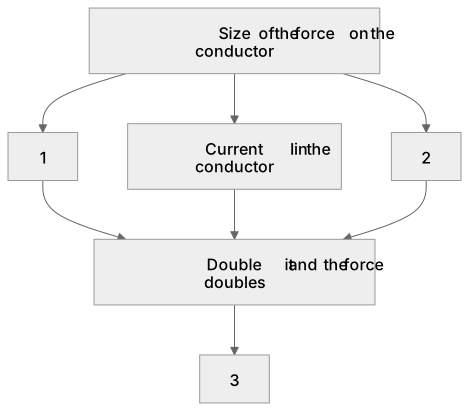
1Box 1
2Box 2
3Box 3
There is more to this lesson
The full lesson goes on to check your understanding and help you earn the marks. Create a free account to carry on, with your progress saved.
A week of Premium from your first lesson · Then the free plan continues · No card, no charge
Test your understanding of Fleming's left-hand rule (HT only): Students should be able to recall the factors that affect the size of the force on the conductor.
Active recall beats re-reading. Take an instant quiz now to test what you’ve learned and lock it into long-term memory.
A week of Premium from your first lesson · Then the free plan continues · No card, no charge