AQA · GCSE · Physics
Course version: 8463 · Version from Sept 2016
Fleming's left-hand rule (HT only): This is called the motor effect.
This is Higher tier only.
Checked against the AQA 8463 specification (opens in a new tab) on .
- Point 2 of 5
- 4 key terms
Study notes
From the checked teaching notes for this specification point.
The idea
This is Higher tier only. The interaction between a current and a magnetic field, and the force it produces, is called the motor effect. The classic demonstrations are a wire resting on rails between the poles of a pair of magnadur magnets, which jumps when the switch is closed, and a current balance, in which the section of wire in the field moves down when the current flows. In a motor the two sides of the coil carry current in opposite directions, so the forces on them are opposite and the coil turns. In a moving-coil loudspeaker the field is radial, so the coil is pushed in and out along its axis rather than turning. Reverse either the current or the field and the force reverses; reverse both and it is unchanged.
What earns the marks
- Naming the motor effect as the force on a current carrying conductor in a magnetic field.
- Describing a demonstration in which the wire moves when the switch is closed.
- Stating that reversing either the current or the field reverses the direction of the force.
- Stating that reversing both the current and the field leaves the direction unchanged.
Common mistakes and how to put them right
Using the name motor effect for the generator effect, where movement produces a potential difference.
Saying the wire moves because it is attracted to the magnet.
Assuming the effect needs an alternating current.
Expecting the force to reverse when both the current and the field are reversed.
Exam tips
- Check what the question gives you: a current suggests the motor effect, a movement the generator effect.
- Name the effect explicitly if the question asks what it is called.
- This content is Higher tier only.
Try the lesson
The start of the Fleming's left-hand rule (HT only): This is called the motor effect. lesson, made from checked teaching notes for this specification point.
Have a go first
A straight current-carrying wire is placed between the poles of a magnet so that the wire is at right angles to the magnetic field. A force acts on the wire. What is this effect called?
Listen
This is Higher tier only. The interaction between a current and a magnetic field, and the force it produces, is called the motor effect. The classic demonstrations are a wire resting on rails between the poles of a pair of magnadur magnets, which jumps when the switch is closed, and a current balance, in which the section of wire in the field moves down when the current flows. In a motor the two sides of the coil carry current in opposite directions, so the forces on them are opposite and the coil turns. In a moving-coil loudspeaker the field is radial, so the coil is pushed in and out along its axis rather than turning. Reverse either the current or the field and the force reverses; reverse both and it is unchanged. A strong answer earns marks for these points. naming the motor effect as the force on a current carrying conductor in a magnetic field. describing a demonstration in which the wire moves when the switch is closed. stating that reversing either the current or the field reverses the direction of the force. stating that reversing both the current and the field leaves the direction unchanged. Exam tip: Check what the question gives you: a current suggests the motor effect, a movement the generator effect.
See it
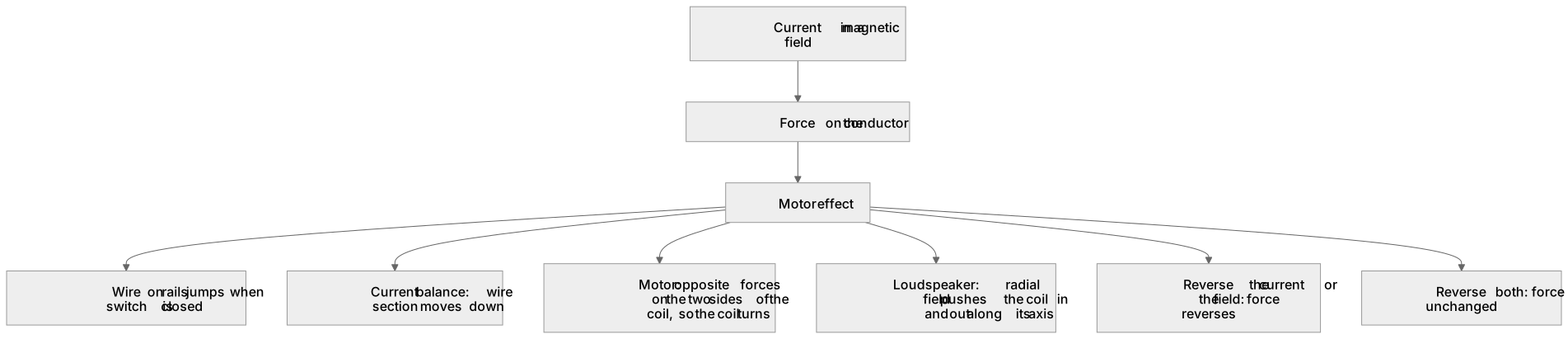
Key words
Say what each word means before you turn the card.
motor effect
Try answering aloud or in your head before turning the card.
demonstrations with a wire
Try answering aloud or in your head before turning the card.
current balance
Try answering aloud or in your head before turning the card.
reversing current or field
Try answering aloud or in your head before turning the card.
See every definition
- motor effect
- The force on a current carrying conductor in a magnetic field, produced by the interaction between a current and a magnetic field.
- demonstrations with a wire
- A wire resting on rails between the poles of a pair of magnadur magnets jumps when the switch is closed.
- current balance
- A demonstration in which the section of wire in the field moves down when the current flows.
- reversing current or field
- Reverse either the current or the field and the force reverses; reverse both and it is unchanged.
Label the diagram
Some boxes have lost their names. Pick the right name for each number.
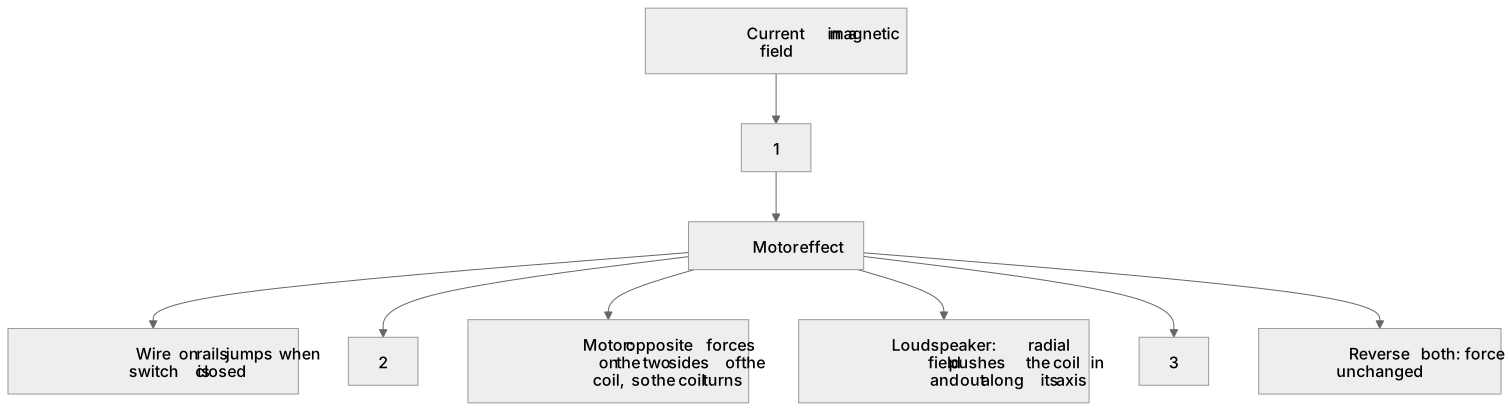
1Box 1
2Box 2
3Box 3
There is more to this lesson
The full lesson goes on to check your understanding and help you earn the marks. Create a free account to carry on, with your progress saved.
A week of Premium from your first lesson · Then the free plan continues · No card, no charge
Test your understanding of Fleming's left-hand rule (HT only): This is called the motor effect.
Active recall beats re-reading. Take an instant quiz now to test what you’ve learned and lock it into long-term memory.
A week of Premium from your first lesson · Then the free plan continues · No card, no charge