AQA · GCSE · Physics
Course version: 8463 · Version from Sept 2016
Students should be able to show that Fleming's left-hand rule represents…
Full specification wording
Fleming's left-hand rule (HT only): Students should be able to show that Fleming's left-hand rule represents the relative orientation of the force, the current in the conductor and the magnetic field.
This is Higher tier only.
Checked against the AQA 8463 specification (opens in a new tab) on .
- Point 3 of 5
- 4 key terms
Study notes
From the checked teaching notes for this specification point.
The idea
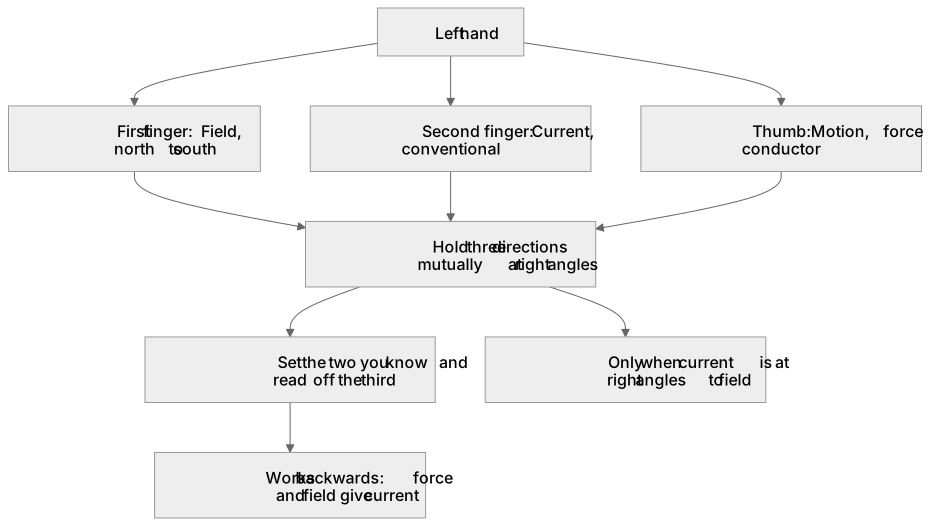
This is Higher tier only. Fleming's left hand rule fixes how the three directions relate. Hold the thumb, first finger and second finger of the left hand mutually at right angles: the First finger points along the Field, from north to south; the seCond finger points along the Current, taken as conventional current from positive to negative; and the thuMb then gives the direction of the Motion, that is the force on the conductor. Set the two you know and read off the third. The rule works backwards too, so if a question gives the force and the field you can find which way the current must flow. It applies only when the current is at right angles to the field.
What earns the marks
- Using the left hand, with first finger for field, second finger for current and thumb for the force.
- Taking the field from north to south and the current as conventional current.
- Holding the three directions mutually at right angles.
- Stating the resulting direction of the force, or working back to the current or field when the force is given.
Common mistakes and how to put them right
Using the right hand, which belongs to the generator effect.
Taking the current as the direction electrons move rather than as conventional current.
Pointing the first finger from south to north.
Applying the rule when the current is parallel to the field, where there is no force at all.
Exam tips
- Write F, B and I against your fingers in the margin before you start.
- Keep the three fingers genuinely perpendicular; a sloppy hand gives the wrong answer.
- This content is Higher tier only, and is usually tested on a diagram.
Try the lesson
The start of the Fleming's left-hand rule (HT only): Students should be able to show that Fleming's left-hand rule represents the relative orientation of the force, the current in the conductor and the magnetic field. lesson, made from checked teaching notes for this specification point.
Have a go first
In Fleming's left-hand rule, which part of the left hand represents the direction of the force acting on the current-carrying conductor?
Listen
This is Higher tier only. Fleming's left hand rule fixes how the three directions relate. Hold the thumb, first finger and second finger of the left hand mutually at right angles: the First finger points along the Field, from north to south; the seCond finger points along the Current, taken as conventional current from positive to negative; and the thuMb then gives the direction of the Motion, that is the force on the conductor. Set the two you know and read off the third. The rule works backwards too, so if a question gives the force and the field you can find which way the current must flow. It applies only when the current is at right angles to the field. A strong answer earns marks for these points. using the left hand, with first finger for field, second finger for current and thumb for the force. taking the field from north to south and the current as conventional current. holding the three directions mutually at right angles. stating the resulting direction of the force, or working back to the current or field when the force is given. Exam tip: Write F, B and I against your fingers in the margin before you start.
See it
Key words
Say what each word means before you turn the card.
Fleming's left hand rule
Try answering aloud or in your head before turning the card.
field, current and force
Try answering aloud or in your head before turning the card.
conventional current
Try answering aloud or in your head before turning the card.
mutually perpendicular directions
Try answering aloud or in your head before turning the card.
See every definition
- Fleming's left hand rule
- A rule that represents the relative orientation of the force, the current in the conductor and the magnetic field, using the thumb, first finger and second finger of the left hand.
- field, current and force
- The three directions related by the rule: the first finger points along the field, the second finger along the current and the thumb gives the direction of the force.
- conventional current
- The current taken from positive to negative, which the second finger points along.
- mutually perpendicular directions
- The thumb, first finger and second finger of the left hand are held mutually at right angles.
Label the diagram
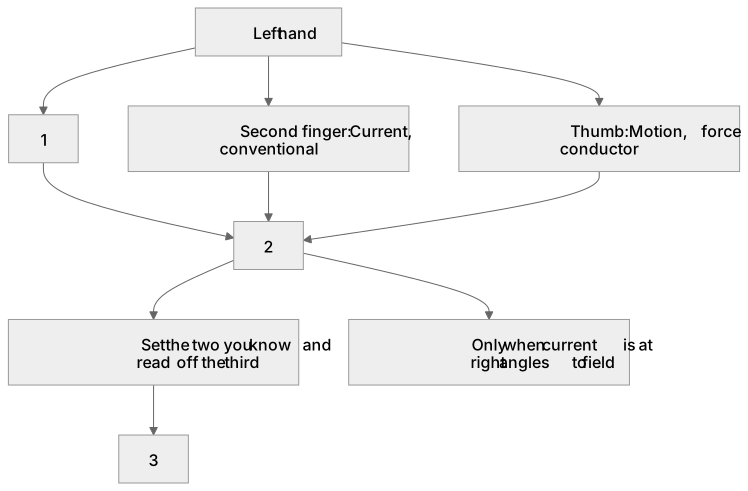
Some boxes have lost their names. Pick the right name for each number.
1Box 1
2Box 2
3Box 3
There is more to this lesson
The full lesson goes on to check your understanding and help you earn the marks. Create a free account to carry on, with your progress saved.
A week of Premium from your first lesson · Then the free plan continues · No card, no charge
Test your understanding of Fleming's left-hand rule (HT only): Students should be able to show that Fleming's left-hand rule represents the relative orientation of the force, the current in the conductor and the magnetic field.
Active recall beats re-reading. Take an instant quiz now to test what you’ve learned and lock it into long-term memory.
A week of Premium from your first lesson · Then the free plan continues · No card, no charge