AQA · GCSE · Physics
Forces
Newton's Third Law is often oversimplified as 'action and reaction,' leading to lost marks in exams. This guide demystifies the four essential rules of force pairs, ensuring you can spot the difference between Third Law interactions and simple balanced forces to secure those tricky 4-6 mark explain questions.
- 5 min read
- 3 worked examples
- 5 practice questions
- 6 key terms
Study Notes
Overview
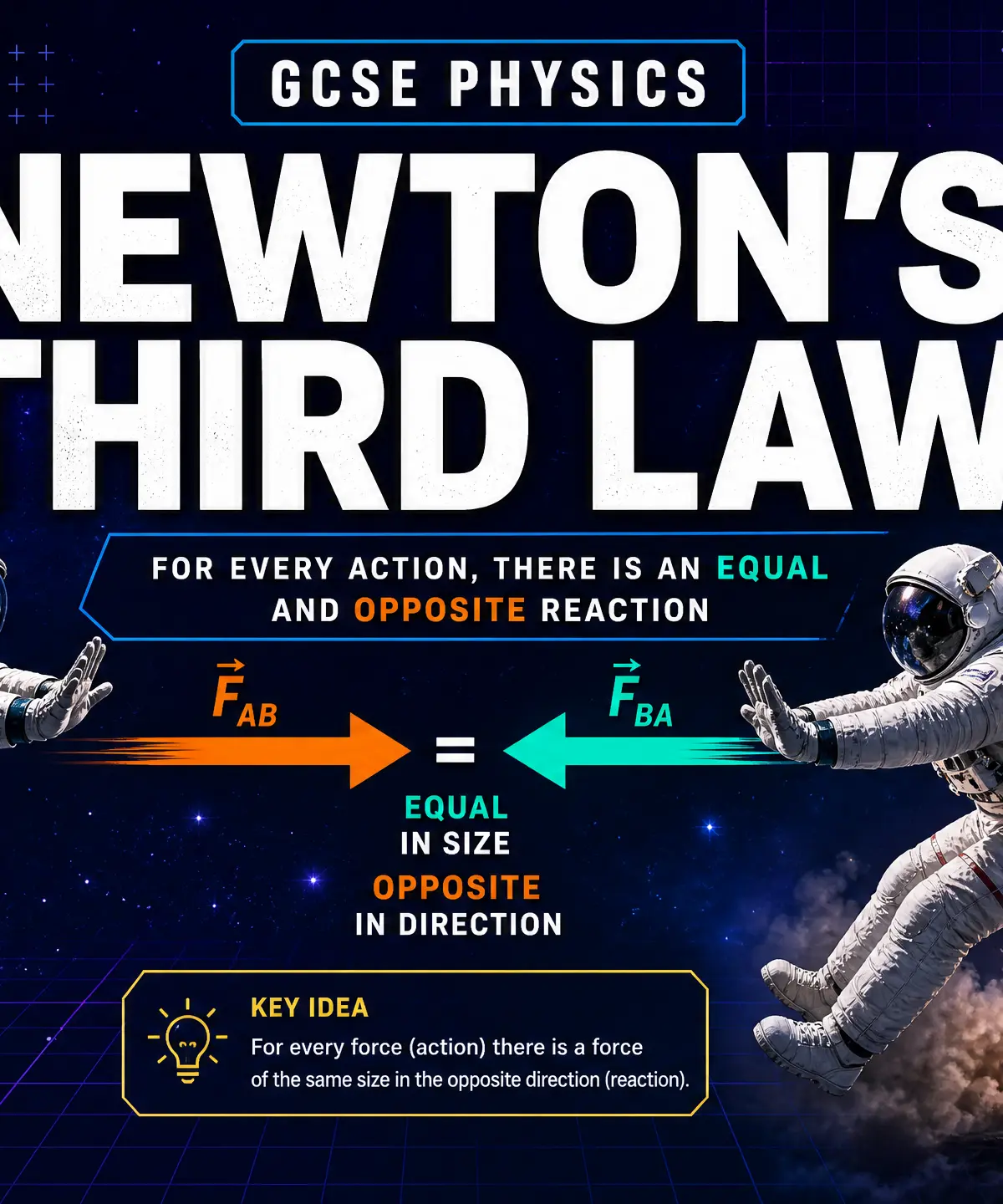
Welcome to Topic 4.5: Forces. While Newton's First and Second Laws deal with how forces affect a single object's motion, Newton's Third Law is entirely about interactions between two objects. It is a fundamental principle in Physics that explains everything from how you walk across a room to how rockets travel through the vacuum of space.
Examiners love this topic because it tests precision. Many candidates mistakenly believe that Newton's Third Law is just about forces 'cancelling out'. This guide will show you exactly why that is incorrect and how to write examiner-perfect answers. We will explore the four non-negotiable rules of force pairs, contrast them with balanced forces, and apply them to real-world scenarios.
Key Concepts
Concept 1: The Four Rules of Newton's Third Law Pairs
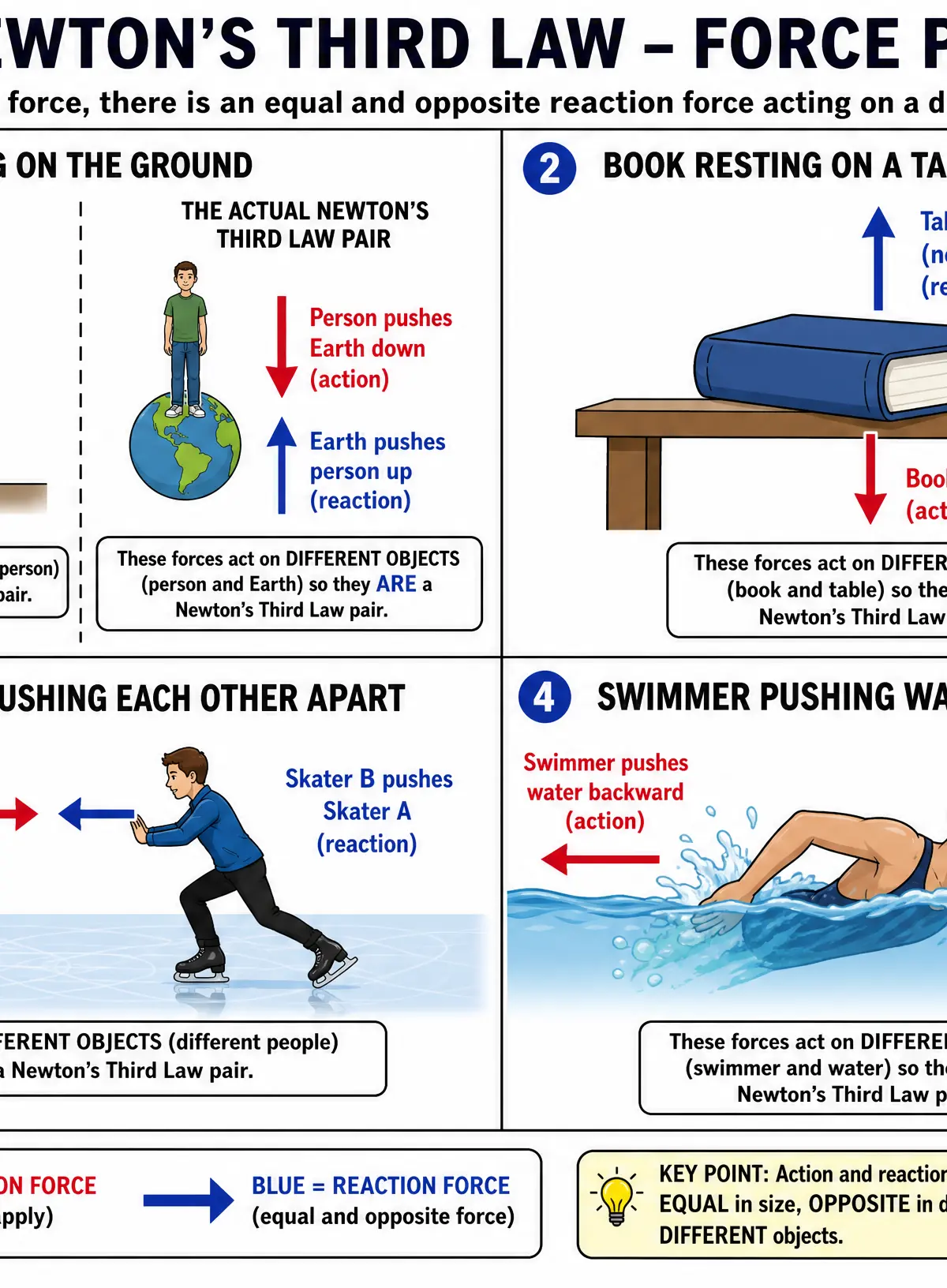
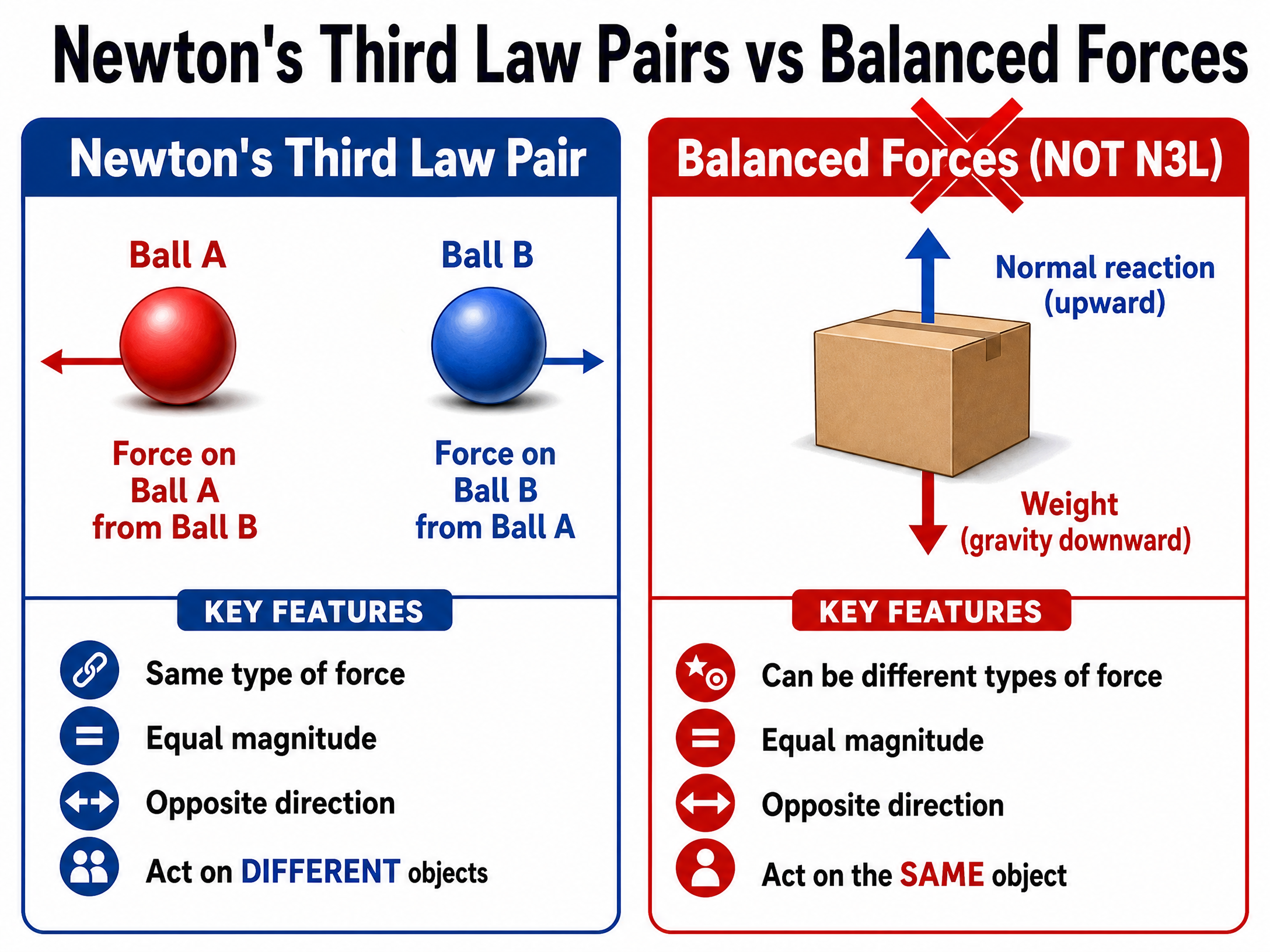
Newton's Third Law states: **Whenever two objects interact, the forces they exert on each other are equal in magnitude and opposite in direction.**However, to earn full marks in an exam, you need to understand the four specific conditions that make up a true Newton's Third Law pair. If even one of these is missing, it is not a Third Law pair.
- Equal in magnitude: Both forces are exactly the same size. If object A pushes object B with 50N, object B pushes object A with exactly 50N.
- Opposite in direction: If one force acts to the left, the other acts to the right.
- Act on TWO DIFFERENT objects: This is the most critical point. The action force is on object B, and the reaction force is on object A.
- Are of the SAME TYPE: If the action is a gravitational force, the reaction must be a gravitational force. If the action is a contact force (like friction or normal reaction), the reaction must be the same type of contact force.
Example: Consider the gravitational pull between the Earth and the Moon. The Earth pulls the Moon with a massive gravitational force. According to Newton's Third Law, the Moon pulls the Earth with an equal gravitational force in the opposite direction. They act on different objects (one on the Moon, one on the Earth), and both are gravitational forces.
Concept 2: Newton's Third Law vs. Balanced Forces
The single most common error candidates make is confusing Newton's Third Law with balanced forces (equilibrium).
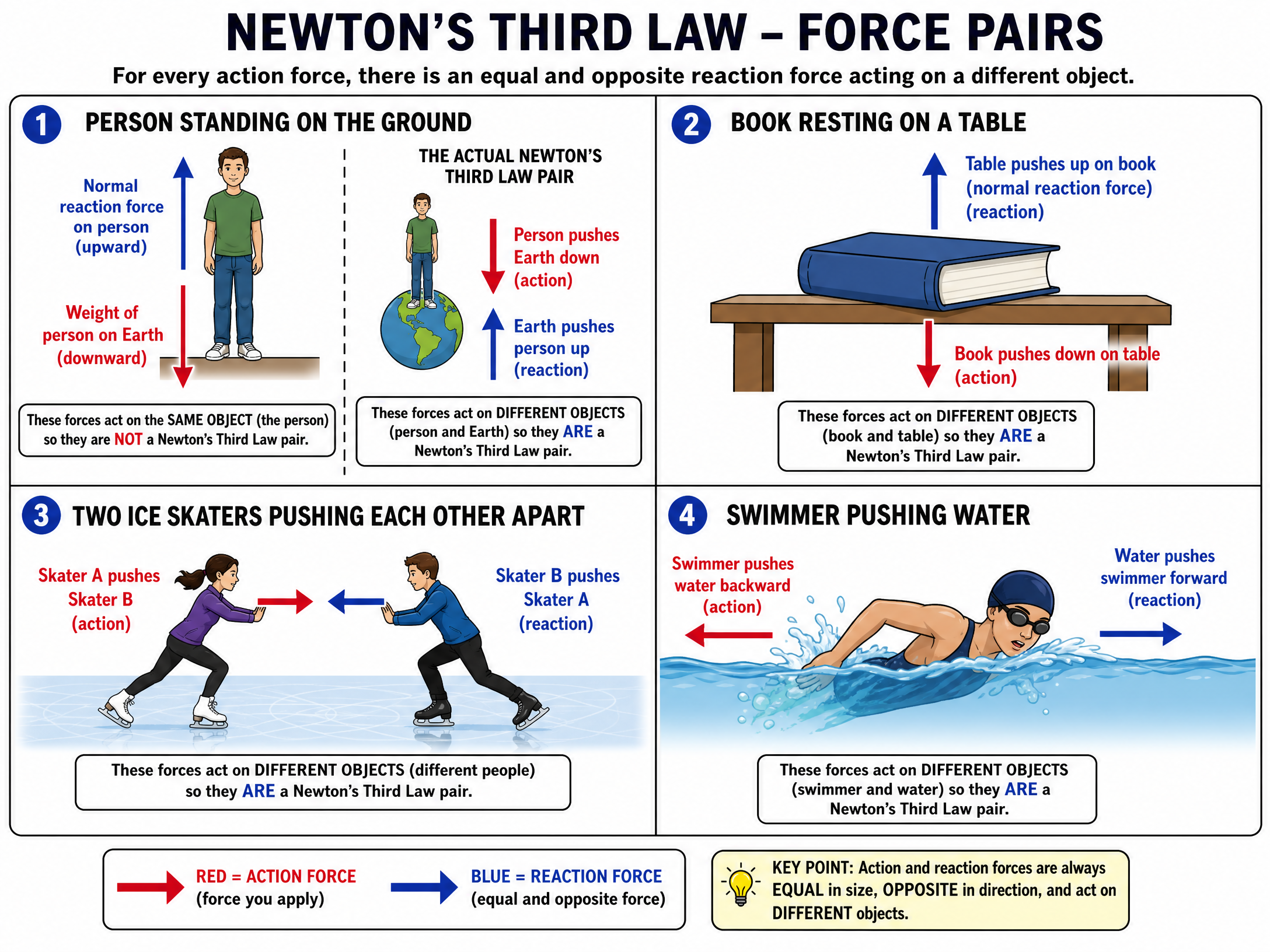
Imagine a book resting on a table. The book has a weight (gravitational force) acting downwards. The table exerts a normal reaction force acting upwards on the book. These forces are equal in size and opposite in direction, so the book does not accelerate.
**Are these a Newton's Third Law pair? NO.**Why? Because both forces act on the SAME object (the book), and they are DIFFERENT types of forces (one is gravitational, one is a contact normal force). This is a case of balanced forces under Newton's First Law.
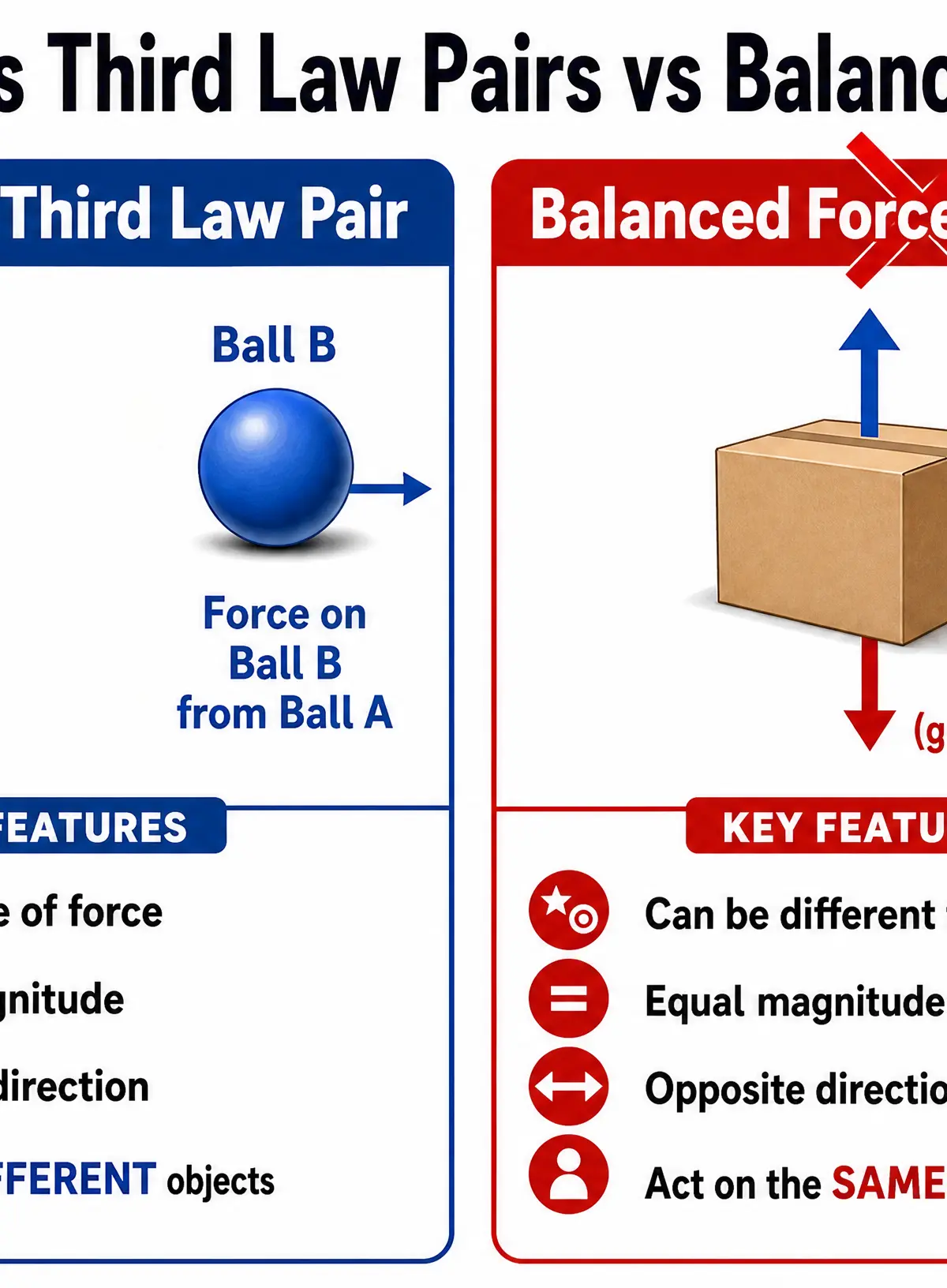
So, what are the actual Newton's Third Law pairs in this scenario?
- Pair 1 (Gravitational): The Earth pulls the book down (Weight). The book pulls the Earth up.
- Pair 2 (Contact): The book pushes down on the table. The table pushes up on the book.
Concept 3: Interaction in Collisions and Explosions
Newton's Third Law is the underlying reason why momentum is conserved in collisions. When two objects collide, they exert equal and opposite forces on each other for the exact same amount of time.
Because Force = \frac{Change\ in\ Momentum}{Time}, equal forces over equal times mean they experience equal and opposite changes in momentum.
Example: If a heavy lorry collides with a small car, the force the lorry exerts on the car is exactly the same size as the force the car exerts on the lorry. The car accelerates much more violently only because it has a much smaller mass (a = \frac{F}{m}, Newton's Second Law), not because the force on it was larger.
Mathematical/Scientific Relationships
While Newton's Third Law doesn't have its own specific formula to calculate a new value, it is expressed mathematically as:
F_{A\ on\ B} = -F_{B\ on\ A}
- F_{A\ on\ B}: The force exerted by object A on object B.
- F_{B\ on\ A}: The force exerted by object B on object A.
- Negative sign (-): Indicates that the direction is opposite.
Link to Newton's Second Law (F = ma):
Even though the forces are equal, the resulting accelerations will be different if the objects have different masses.
If m_A > m_B, then a_A < a_B.
Practical Applications
Examiners frequently use these real-world scenarios to test your understanding:
- Swimming / Rowing: A swimmer uses their arms to push the water backwards (Action). The water exerts an equal and opposite force forwards on the swimmer (Reaction), propelling them through the pool.
- Rockets in Space: A common misconception is that rockets need air to push against. They do not. The rocket engine pushes exhaust gases out of the back (Action). The exhaust gases push the rocket forward with an equal and opposite force (Reaction). This works perfectly in a vacuum.
- Walking: When you walk, your foot pushes backwards against the ground due to friction (Action). The ground pushes forwards on your foot with an equal and opposite frictional force (Reaction), moving you forward.
Listen to the Podcast
Review this topic on the go with our dedicated podcast episode:
Visual Resources
2 diagrams and illustrations
Interactive Diagrams
2 interactive diagrams to visualise key concepts
Conceptual Flow Outline
Decision tree to identify a true Newton's Third Law Pair
Conceptual Flow Outline
Interaction pair for a person standing on Earth
Worked Examples
3 worked examples — open one to explore the question and available guidance.
Practice Questions
Test your understanding — click to reveal model answers
State Newton's Third Law of Motion. [2 marks]
Hint: Think about interactions between two objects.
A car of mass 1200 kg collides with a stationary van of mass 2500 kg. During the collision, the car exerts a force of 8000 N on the van. State the size and direction of the force exerted by the van on the car. [2 marks]
Hint: Does the mass of the vehicles change the size of the interaction forces?
A bird flies by pushing air downwards with its wings. Explain how this allows the bird to fly upwards. [3 marks]
Hint: Apply Newton's Third Law to the bird's wings and the air.
A student states: 'When a book rests on a table, the weight of the book and the normal contact force from the table are a Newton's Third Law pair because they are equal and opposite.' Explain why the student is incorrect. [3 marks]
Hint: Check the four rules of a Third Law pair (E-O-D-S). Which ones fail here?
A spacecraft is moving through the vacuum of space at a constant velocity. It fires its thrusters, ejecting hot gas backwards. Explain, in terms of forces, why the spacecraft accelerates forwards. [4 marks]
Hint: Identify the two objects interacting. Why does a force on the gas cause the spacecraft to move?
Test your understanding of Forces
Active recall beats re-reading. Take an instant quiz now to test what you’ve learned and lock it into long-term memory.
7 days Premium · Then free forever · No card, no charge