AQA · GCSE · Physics
Course version: 8463 · Version from Sept 2016
Provided the spring is not inelastically deformed, the work done on the…
Full specification wording
Forces and elasticity: Provided the spring is not inelastically deformed, the work done on the spring and the elastic potential energy stored are equal.
Below the limit of proportionality a spring is a perfect energy store: every joule of work done stretching it comes back when it is released, so the work done and the energy stored are equal and…
Checked against the AQA 8463 specification (opens in a new tab) on .
- Point 5 of 7
- 4 key terms
Study notes
From the checked teaching notes for this specification point.
The idea
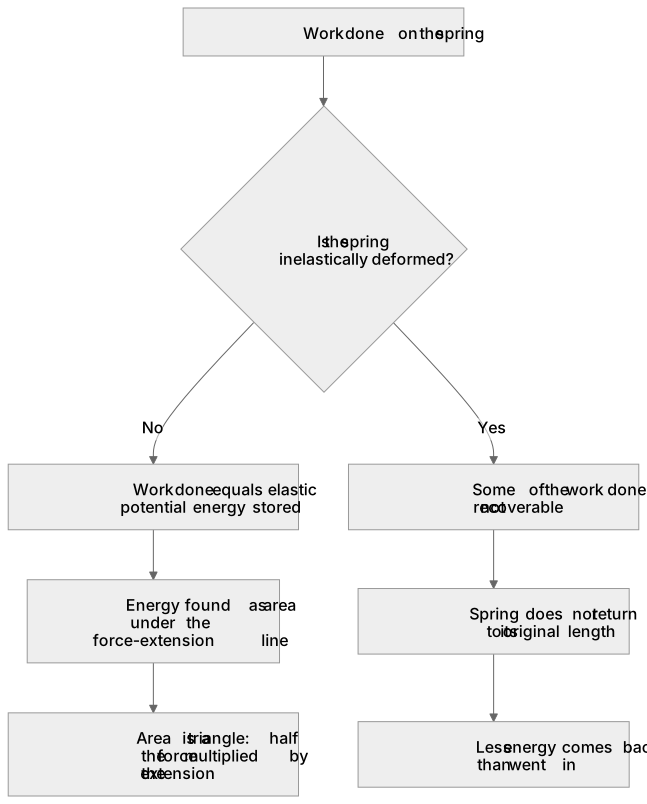
Below the limit of proportionality a spring is a perfect energy store: every joule of work done stretching it comes back when it is released, so the work done and the energy stored are equal and either can be found from the area under the force-extension line. That area is a triangle, half the force multiplied by the extension, which is the same as half the spring constant multiplied by the extension squared. Once the spring has been stretched far enough to be inelastically deformed the bookkeeping changes: some of the work done goes into permanently rearranging the material rather than into the elastic store, the spring does not return to its original length, and less energy comes back than went in. Mark schemes accept elastic limit as an alternative name for the limit of proportionality.
What earns the marks
- Equating the work done on the spring with the elastic potential energy stored.
- Finding that energy as the area under the force-extension graph.
- Stating the condition that the spring has not been inelastically deformed.
- Stating that beyond that point some of the work done is not recoverable and the spring stays deformed.
Common mistakes and how to put them right
Using the whole rectangle under the graph rather than the triangle, which doubles the energy.
Assuming the equality still holds after the limit of proportionality has been passed.
Saying the spring loses the energy rather than transferring it to internal energy and permanent deformation.
Treating an inelastically deformed spring as broken rather than permanently longer.
Exam tips
- Area under a force-extension graph is energy; the gradient is the spring constant. Check which the question wants.
- Look for the phrase not inelastically deformed in a question - it is telling you the equality applies.
Try the lesson
The start of the Forces and elasticity: Provided the spring is not inelastically deformed, the work done on the spring and the elastic potential energy stored are equal. lesson, made from checked teaching notes for this specification point.
Have a go first
A spring is stretched but is not inelastically deformed. How does the work done on the spring compare with the elastic potential energy stored in it?
Listen
Below the limit of proportionality a spring is a perfect energy store: every joule of work done stretching it comes back when it is released, so the work done and the energy stored are equal and either can be found from the area under the force-extension line. That area is a triangle, half the force multiplied by the extension, which is the same as half the spring constant multiplied by the extension squared. Once the spring has been stretched far enough to be inelastically deformed the bookkeeping changes: some of the work done goes into permanently rearranging the material rather than into the elastic store, the spring does not return to its original length, and less energy comes back than went in. Mark schemes accept elastic limit as an alternative name for the limit of proportionality. A strong answer earns marks for these points. equating the work done on the spring with the elastic potential energy stored. finding that energy as the area under the force-extension graph. stating the condition that the spring has not been inelastically deformed. stating that beyond that point some of the work done is not recoverable and the spring stays deformed. Exam tip: Area under a force-extension graph is energy; the gradient is the spring constant. Check which the question wants.
See it
Key words
Say what each word means before you turn the card.
work done equals energy stored
Try answering aloud or in your head before turning the card.
area under the graph
Try answering aloud or in your head before turning the card.
limit of proportionality
Try answering aloud or in your head before turning the card.
inelastic deformation
Try answering aloud or in your head before turning the card.
See every definition
- work done equals energy stored
- Provided the spring is not inelastically deformed, the work done on the spring and the elastic potential energy stored are equal.
- area under the graph
- The energy can be found from the area under the force-extension line, which is a triangle.
- limit of proportionality
- Beyond this point the spring is inelastically deformed; mark schemes accept elastic limit as an alternative name.
- inelastic deformation
- Once stretched far enough for this, some of the work done goes into permanently rearranging the material rather than into the elastic store, and the spring does not return to its original length.
There is more to this lesson
The full lesson goes on to check your understanding and help you earn the marks. Create a free account to carry on, with your progress saved.
A week of Premium from your first lesson · Then the free plan continues · No card, no charge
Test your understanding of Forces and elasticity: Provided the spring is not inelastically deformed, the work done on the spring and the elastic potential energy stored are equal.
Active recall beats re-reading. Take an instant quiz now to test what you’ve learned and lock it into long-term memory.
A week of Premium from your first lesson · Then the free plan continues · No card, no charge