AQA · GCSE · Physics
Course version: 8463 · Version from Sept 2016
Students should be able to calculate relevant values of stored energy and…
Full specification wording
Forces and elasticity: Students should be able to calculate relevant values of stored energy and energy transfers.
These are the multi-step questions.
Checked against the AQA 8463 specification (opens in a new tab) on .
- Point 6 of 7
- 2 key terms
Study notes
From the checked teaching notes for this specification point.
The idea
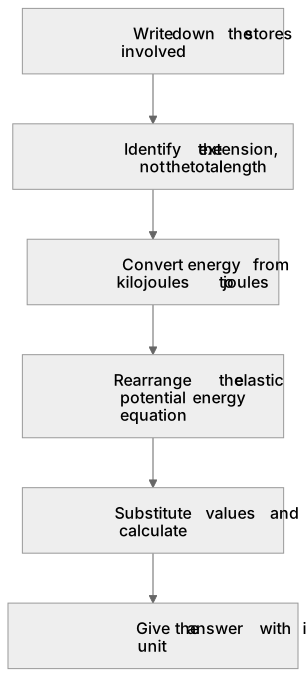
These are the multi-step questions. A typical one gives the energy stored in a stretched cord and asks for the spring constant, so the elastic energy equation is rearranged to make the spring constant the subject and the energy is converted from kilojoules to joules first: 24500 = ½ × k × 35² gives k = 40 N/m. Others chain the equations together - elastic potential to kinetic, so the two expressions are equated and a speed is found; or elastic potential to gravitational potential, giving a height. The two traps are using the total stretched length instead of the extension, and forgetting to square. Keep every value in joules, newtons, metres and kilograms, and write down the transfer you are assuming before you start.
What earns the marks
- Identifying the extension rather than the total length, such as 35 m of stretch on a cord that began at 20 m.
- Converting the energy from kilojoules into joules.
- A correct substitution and a correct rearrangement of the energy equation.
- The answer with its unit, with full credit available for a correct answer shown without working.
Common mistakes and how to put them right
Using the full stretched length of a bungee cord as the extension, which gives 16.2 rather than 40.
Forgetting to square the extension when rearranging for the spring constant.
Leaving the energy in kilojoules, so the answer is a thousand times too small.
Halving twice, by using the half in the equation and then dividing the answer by two.
Exam tips
- Write down which stores are involved before touching the calculator; the chain tells you which equations to equate.
- A correct answer without working still scores, but a wrong one without working scores nothing, so show the substitution.
Try the lesson
The start of the Forces and elasticity: Students should be able to calculate relevant values of stored energy and energy transfers. lesson, made from checked teaching notes for this specification point.
Have a go first
A spring has a spring constant of 250 N/m. It is compressed by 0.08 m. Calculate the elastic potential energy stored in the spring.
Listen
These are the multi-step questions. A typical one gives the energy stored in a stretched cord and asks for the spring constant, so the elastic energy equation is rearranged to make the spring constant the subject and the energy is converted from kilojoules to joules first: 24500 = ½ × k × 35² gives k = 40 N/m. Others chain the equations together - elastic potential to kinetic, so the two expressions are equated and a speed is found; or elastic potential to gravitational potential, giving a height. The two traps are using the total stretched length instead of the extension, and forgetting to square. Keep every value in joules, newtons, metres and kilograms, and write down the transfer you are assuming before you start. A strong answer earns marks for these points. identifying the extension rather than the total length, such as 35 m of stretch on a cord that began at 20 m. converting the energy from kilojoules into joules. a correct substitution and a correct rearrangement of the energy equation. the answer with its unit, with full credit available for a correct answer shown without working. Exam tip: Write down which stores are involved before touching the calculator; the chain tells you which equations to equate.
See it
Put it in order
Put these steps in the order they happen.
- 1. Convert energy from kilojoules to joules
- 2. Identify the extension, not the total length
- 3. Write down the stores involved
- 4. Give the answer with its unit
- 5. Substitute values and calculate
- 6. Rearrange the elastic potential energy equation
Key words
Say what each word means before you turn the card.
rearrangement
Try answering aloud or in your head before turning the card.
unit conversion
Try answering aloud or in your head before turning the card.
See every definition
- rearrangement
- Making a quantity the subject of an equation, such as rearranging the elastic energy equation to make the spring constant the subject.
- unit conversion
- Changing values into the right units before substituting, such as converting energy from kilojoules into joules and lengths into metres.
Label the diagram
Some boxes have lost their names. Pick the right name for each number.
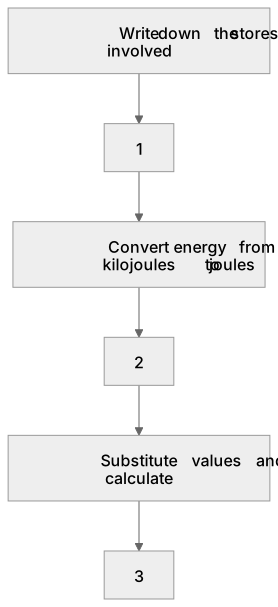
1Box 1
2Box 2
3Box 3
There is more to this lesson
The full lesson goes on to check your understanding and help you earn the marks. Create a free account to carry on, with your progress saved.
A week of Premium from your first lesson · Then the free plan continues · No card, no charge
Test your understanding of Forces and elasticity: Students should be able to calculate relevant values of stored energy and energy transfers.
Active recall beats re-reading. Take an instant quiz now to test what you’ve learned and lock it into long-term memory.
A week of Premium from your first lesson · Then the free plan continues · No card, no charge