AQA · GCSE · Physics
Course version: 8463 · Version from Sept 2016
Students should be able to: give examples of the forces involved in…
Full specification wording
Forces and elasticity: Students should be able to: give examples of the forces involved in stretching, bending or compressing an object explain why, to change the shape of an object (by stretching, bending or compressing), more than one force has to be applied – this is limited to stationary objects only describe the difference between elastic deformation and inelastic deformation caused by stretching forces.
One force on a free object simply makes it accelerate; to change its shape you need at least two.
Checked against the AQA 8463 specification (opens in a new tab) on .
- Point 1 of 7
- 4 key terms
Study notes
From the checked teaching notes for this specification point.
The idea
One force on a free object simply makes it accelerate; to change its shape you need at least two. A spring hangs from a stand, so the weight of the load pulls down while the stand pulls up, and the spring stretches between them. Bend a ruler and each hand pushes the opposite way; compress a spring and the hand pushes down while the bench pushes up. Because the object stays still, those forces must be balanced, which is why the specification limits this to stationary objects. Deformation is elastic if the object returns to its original length and shape the moment the forces are removed, as a spring balance must so that it reads correctly next time; it is inelastic if part of the change of shape is permanent, as when a spring stretched too far stays longer than it began.
What earns the marks
- Stating that at least two forces are needed to change the shape of a stationary object.
- Naming the pair of forces in a given example, such as the weight and the pull of the support on a hanging spring.
- Elastic deformation described as returning to the original length or shape when the force is removed.
- Inelastic deformation described as a permanent change of shape that remains after the force is removed.
Common mistakes and how to put them right
Describing only the load and forgetting the force from the support or the second hand.
Saying a single force stretches a spring, which would only accelerate it.
Defining elastic deformation as it stretches rather than as returning to its original length.
Treating any large extension as inelastic, when the test is whether the change is permanent.
Exam tips
- Name both forces and their directions; one force is never enough for a change of shape.
- Use the words returns to its original length - that is the credited phrase for elastic deformation.
Try the lesson
The start of the Forces and elasticity: Students should be able to: give examples of the forces involved in stretching, bending or compressing an object explain why, to change the shape of an object (by stretching, bending or compressing), more than one force has to be applied – this is limited to stationary objects only describe the difference between elastic deformation and inelastic deformation caused by stretching forces. lesson, made from checked teaching notes for this specification point.
Have a go first
A spring is stretched by pulling both ends outwards. Which pair of forces acts on the spring to stretch it?
Listen
One force on a free object simply makes it accelerate; to change its shape you need at least two. A spring hangs from a stand, so the weight of the load pulls down while the stand pulls up, and the spring stretches between them. Bend a ruler and each hand pushes the opposite way; compress a spring and the hand pushes down while the bench pushes up. Because the object stays still, those forces must be balanced, which is why the specification limits this to stationary objects. Deformation is elastic if the object returns to its original length and shape the moment the forces are removed, as a spring balance must so that it reads correctly next time; it is inelastic if part of the change of shape is permanent, as when a spring stretched too far stays longer than it began. A strong answer earns marks for these points. stating that at least two forces are needed to change the shape of a stationary object. naming the pair of forces in a given example, such as the weight and the pull of the support on a hanging spring. elastic deformation described as returning to the original length or shape when the force is removed. inelastic deformation described as a permanent change of shape that remains after the force is removed. Exam tip: Name both forces and their directions; one force is never enough for a change of shape.
See it

Key words
Say what each word means before you turn the card.
pairs of forces
Try answering aloud or in your head before turning the card.
stretching, bending and compressing
Try answering aloud or in your head before turning the card.
elastic deformation
Try answering aloud or in your head before turning the card.
inelastic deformation
Try answering aloud or in your head before turning the card.
See every definition
- pairs of forces
- To change the shape of a stationary object, more than one force has to be applied, such as the weight and the pull of the support on a hanging spring.
- stretching, bending and compressing
- Ways of changing the shape of an object, for which students should be able to give examples of the forces involved.
- elastic deformation
- The object returns to its original length and shape the moment the forces are removed.
- inelastic deformation
- Part of the change of shape is permanent, as when a spring stretched too far stays longer than it began.
Label the diagram
Some boxes have lost their names. Pick the right name for each number.
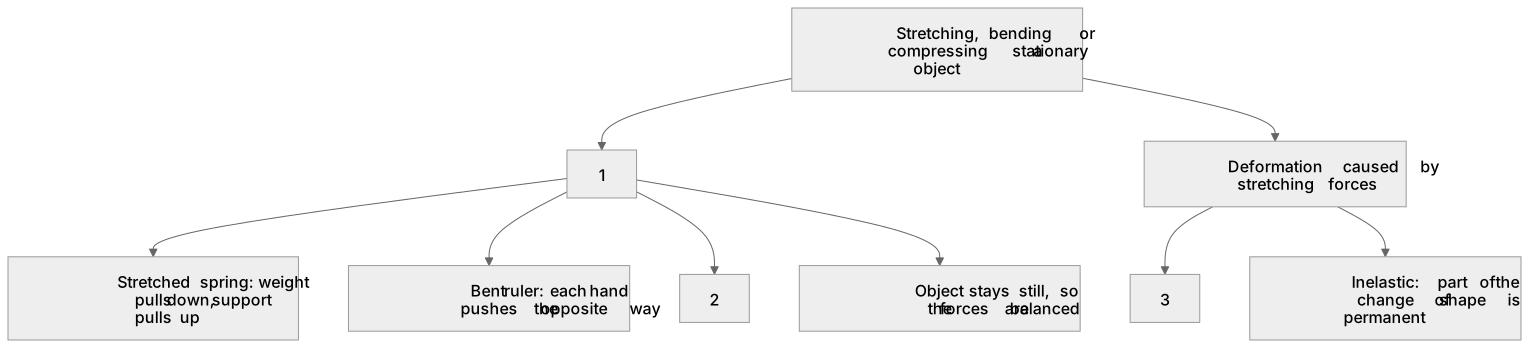
1Box 1
2Box 2
3Box 3
There is more to this lesson
The full lesson goes on to check your understanding and help you earn the marks. Create a free account to carry on, with your progress saved.
A week of Premium from your first lesson · Then the free plan continues · No card, no charge
Test your understanding of Forces and elasticity: Students should be able to: give examples of the forces involved in stretching, bending or compressing an object explain why, to change the shape of an object (by stretching, bending or compressing), more than one force has to be applied – this is limited to stationary objects only describe the difference between elastic deformation and inelastic deformation caused by stretching forces.
Active recall beats re-reading. Take an instant quiz now to test what you’ve learned and lock it into long-term memory.
A week of Premium from your first lesson · Then the free plan continues · No card, no charge