AQA · GCSE · Physics
Course version: 8463 · Version from Sept 2016
The extension of an elastic object, such as a spring, is directly…
Full specification wording
Forces and elasticity: The extension of an elastic object, such as a spring, is directly proportional to the force applied, provided that the limit of proportionality is not exceeded.
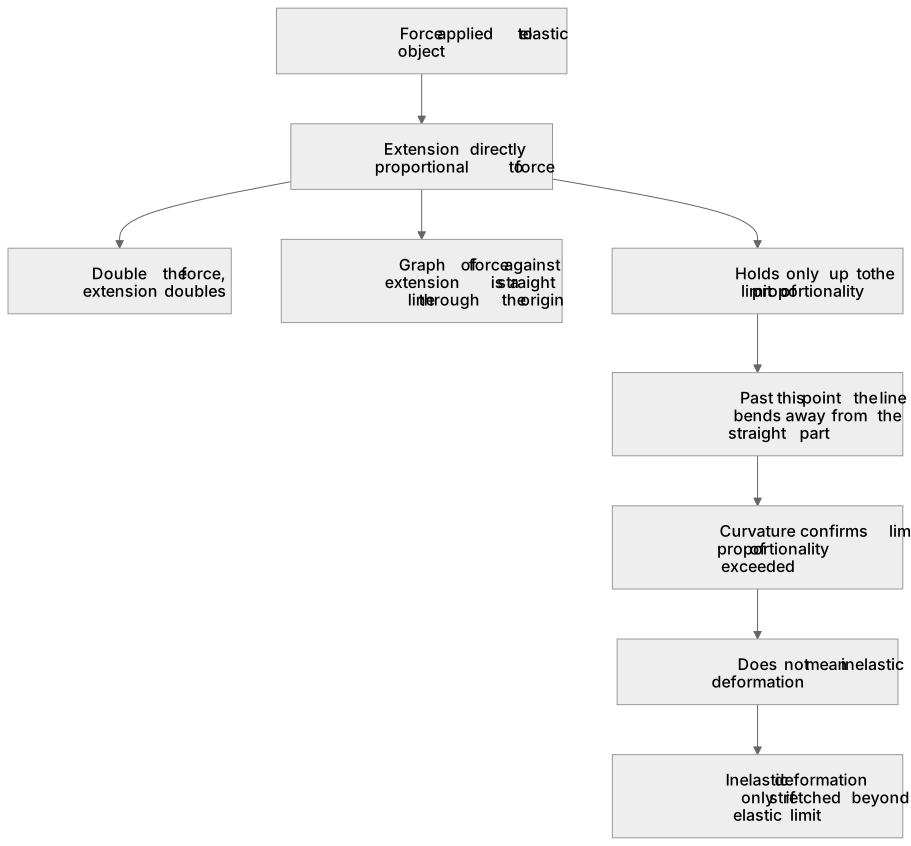
Directly proportional has a precise meaning: double the force and the extension doubles, and a graph of force against extension is a straight line through the origin.
Checked against the AQA 8463 specification (opens in a new tab) on .
- Point 2 of 7
- 4 key terms
Study notes
From the checked teaching notes for this specification point.
The idea
Directly proportional has a precise meaning: double the force and the extension doubles, and a graph of force against extension is a straight line through the origin. That is what makes a spring balance useful, because a linear scale turns equal steps of mass into equal steps of length. Extension is not length: it is the stretched length minus the original unstretched length, so a spring 30 mm long that becomes 50 mm long has an extension of 20 mm. The proportionality holds only up to the limit of proportionality. Past that point the line bends away from the straight part. Note that curvature only confirms the limit of proportionality has been exceeded; it does not mean the spring has been inelastically deformed. Inelastic deformation only occurs if the spring is stretched beyond its elastic limit, meaning it no longer returns to its original length when unloaded.
What earns the marks
- A straight line through the origin as the test for direct proportionality.
- Extension calculated as stretched length minus original length.
- Stating that the relationship holds only up to the limit of proportionality.
- Identifying that the graph curving means the limit of proportionality is exceeded, not necessarily the elastic limit.
Common mistakes and how to put them right
Plotting or using the total length instead of the extension, so the line misses the origin.
Put it right: Subtract the unstretched length.
Calling a straight line that does not pass through the origin a proportional relationship.
Put it right: It must pass through the origin.
Conflating the limit of proportionality with the elastic limit by assuming a curved graph means permanent deformation.
Put it right: Curvature only indicates the limit of proportionality is exceeded.
Assuming that doubling the force always doubles the extension, even beyond the straight section.
Put it right: This only applies up to the limit of proportionality.
Exam tips
- Subtract the unstretched length before you plot or calculate anything.
- Where a graph curves, name the limit of proportionality. Do not assume curvature immediately means inelastic deformation.
Try the lesson
The start of the Forces and elasticity: The extension of an elastic object, such as a spring, is directly proportional to the force applied, provided that the limit of proportionality is not exceeded. lesson, made from checked teaching notes for this specification point.
Have a go first
A student hangs a 2 N weight on a spring and the spring stretches by 4 cm. She then hangs a 4 N weight on the same spring, which is still below its limit of proportionality. What is the new extension of the spring?
Listen
Directly proportional has a precise meaning: double the force and the extension doubles, and a graph of force against extension is a straight line through the origin. That is what makes a spring balance useful, because a linear scale turns equal steps of mass into equal steps of length. Extension is not length: it is the stretched length minus the original unstretched length, so a spring 30 mm long that becomes 50 mm long has an extension of 20 mm. The proportionality holds only up to the limit of proportionality. Past that point the line bends away from the straight part. Note that curvature only confirms the limit of proportionality has been exceeded; it does not mean the spring has been inelastically deformed. Inelastic deformation only occurs if the spring is stretched beyond its elastic limit, meaning it no longer returns to its original length when unloaded. A strong answer earns marks for these points. a straight line through the origin as the test for direct proportionality. extension calculated as stretched length minus original length. stating that the relationship holds only up to the limit of proportionality. identifying that the graph curving means the limit of proportionality is exceeded, not necessarily the elastic limit. Exam tip: Subtract the unstretched length before you plot or calculate anything.
See it
Key words
Say what each word means before you turn the card.
direct proportionality
Try answering aloud or in your head before turning the card.
extension
Try answering aloud or in your head before turning the card.
limit of proportionality
Try answering aloud or in your head before turning the card.
elastic limit
Try answering aloud or in your head before turning the card.
See every definition
- direct proportionality
- The relationship where double the force gives double the extension, shown by a straight line through the origin on a graph of force against extension.
- extension
- The stretched length minus the original unstretched length, so a spring 30 mm long that becomes 50 mm long has an extension of 20 mm.
- limit of proportionality
- The point up to which the extension is directly proportional to the force applied; past it the line bends away from the straight part.
- elastic limit
- The point beyond which a spring no longer returns to its original length when unloaded, meaning inelastic deformation has occurred.
Label the diagram
Some boxes have lost their names. Pick the right name for each number.
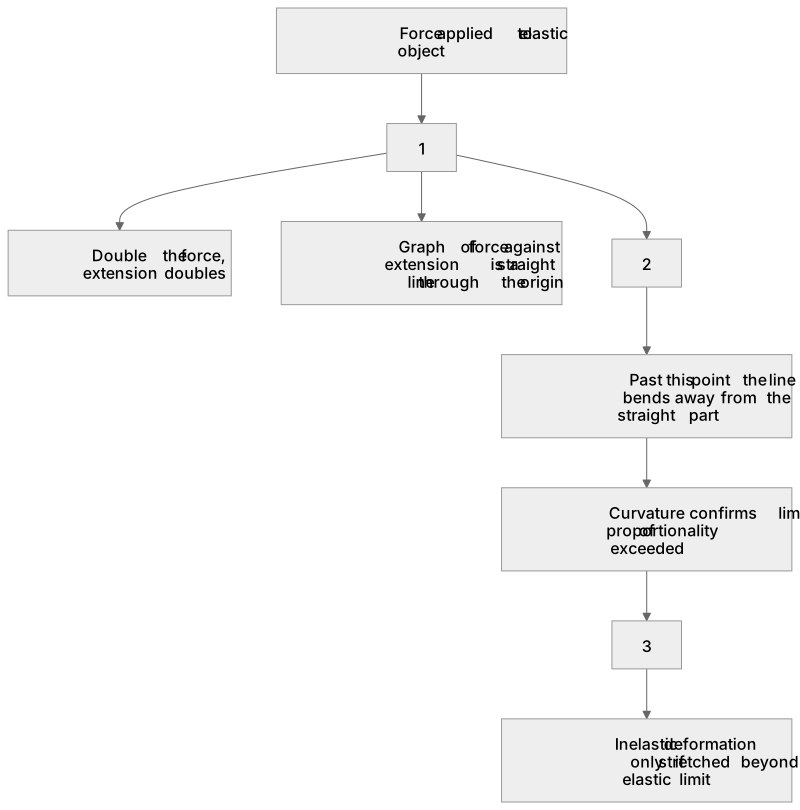
1Box 1
2Box 2
3Box 3
There is more to this lesson
The full lesson goes on to check your understanding and help you earn the marks. Create a free account to carry on, with your progress saved.
A week of Premium from your first lesson · Then the free plan continues · No card, no charge
Test your understanding of Forces and elasticity: The extension of an elastic object, such as a spring, is directly proportional to the force applied, provided that the limit of proportionality is not exceeded.
Active recall beats re-reading. Take an instant quiz now to test what you’ve learned and lock it into long-term memory.
A week of Premium from your first lesson · Then the free plan continues · No card, no charge