AQA · GCSE · Physics
Course version: 8463 · Version from Sept 2016
The weight of an object depends on the gravitational field strength at the…
Full specification wording
Gravity: The weight of an object depends on the gravitational field strength at the point where the object is.
Mass is the quantity of matter in an object and is the same everywhere; weight is a force and depends on where the object is.
Checked against the AQA 8463 specification (opens in a new tab) on .
- Point 2 of 5
- 4 key terms
Study notes
From the checked teaching notes for this specification point.
The idea
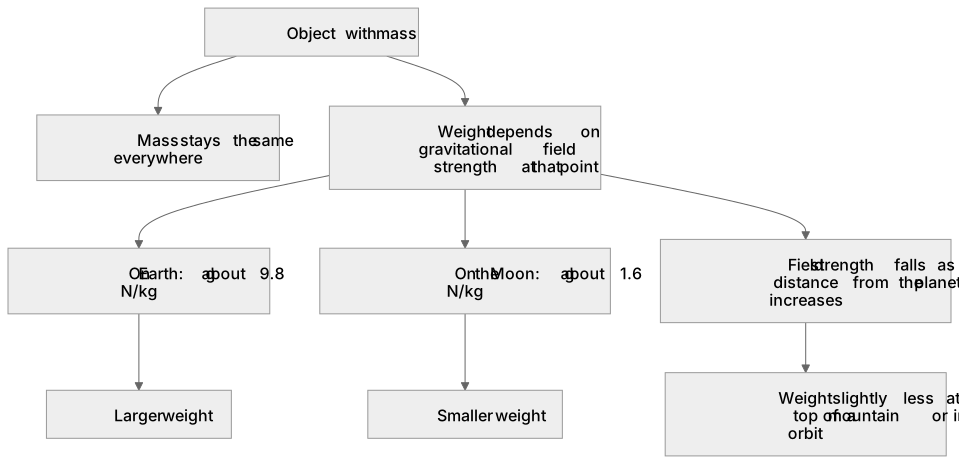
Mass is the quantity of matter in an object and is the same everywhere; weight is a force and depends on where the object is. What changes is the gravitational field strength at that point. On the Earth's surface g is about 9.8 N/kg, on the Moon about 1.6 N/kg, so a 60 kg astronaut has a weight of about 588 N on Earth but only about 96 N on the Moon, with the same 60 kg of mass in both places. Field strength also falls as you move away from a planet, so the same object weighs slightly less at the top of a mountain or in orbit. Any value of g you need will be given in the question, so use the value supplied, not a remembered one.
What earns the marks
- The mass of the object staying the same wherever it is.
- The weight changing because the gravitational field strength changes.
- A correct comparison using the values given, such as a smaller weight on the Moon where g is smaller.
- Stating that field strength falls as distance from the planet increases.
Common mistakes and how to put them right
Saying an astronaut's mass decreases on the Moon.
Using a remembered value of g when the question supplies a different one.
Quoting a weight in kilograms or a mass in newtons.
Claiming weight is zero in orbit because there is no gravity.
Treating gravitational field strength as a force rather than a force per kilogram.
Exam tips
- Underline the value of g given in the question before you start, because questions deliberately vary it.
- State clearly which quantity stays the same and which changes; that contrast is what is being marked.
- Check your units at the end: newtons for weight, kilograms for mass, N/kg for field strength.
Try the lesson
The start of the Gravity: The weight of an object depends on the gravitational field strength at the point where the object is. lesson, made from checked teaching notes for this specification point.
Have a go first
A pupil takes a 2 kg bag of flour from the kitchen to the top of a high mountain. What happens to the weight of the bag?
Listen
Mass is the quantity of matter in an object and is the same everywhere; weight is a force and depends on where the object is. What changes is the gravitational field strength at that point. On the Earth's surface g is about 9.8 N/kg, on the Moon about 1.6 N/kg, so a 60 kg astronaut has a weight of about 588 N on Earth but only about 96 N on the Moon, with the same 60 kg of mass in both places. Field strength also falls as you move away from a planet, so the same object weighs slightly less at the top of a mountain or in orbit. Any value of g you need will be given in the question, so use the value supplied, not a remembered one. A strong answer earns marks for these points. the mass of the object staying the same wherever it is. the weight changing because the gravitational field strength changes. a correct comparison using the values given, such as a smaller weight on the Moon where g is smaller. stating that field strength falls as distance from the planet increases. Exam tip: Underline the value of g given in the question before you start, because questions deliberately vary it.
See it
Key words
Say what each word means before you turn the card.
mass unchanged
Try answering aloud or in your head before turning the card.
weight depends on location
Try answering aloud or in your head before turning the card.
gravitational field strength
Try answering aloud or in your head before turning the card.
using supplied values
Try answering aloud or in your head before turning the card.
See every definition
- mass unchanged
- The quantity of matter in an object, which is the same everywhere and stays the same wherever the object is.
- weight depends on location
- A force that depends on where the object is, because the gravitational field strength at that point changes.
- gravitational field strength
- A force per kilogram at the point where the object is, which falls as you move away from a planet.
- using supplied values
- Using the value of g given in the question rather than a remembered one, since any value needed will be supplied.
Label the diagram
Some boxes have lost their names. Pick the right name for each number.
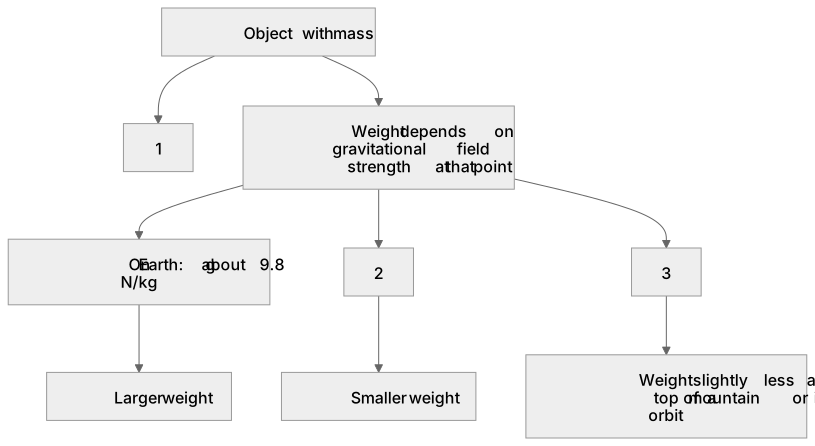
1Box 1
2Box 2
3Box 3
There is more to this lesson
The full lesson goes on to check your understanding and help you earn the marks. Create a free account to carry on, with your progress saved.
A week of Premium from your first lesson · Then the free plan continues · No card, no charge
Test your understanding of Gravity: The weight of an object depends on the gravitational field strength at the point where the object is.
Active recall beats re-reading. Take an instant quiz now to test what you’ve learned and lock it into long-term memory.
A week of Premium from your first lesson · Then the free plan continues · No card, no charge