AQA · GCSE · Physics
Course version: 8463 · Version from Sept 2016
The weight of an object can be calculated using the equation: weight =…
Full specification wording
Gravity: The weight of an object can be calculated using the equation: weight = mass × gravitational field strength W = m g weight, W, in newtons, N mass, m, in kilograms, kg gravitational field strength, g, in newtons per kilogram, N/kg (In any calculation the value of the gravitational field strength (g) will be given.) The weight of an object may be considered to act at a single point referred to as the object’s ‘centre of mass’.
Weight is calculated from W = m g, with weight W in newtons, mass m in kilograms and gravitational field strength g in N/kg.
Checked against the AQA 8463 specification (opens in a new tab) on .
- Point 3 of 5
- 4 key terms
Study notes
From the checked teaching notes for this specification point.
The idea
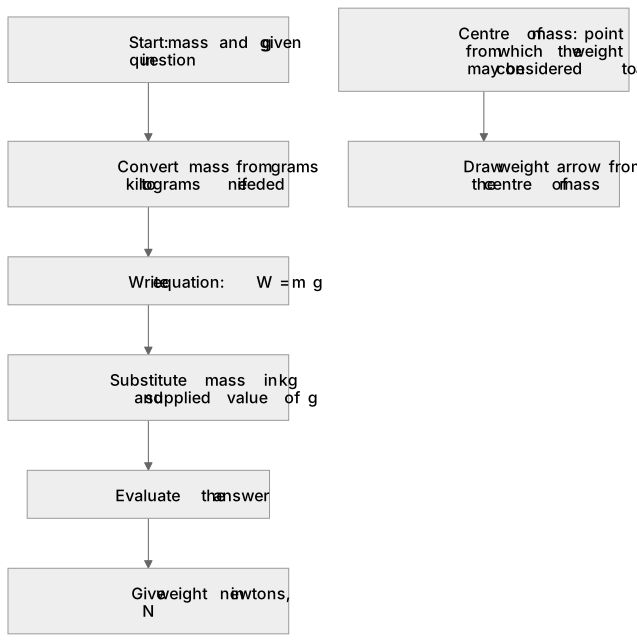
Weight is calculated from W = m g, with weight W in newtons, mass m in kilograms and gravitational field strength g in N/kg. Write the equation first, substitute, then evaluate: a 4.0 kg bag where g = 9.8 N/kg has a weight of 4.0 × 9.8 = 39.2 N. The value of g is always given, so use the one in the question. Mass supplied in grams must be converted to kilograms first, so 250 g becomes 0.250 kg. The weight of an object may be treated as acting at a single point called the centre of mass, the point from which the weight may be considered to act, or equivalently the point where the mass appears to be concentrated; on a diagram the weight arrow is drawn from there.
What earns the marks
- Writing W = m g before substituting.
- A correct substitution with the mass in kilograms and the value of g given in the question.
- The answer in newtons.
- Defining centre of mass as the point from which the weight may be considered to act, or where the mass appears to be concentrated.
Common mistakes and how to put them right
Leaving the mass in grams, so the weight comes out a thousand times too large.
Using a remembered value of g instead of the one supplied.
Quoting the weight in kilograms.
Describing the centre of mass as the middle of the object, which fails for irregular shapes.
Drawing the weight arrow from the base of the object rather than from its centre of mass.
Exam tips
- Set out equation, substitution and answer on three lines; the first two carry marks even if the arithmetic slips.
- Convert grams to kilograms as your first line of working, in view of the examiner.
- For centre of mass, 'the point through which the line of action of the weight acts' is also accepted.
Try the lesson
The start of the Gravity: The weight of an object can be calculated using the equation: weight = mass × gravitational field strength W = m g weight, W, in newtons, N mass, m, in kilograms, kg gravitational field strength, g, in newtons per kilogram, N/kg (In any calculation the value of the gravitational field strength (g) will be given.) The weight of an object may be considered to act at a single point referred to as the object’s ‘centre of mass’. lesson, made from checked teaching notes for this specification point.
Have a go first
A box has a mass of 6 kg. The gravitational field strength is 10 N/kg. What is the weight of the box?
Listen
Weight is calculated from W = m g, with weight W in newtons, mass m in kilograms and gravitational field strength g in N/kg. Write the equation first, substitute, then evaluate: a 4.0 kg bag where g = 9.8 N/kg has a weight of 4.0 × 9.8 = 39.2 N. The value of g is always given, so use the one in the question. Mass supplied in grams must be converted to kilograms first, so 250 g becomes 0.250 kg. The weight of an object may be treated as acting at a single point called the centre of mass, the point from which the weight may be considered to act, or equivalently the point where the mass appears to be concentrated; on a diagram the weight arrow is drawn from there. A strong answer earns marks for these points. writing W = m g before substituting. a correct substitution with the mass in kilograms and the value of g given in the question. the answer in newtons. defining centre of mass as the point from which the weight may be considered to act, or where the mass appears to be concentrated. Exam tip: Set out equation, substitution and answer on three lines; the first two carry marks even if the arithmetic slips.
See it
Key words
Say what each word means before you turn the card.
W = m g
Try answering aloud or in your head before turning the card.
units N, kg and N/kg
Try answering aloud or in your head before turning the card.
unit conversion
Try answering aloud or in your head before turning the card.
centre of mass
Try answering aloud or in your head before turning the card.
See every definition
- W = m g
- The equation used to calculate the weight of an object, where weight = mass × gravitational field strength.
- units N, kg and N/kg
- Weight, W, is in newtons, N; mass, m, is in kilograms, kg; and gravitational field strength, g, is in newtons per kilogram, N/kg.
- unit conversion
- Mass supplied in grams must be converted to kilograms first, so 250 g becomes 0.250 kg.
- centre of mass
- The point from which the weight may be considered to act, or where the mass appears to be concentrated.
Label the diagram
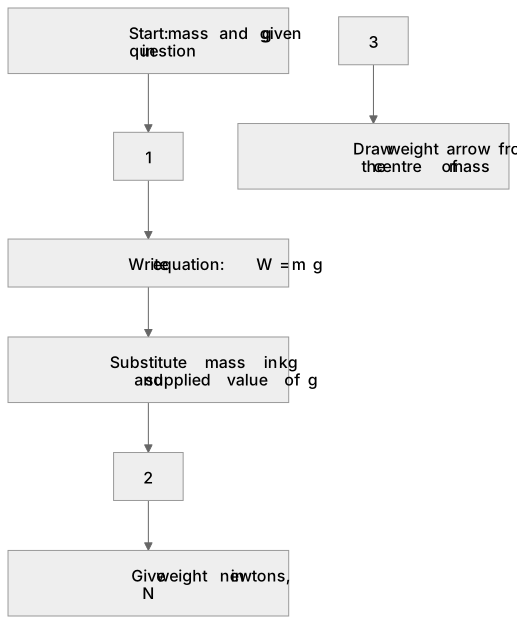
Some boxes have lost their names. Pick the right name for each number.
1Box 1
2Box 2
3Box 3
There is more to this lesson
The full lesson goes on to check your understanding and help you earn the marks. Create a free account to carry on, with your progress saved.
A week of Premium from your first lesson · Then the free plan continues · No card, no charge
Test your understanding of Gravity: The weight of an object can be calculated using the equation: weight = mass × gravitational field strength W = m g weight, W, in newtons, N mass, m, in kilograms, kg gravitational field strength, g, in newtons per kilogram, N/kg (In any calculation the value of the gravitational field strength (g) will be given.) The weight of an object may be considered to act at a single point referred to as the object’s ‘centre of mass’.
Active recall beats re-reading. Take an instant quiz now to test what you’ve learned and lock it into long-term memory.
A week of Premium from your first lesson · Then the free plan continues · No card, no charge