AQA · GCSE · Physics
Course version: 8463 · Version from Sept 2016
Weight is measured using a calibrated spring-balance (a newtonmeter).
Full specification wording
Gravity: Weight is measured using a calibrated spring-balance (a newtonmeter).
Weight is a force, so it is measured with a calibrated spring-balance, also called a newtonmeter, which reads directly in newtons.
Checked against the AQA 8463 specification (opens in a new tab) on .
- Point 5 of 5
- 4 key terms
Study notes
From the checked teaching notes for this specification point.
The idea
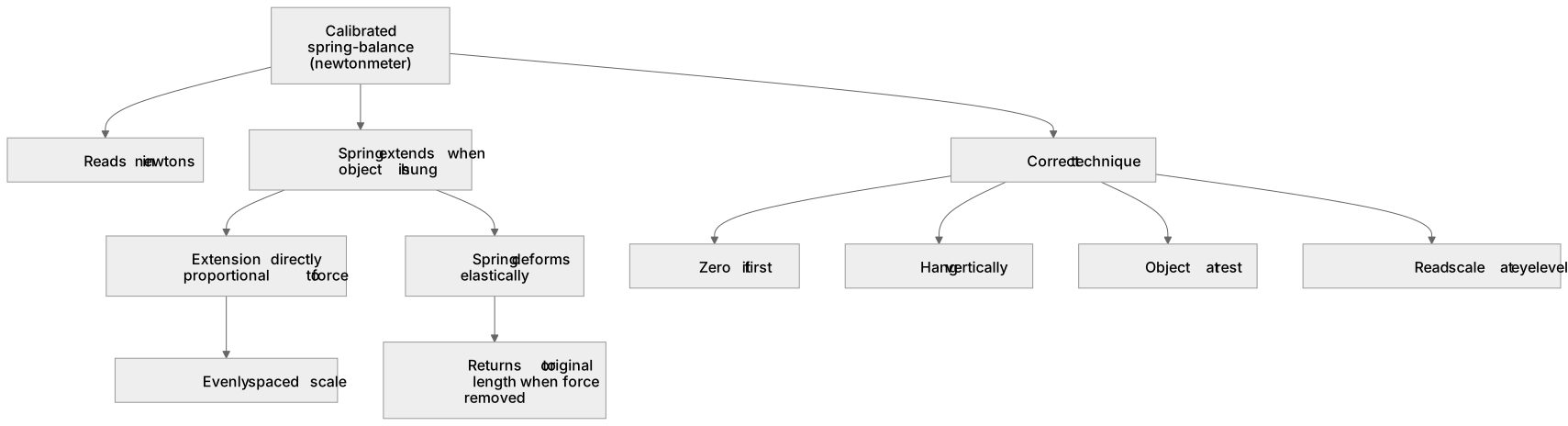
Weight is a force, so it is measured with a calibrated spring-balance, also called a newtonmeter, which reads directly in newtons. Inside, a spring extends when the object is hung from it. Because the extension is directly proportional to the force applied, the scale is linear with evenly spaced divisions, which makes the instrument straightforward to calibrate. The spring must deform elastically so that it returns to its original length once the object is removed; if it is overloaded so far that it deforms inelastically it stays stretched and the readings are wrong afterwards; past the limit of proportionality the scale also stops being evenly spaced. To use it well, zero it first, hang it vertically, let the object come to rest and read the scale at eye level.
What earns the marks
- Naming the instrument as a calibrated spring-balance or newtonmeter, reading in newtons.
- The extension of the spring being directly proportional to the force, giving an evenly spaced scale.
- The spring deforming elastically, so it returns to its original length when the force is removed.
- A correct technique, such as zeroing the instrument and reading the scale at eye level with the object stationary.
Common mistakes and how to put them right
Naming a top-pan balance, which measures mass in grams rather than weight in newtons.
Reading the scale while the object is still swinging.
Failing to zero the newtonmeter before hanging the object on it.
Recording the reading in kilograms.
Overloading the spring past its limit of proportionality and continuing to use the readings.
Exam tips
- If asked why a spring suits this job, give the elastic deformation and the linear scale as two separate points.
- Say the instrument is 'calibrated' in newtons; that word is in the specification and signals you know it reads force.
- Mention eye level and a stationary object when a question asks how to improve accuracy.
Try the lesson
The start of the Gravity: Weight is measured using a calibrated spring-balance (a newtonmeter). lesson, made from checked teaching notes for this specification point.
Have a go first
What is the name of the instrument used to measure the weight of an object?
Listen
Weight is a force, so it is measured with a calibrated spring-balance, also called a newtonmeter, which reads directly in newtons. Inside, a spring extends when the object is hung from it. Because the extension is directly proportional to the force applied, the scale is linear with evenly spaced divisions, which makes the instrument straightforward to calibrate. The spring must deform elastically so that it returns to its original length once the object is removed; if it is overloaded so far that it deforms inelastically it stays stretched and the readings are wrong afterwards; past the limit of proportionality the scale also stops being evenly spaced. To use it well, zero it first, hang it vertically, let the object come to rest and read the scale at eye level. A strong answer earns marks for these points. naming the instrument as a calibrated spring-balance or newtonmeter, reading in newtons. the extension of the spring being directly proportional to the force, giving an evenly spaced scale. the spring deforming elastically, so it returns to its original length when the force is removed. a correct technique, such as zeroing the instrument and reading the scale at eye level with the object stationary. Exam tip: If asked why a spring suits this job, give the elastic deformation and the linear scale as two separate points.
See it
Key words
Say what each word means before you turn the card.
newtonmeter
Try answering aloud or in your head before turning the card.
elastic deformation
Try answering aloud or in your head before turning the card.
linear scale
Try answering aloud or in your head before turning the card.
measurement technique
Try answering aloud or in your head before turning the card.
See every definition
- newtonmeter
- A calibrated spring-balance that is used to measure weight and reads directly in newtons.
- elastic deformation
- The spring deforms elastically so that it returns to its original length once the object is removed.
- linear scale
- Because the extension is directly proportional to the force applied, the scale has evenly spaced divisions.
- measurement technique
- Zero the instrument first, hang it vertically, let the object come to rest and read the scale at eye level.
Label the diagram
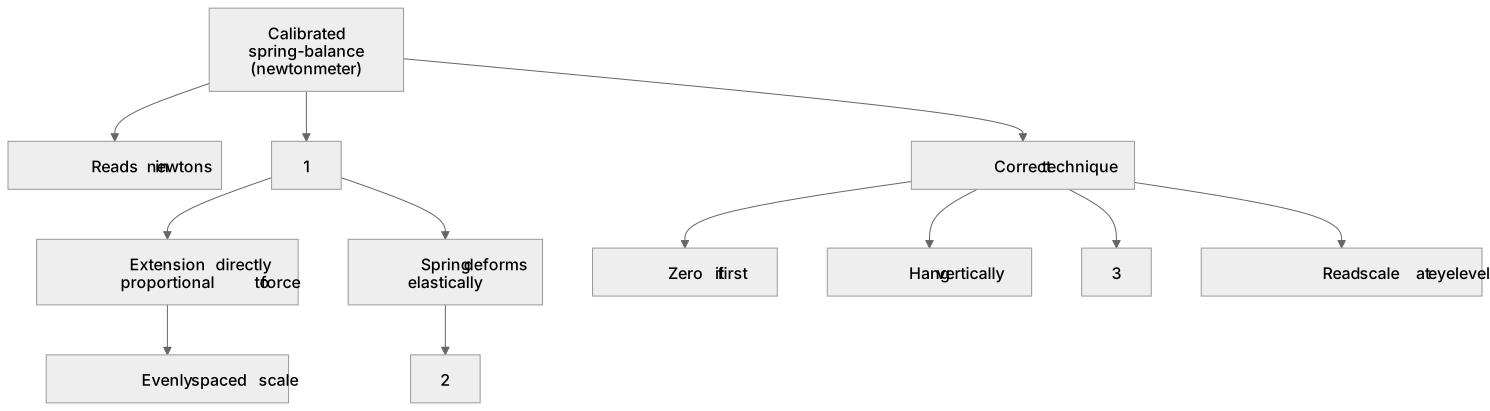
Some boxes have lost their names. Pick the right name for each number.
1Box 1
2Box 2
3Box 3
There is more to this lesson
The full lesson goes on to check your understanding and help you earn the marks. Create a free account to carry on, with your progress saved.
A week of Premium from your first lesson · Then the free plan continues · No card, no charge
Test your understanding of Gravity: Weight is measured using a calibrated spring-balance (a newtonmeter).
Active recall beats re-reading. Take an instant quiz now to test what you’ve learned and lock it into long-term memory.
A week of Premium from your first lesson · Then the free plan continues · No card, no charge