AQA · GCSE · Physics
Course version: 8463 · Version from Sept 2016
The weight of an object and the mass of an object are directly proportional.
Full specification wording
Gravity: The weight of an object and the mass of an object are directly proportional.
Weight is directly proportional to mass, written W ∝ m, because W = m g and g is constant at a given place.
Checked against the AQA 8463 specification (opens in a new tab) on .
- Point 4 of 5
- 4 key terms
Study notes
From the checked teaching notes for this specification point.
The idea
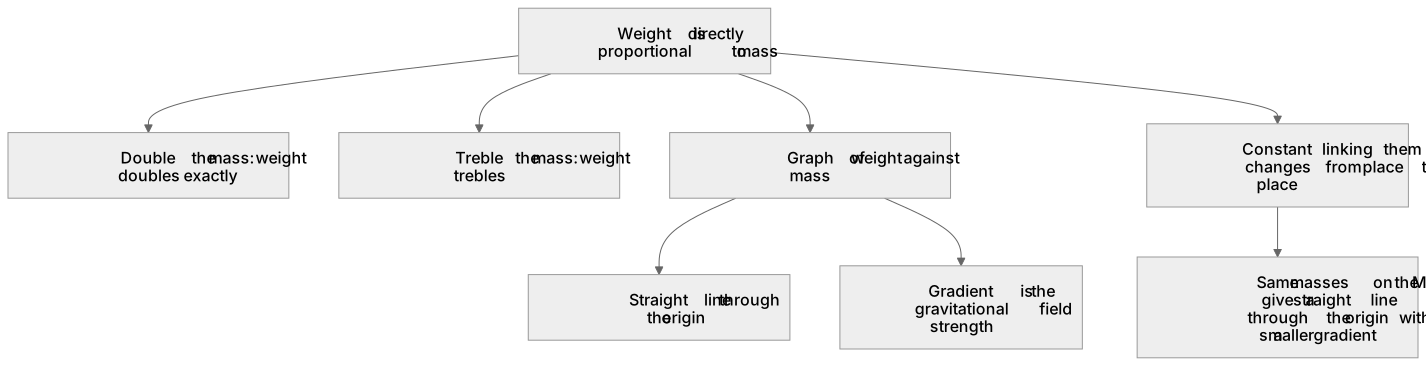
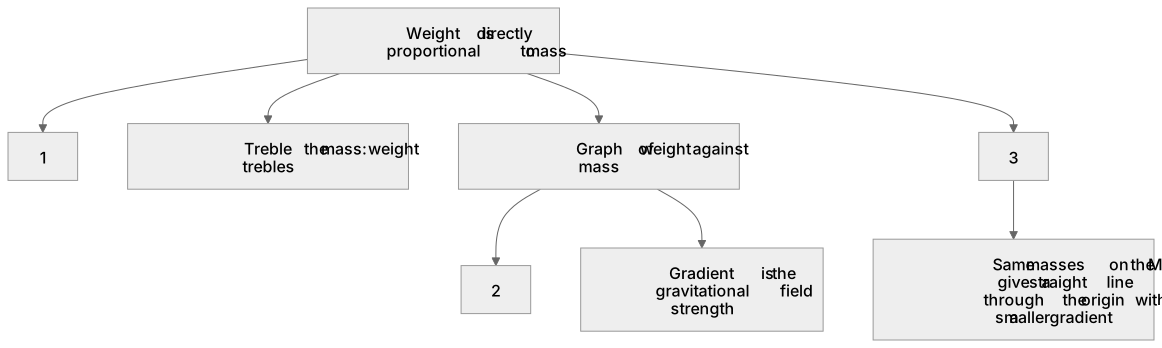
Weight is directly proportional to mass, written W ∝ m, because W = m g and g is constant at a given place. Directly proportional has a precise meaning: double the mass and the weight doubles exactly, treble it and the weight trebles. On a graph of weight against mass, this shows as a straight line that passes through the origin, and the gradient of that line is the gravitational field strength. The relationship is not the same as weight being approximately equal to mass; they are different quantities in different units, and the constant linking them changes from place to place, so the same masses plotted on the Moon give a straight line through the origin with a much smaller gradient.
What earns the marks
- Reading W ∝ m as 'weight is directly proportional to mass'.
- Recognising a graph of weight against mass as a straight line through the origin.
- Identifying the gradient of that line as the gravitational field strength.
- Using the proportionality to scale a value, such as doubling the mass to double the weight.
Common mistakes and how to put them right
Reading directly proportional as approximately equal.
Accepting a straight line that does not pass through the origin as showing proportionality.
Assuming the constant of proportionality is the same on every planet.
Treating weight and mass as the same quantity in different units.
Reading a single weight value off the graph as the gradient without dividing by the corresponding mass.
Exam tips
- In a multiple choice question, the phrase to look for is 'directly proportional to', not 'approximately equal to'.
- Check the line passes through the origin before claiming proportionality from a graph.
- Use a large triangle when finding the gradient, so the reading error is a smaller fraction of the result.
Try the lesson
The start of the Gravity: The weight of an object and the mass of an object are directly proportional. lesson, made from checked teaching notes for this specification point.
Have a go first
What is the name of the constant that relates the weight of an object to its mass?
Listen
Weight is directly proportional to mass, written W ∝ m, because W = m g and g is constant at a given place. Directly proportional has a precise meaning: double the mass and the weight doubles exactly, treble it and the weight trebles. On a graph of weight against mass, this shows as a straight line that passes through the origin, and the gradient of that line is the gravitational field strength. The relationship is not the same as weight being approximately equal to mass; they are different quantities in different units, and the constant linking them changes from place to place, so the same masses plotted on the Moon give a straight line through the origin with a much smaller gradient. A strong answer earns marks for these points. reading W ∝ m as 'weight is directly proportional to mass'. recognising a graph of weight against mass as a straight line through the origin. identifying the gradient of that line as the gravitational field strength. using the proportionality to scale a value, such as doubling the mass to double the weight. Exam tip: In a multiple choice question, the phrase to look for is 'directly proportional to', not 'approximately equal to'.
See it
Key words
Say what each word means before you turn the card.
direct proportion
Try answering aloud or in your head before turning the card.
straight line through the origin
Try answering aloud or in your head before turning the card.
gradient is g
Try answering aloud or in your head before turning the card.
scaling values
Try answering aloud or in your head before turning the card.
See every definition
- direct proportion
- A relationship in which doubling the mass doubles the weight exactly, and trebling it trebles the weight.
- straight line through the origin
- The shape of a graph of weight against mass when the two quantities are directly proportional.
- gradient is g
- The gradient of a weight against mass graph is the gravitational field strength.
- scaling values
- Using the proportionality to change a value, such as doubling the mass to double the weight.
Label the diagram
Some boxes have lost their names. Pick the right name for each number.
1Box 1
2Box 2
3Box 3
There is more to this lesson
The full lesson goes on to check your understanding and help you earn the marks. Create a free account to carry on, with your progress saved.
A week of Premium from your first lesson · Then the free plan continues · No card, no charge
Test your understanding of Gravity: The weight of an object and the mass of an object are directly proportional.
Active recall beats re-reading. Take an instant quiz now to test what you’ve learned and lock it into long-term memory.
A week of Premium from your first lesson · Then the free plan continues · No card, no charge