AQA · GCSE · Physics
Course version: 8463 · Version from Sept 2016
(HT only) Students should be able to calculate the net decline, expressed…
Full specification wording
Half-lives and the random nature of radioactive decay: (HT only) Students should be able to calculate the net decline, expressed as a ratio, in a radioactive emission after a given number of half-lives.
Higher tier only.
Checked against the AQA 8463 specification (opens in a new tab) on .
- Point 5 of 5
- 4 key terms
Study notes
From the checked teaching notes for this specification point.
The idea
Higher tier only. After n half-lives the fraction of the original emission still present is 1/2ⁿ, so the net decline is written as a ratio such as 1:16 after four half-lives. The method is always the same. Divide the starting value by the final value to get the factor the emission has fallen by, write that factor as a power of two to get the number of half-lives, then multiply by the half-life if the question wants a time. Worked example: a polonium-210 sample falls from 256 000 atoms to 16 000. The factor is 16, which is 2⁴, so four half-lives have passed; at 138 days each that is 4 × 138 = 552 days, and the net decline is 1:16. Ratios have no unit.
What earns the marks
- The number of half-lives, found by halving repeatedly or by writing the fall as a power of two.
- The net decline expressed as a ratio in the form 1:2ⁿ, such as 1:16 after four half-lives.
- Multiplying the number of half-lives by the half-life, such as 4 × 138.
- The final value with the correct unit, such as 552 days.
Common mistakes and how to put them right
Multiplying the half-life by the ratio rather than by the number of half-lives, giving 138 × 16.
Giving the ratio the wrong way round when the question asks for the decline in the emission.
Treating four half-lives as a fall to one quarter instead of one sixteenth.
Attaching a unit such as becquerels to a ratio.
Rounding the number of half-lives to a whole number when the data does not actually give a whole number of halvings.
Exam tips
- Write the halving chain, 256 000, 128 000, 64 000, 32 000, 16 000, and count the arrows; that count is the number of half-lives.
- Read whether the question wants a ratio, a fraction or a time, because the three answers look very different from the same working.
- Show the multiplication before you evaluate it, so a substitution mark is available even if the arithmetic slips.
Try the lesson
The start of the Half-lives and the random nature of radioactive decay: (HT only) Students should be able to calculate the net decline, expressed as a ratio, in a radioactive emission after a given number of half-lives. lesson, made from checked teaching notes for this specification point.
Have a go first
A radioactive source has an initial count rate of 800 counts per minute. After 3 half-lives, what is the net decline in the count rate, expressed as a ratio of the decline to the initial count rate?
Listen
Higher tier only. After n half-lives the fraction of the original emission still present is 1/2ⁿ, so the net decline is written as a ratio such as 1:16 after four half-lives. The method is always the same. Divide the starting value by the final value to get the factor the emission has fallen by, write that factor as a power of two to get the number of half-lives, then multiply by the half-life if the question wants a time. Worked example: a polonium-210 sample falls from 256 000 atoms to 16 000. The factor is 16, which is 2⁴, so four half-lives have passed; at 138 days each that is 4 × 138 = 552 days, and the net decline is 1:16. Ratios have no unit. A strong answer earns marks for these points. the number of half-lives, found by halving repeatedly or by writing the fall as a power of two. the net decline expressed as a ratio in the form 1:2ⁿ, such as 1:16 after four half-lives. multiplying the number of half-lives by the half-life, such as 4 × 138. the final value with the correct unit, such as 552 days. Exam tip: Write the halving chain, 256 000, 128 000, 64 000, 32 000, 16 000, and count the arrows; that count is the number of half-lives.
See it
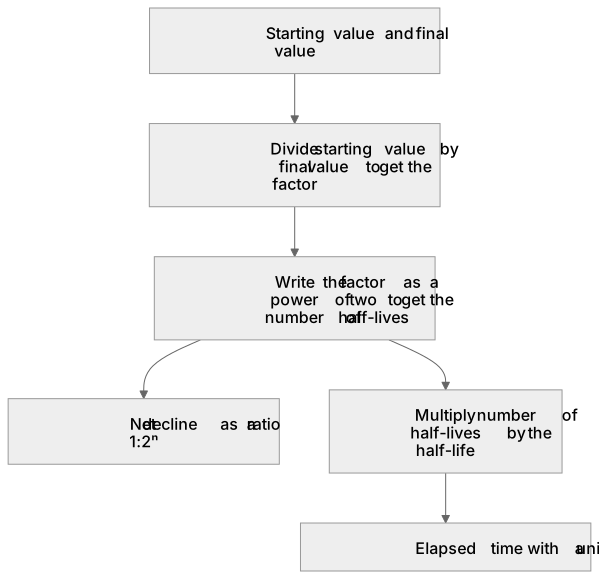
Key words
Say what each word means before you turn the card.
net decline as a ratio
Try answering aloud or in your head before turning the card.
powers of two
Try answering aloud or in your head before turning the card.
number of half-lives
Try answering aloud or in your head before turning the card.
time from half-lives
Try answering aloud or in your head before turning the card.
See every definition
- net decline as a ratio
- The fall in a radioactive emission after a given number of half-lives, written as a ratio such as 1:16 after four half-lives.
- powers of two
- The factor the emission has fallen by is written as a power of two to get the number of half-lives.
- number of half-lives
- Found by halving repeatedly or by writing the fall as a power of two.
- time from half-lives
- Worked out by multiplying the number of half-lives by the half-life, giving the final value with the correct unit.
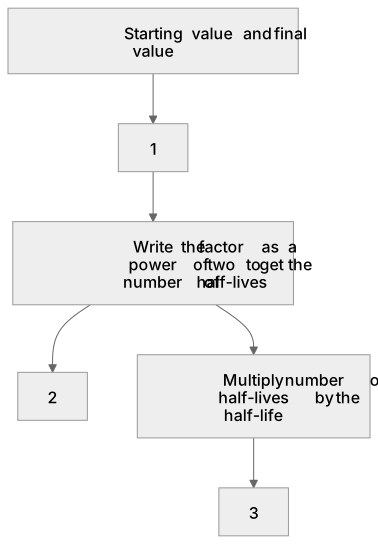
Label the diagram
Some boxes have lost their names. Pick the right name for each number.
1Box 1
2Box 2
3Box 3
There is more to this lesson
The full lesson goes on to check your understanding and help you earn the marks. Create a free account to carry on, with your progress saved.
A week of Premium from your first lesson · Then the free plan continues · No card, no charge
Test your understanding of Half-lives and the random nature of radioactive decay: (HT only) Students should be able to calculate the net decline, expressed as a ratio, in a radioactive emission after a given number of half-lives.
Active recall beats re-reading. Take an instant quiz now to test what you’ve learned and lock it into long-term memory.
A week of Premium from your first lesson · Then the free plan continues · No card, no charge