AQA · GCSE · Physics
Course version: 8463 · Version from Sept 2016
Students should be able to determine the half-life of a radioactive…
Full specification wording
Half-lives and the random nature of radioactive decay: Students should be able to determine the half-life of a radioactive isotope from given information.
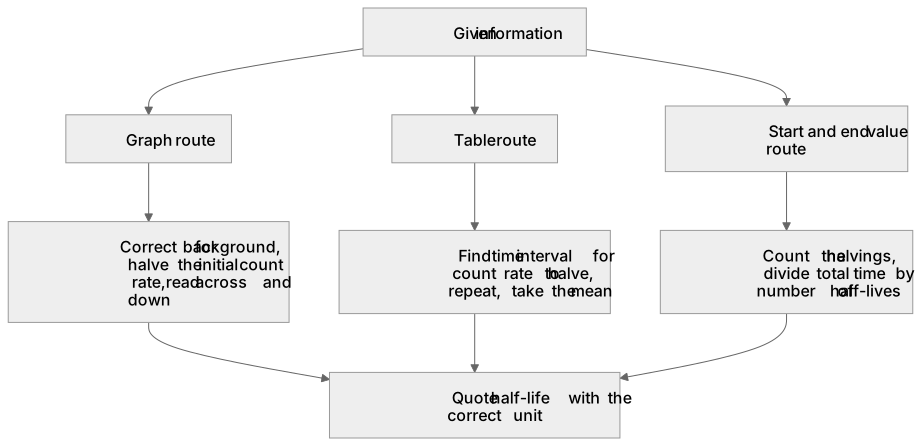
There are three routes to a half-life and the data decides which one you use.
Checked against the AQA 8463 specification (opens in a new tab) on .
- Point 4 of 5
- 4 key terms
Study notes
From the checked teaching notes for this specification point.
The idea
There are three routes to a half-life and the data decides which one you use. From a graph: correct for background, halve the initial count rate, read across to the curve and down to the time axis. From a table: find the time interval over which the count rate falls to half, do it again for a second interval and take the mean. From a start and end value: count how many halvings take you from one to the other, then divide the total time by that number. For example, 800 Bq falling to 100 Bq is three halvings, 800 to 400 to 200 to 100, so if this took 24 minutes the half-life is 8 minutes. Always check the unit on the time axis, and quote the answer in the same unit.
What earns the marks
- Halving the corrected initial count rate and reading the time for that fall.
- Counting the number of halvings between the two values given.
- Dividing the total time by the number of half-lives.
- The half-life with the correct unit taken from the data.
Common mistakes and how to put them right
Dividing the total time by the ratio of the counts, for example by 8 rather than by the 3 halvings it represents.
Using raw counts when a background count rate has been given in the question.
Reading the time at which the count rate reaches zero, which it never does.
Taking the half-life from the flat tail of the curve where the readings are least reliable.
Quoting the answer in seconds when the axis is in minutes or years.
Exam tips
- Write the halving chain out in full, such as 800, 400, 200, 100, so the number of half-lives is on the page for a method mark.
- If a background count rate is quoted anywhere in the question, subtract it from every value before you start.
- Show the reading lines you draw on a printed graph; examiners credit the construction even if the final number is slightly out.
Try the lesson
The start of the Half-lives and the random nature of radioactive decay: Students should be able to determine the half-life of a radioactive isotope from given information. lesson, made from checked teaching notes for this specification point.
Have a go first
A radioactive isotope has a corrected count rate of 800 counts per minute. After 6 hours the corrected count rate has fallen to 400 counts per minute. What is the half-life of the isotope?
Listen
There are three routes to a half-life and the data decides which one you use. From a graph: correct for background, halve the initial count rate, read across to the curve and down to the time axis. From a table: find the time interval over which the count rate falls to half, do it again for a second interval and take the mean. From a start and end value: count how many halvings take you from one to the other, then divide the total time by that number. For example, 800 Bq falling to 100 Bq is three halvings, 800 to 400 to 200 to 100, so if this took 24 minutes the half-life is 8 minutes. Always check the unit on the time axis, and quote the answer in the same unit. A strong answer earns marks for these points. halving the corrected initial count rate and reading the time for that fall. counting the number of halvings between the two values given. dividing the total time by the number of half-lives. the half-life with the correct unit taken from the data. Exam tip: Write the halving chain out in full, such as 800, 400, 200, 100, so the number of half-lives is on the page for a method mark.
See it
Key words
Say what each word means before you turn the card.
reading decay graphs
Try answering aloud or in your head before turning the card.
halving chains
Try answering aloud or in your head before turning the card.
mean of intervals
Try answering aloud or in your head before turning the card.
background correction
Try answering aloud or in your head before turning the card.
See every definition
- reading decay graphs
- Correct for background, halve the initial count rate, read across to the curve and down to the time axis.
- halving chains
- Write the chain out in full, such as 800, 400, 200, 100, so the number of half-lives is on the page.
- mean of intervals
- Find the time interval over which the count rate falls to half, do it again for a second interval and take the mean.
- background correction
- If a background count rate is quoted anywhere in the question, subtract it from every value before you start.
Label the diagram
Some boxes have lost their names. Pick the right name for each number.
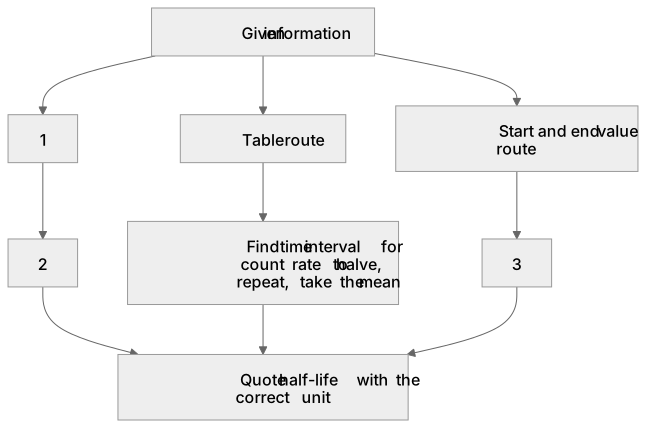
1Box 1
2Box 2
3Box 3
There is more to this lesson
The full lesson goes on to check your understanding and help you earn the marks. Create a free account to carry on, with your progress saved.
A week of Premium from your first lesson · Then the free plan continues · No card, no charge
Test your understanding of Half-lives and the random nature of radioactive decay: Students should be able to determine the half-life of a radioactive isotope from given information.
Active recall beats re-reading. Take an instant quiz now to test what you’ve learned and lock it into long-term memory.
A week of Premium from your first lesson · Then the free plan continues · No card, no charge