AQA · GCSE · Physics
Course version: 8463 · Version from Sept 2016
Students should be able to explain the concept of half-life and how it is…
Full specification wording
Half-lives and the random nature of radioactive decay: Students should be able to explain the concept of half-life and how it is related to the random nature of radioactive decay.
Half-life and randomness fit together through one idea: a constant chance of decay per nucleus per second.
Checked against the AQA 8463 specification (opens in a new tab) on .
- Point 3 of 5
- 4 key terms
Study notes
From the checked teaching notes for this specification point.
The idea
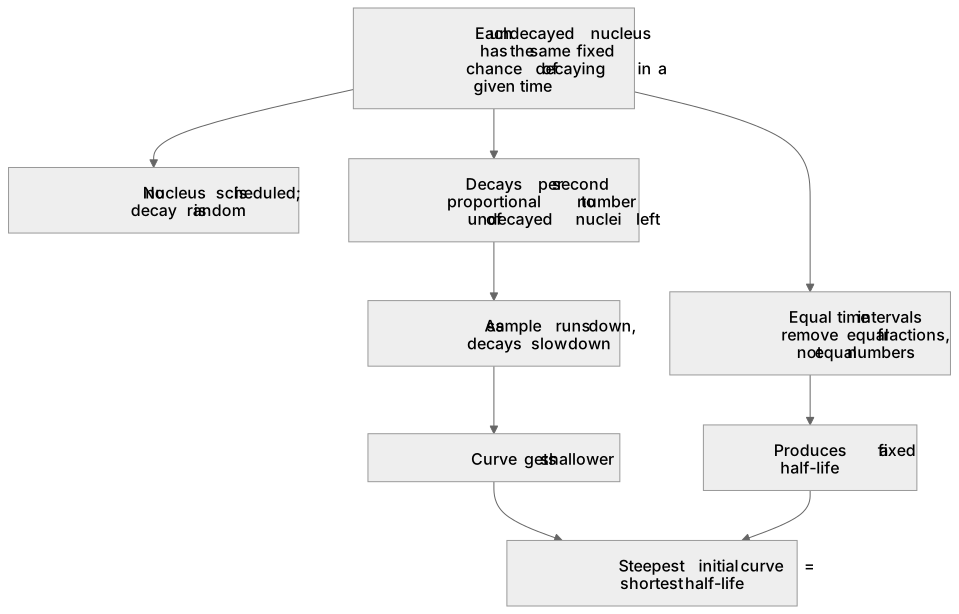
Half-life and randomness fit together through one idea: a constant chance of decay per nucleus per second. No nucleus is scheduled, but each has the same probability of going in the next interval. The number of decays per second is therefore proportional to how many undecayed nuclei are left, so as the sample runs down the decays slow down and the curve gets shallower. Equal time intervals remove equal fractions rather than equal numbers, which is exactly what produces a fixed half-life. So the behaviour of one nucleus is unpredictable while the behaviour of billions is reliable. On a graph of several isotopes, the steepest initial curve belongs to the isotope with the shortest half-life, because it decays quickest and has the smallest percentage left at any later time.
What earns the marks
- Identifying the isotope with the shortest half-life as the one whose curve is steepest at the start.
- The supporting reason, that it decays quickest or has the smallest percentage of nuclei left at any time after the start.
- Each undecayed nucleus having the same fixed chance of decaying in a given time, whatever its age.
- Linking the falling number of undecayed nuclei to the falling activity, which is why the curve flattens.
Common mistakes and how to put them right
Arguing that random decay makes the half-life unpredictable too.
Saying equal times remove equal numbers of nuclei instead of equal fractions.
Reading the steepest curve as the longest half-life.
Giving the reason without first naming the isotope, when the reason mark depends on the identification.
Explaining half-life purely as a rule to follow, with no mention of chance per nucleus.
Exam tips
- Answer in the order the mark scheme works: name the isotope, then justify it, because the second mark is usually dependent on the first.
- Use the word 'percentage' or 'fraction' when comparing curves, since the graphs are often plotted as percentage of nuclei remaining.
- Link randomness to half-life explicitly with the phrase 'constant chance of decay', which is the bridge the question is testing.
Try the lesson
The start of the Half-lives and the random nature of radioactive decay: Students should be able to explain the concept of half-life and how it is related to the random nature of radioactive decay. lesson, made from checked teaching notes for this specification point.
Have a go first
Which statement describes the half-life of a radioactive isotope?
Listen
Half-life and randomness fit together through one idea: a constant chance of decay per nucleus per second. No nucleus is scheduled, but each has the same probability of going in the next interval. The number of decays per second is therefore proportional to how many undecayed nuclei are left, so as the sample runs down the decays slow down and the curve gets shallower. Equal time intervals remove equal fractions rather than equal numbers, which is exactly what produces a fixed half-life. So the behaviour of one nucleus is unpredictable while the behaviour of billions is reliable. On a graph of several isotopes, the steepest initial curve belongs to the isotope with the shortest half-life, because it decays quickest and has the smallest percentage left at any later time. A strong answer earns marks for these points. identifying the isotope with the shortest half-life as the one whose curve is steepest at the start. the supporting reason, that it decays quickest or has the smallest percentage of nuclei left at any time after the start. each undecayed nucleus having the same fixed chance of decaying in a given time, whatever its age. linking the falling number of undecayed nuclei to the falling activity, which is why the curve flattens. Exam tip: Answer in the order the mark scheme works: name the isotope, then justify it, because the second mark is usually dependent on the first.
See it
Key words
Say what each word means before you turn the card.
constant chance of decay
Try answering aloud or in your head before turning the card.
fraction not number
Try answering aloud or in your head before turning the card.
steepest curve
Try answering aloud or in your head before turning the card.
why activity falls
Try answering aloud or in your head before turning the card.
See every definition
- constant chance of decay
- Each undecayed nucleus has the same fixed chance of decaying in a given time, whatever its age.
- fraction not number
- Equal time intervals remove equal fractions rather than equal numbers, which is exactly what produces a fixed half-life.
- steepest curve
- On a graph of several isotopes, the steepest initial curve belongs to the isotope with the shortest half-life, because it decays quickest.
- why activity falls
- The number of decays per second is proportional to how many undecayed nuclei are left, so as the sample runs down the decays slow down and the curve gets shallower.
Label the diagram
Some boxes have lost their names. Pick the right name for each number.
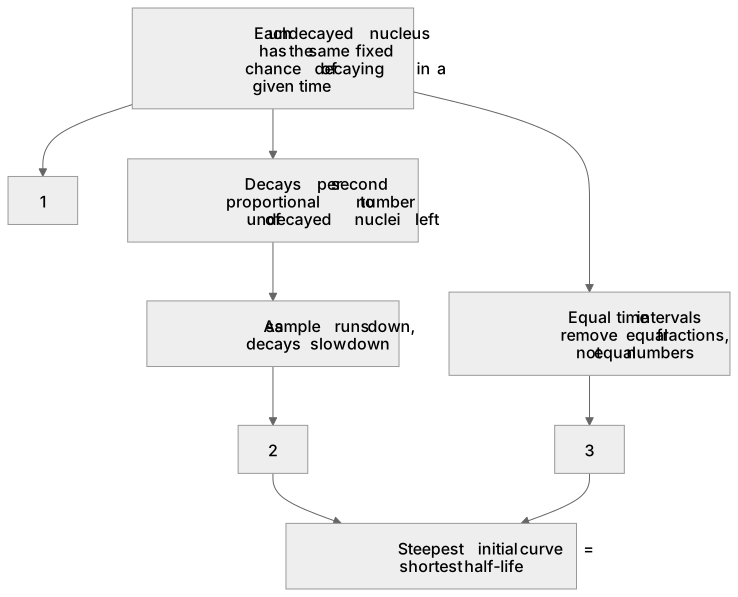
1Box 1
2Box 2
3Box 3
There is more to this lesson
The full lesson goes on to check your understanding and help you earn the marks. Create a free account to carry on, with your progress saved.
A week of Premium from your first lesson · Then the free plan continues · No card, no charge
Test your understanding of Half-lives and the random nature of radioactive decay: Students should be able to explain the concept of half-life and how it is related to the random nature of radioactive decay.
Active recall beats re-reading. Take an instant quiz now to test what you’ve learned and lock it into long-term memory.
A week of Premium from your first lesson · Then the free plan continues · No card, no charge