AQA · GCSE · Physics
Course version: 8463 · Version from Sept 2016
Students should be able to explain how, in a given situation eg a bicycle…
Full specification wording
Increasing the pressure of a gas (physics only) (HT only): Students should be able to explain how, in a given situation eg a bicycle pump, doing work on an enclosed gas leads to an increase in the temperature of the gas.
In a bicycle pump the air is enclosed by the valve and the piston.
Checked against the AQA 8463 specification (opens in a new tab) on .
- Point 3 of 3
Study notes
From the checked teaching notes for this specification point.
The idea
In a bicycle pump the air is enclosed by the valve and the piston. Pushing the handle applies a force to the piston that moves through a distance, so work is done on the air. That energy is transferred to the internal energy store of the gas, the mean kinetic energy of its molecules rises, and its temperature goes up, which is why the barrel becomes noticeably warm after a few strokes. The same physics drives a fire piston, where air compressed rapidly gets hot enough to ignite tinder, and a diesel engine, which needs no spark plug. Friction between piston and barrel adds a little warming, but it is not the main effect and on its own it does not earn the marks.
What earns the marks
- Identifying a force applied to the piston that moves through a distance, so work is done on the enclosed gas.
- Stating that the energy transferred increases the internal energy of the gas.
- Stating that the mean kinetic energy of the gas molecules increases.
- Concluding that the temperature of the gas, and so of the pump, rises.
Common mistakes and how to put them right
Explaining the warm pump entirely by friction between the piston and the barrel.
Saying the gas gets hot because the molecules are squashed closer together.
Treating the rise in pressure as though it were itself the rise in temperature.
Omitting the phrase work is done, which is usually the first marking point.
Exam tips
- Name the force and say it moves through a distance; that is what turns a description into an explanation of work.
- Mention the gas is enclosed, so the energy transferred stays in the gas rather than escaping with it.
- Use the same four-step chain for any context the examiner invents, from a fire piston to a diesel engine.
Try the lesson
The start of the Increasing the pressure of a gas (physics only) (HT only): Students should be able to explain how, in a given situation eg a bicycle pump, doing work on an enclosed gas leads to an increase in the temperature of the gas. lesson, made from checked teaching notes for this specification point.
Have a go first
A cyclist pushes down the handle of a bicycle pump, compressing the air inside. The air is trapped and no air escapes. Explain why the temperature of the trapped air increases.
Listen
In a bicycle pump the air is enclosed by the valve and the piston. Pushing the handle applies a force to the piston that moves through a distance, so work is done on the air. That energy is transferred to the internal energy store of the gas, the mean kinetic energy of its molecules rises, and its temperature goes up, which is why the barrel becomes noticeably warm after a few strokes. The same physics drives a fire piston, where air compressed rapidly gets hot enough to ignite tinder, and a diesel engine, which needs no spark plug. Friction between piston and barrel adds a little warming, but it is not the main effect and on its own it does not earn the marks. A strong answer earns marks for these points. identifying a force applied to the piston that moves through a distance, so work is done on the enclosed gas. stating that the energy transferred increases the internal energy of the gas. stating that the mean kinetic energy of the gas molecules increases. concluding that the temperature of the gas, and so of the pump, rises. Exam tip: Name the force and say it moves through a distance; that is what turns a description into an explanation of work.
See it
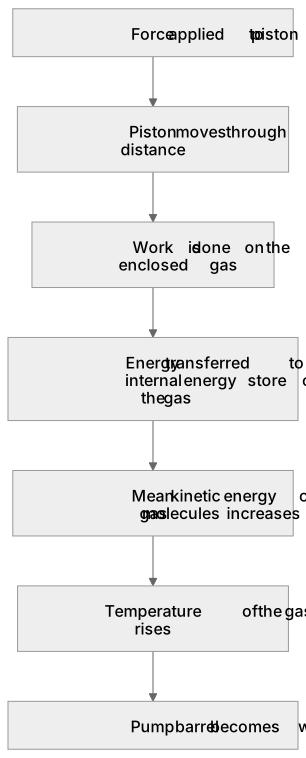
Put it in order
Put these steps in the order they happen.
- 1. Pump barrel becomes warm
- 2. Temperature of the gas rises
- 3. Work is done on the enclosed gas
- 4. Mean kinetic energy of gas molecules increases
- 5. Force applied to piston
- 6. Piston moves through a distance
- 7. Energy transferred to internal energy store of the gas
Label the diagram
Some boxes have lost their names. Pick the right name for each number.
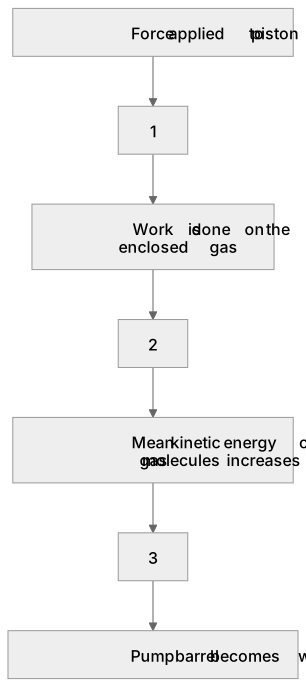
1Box 1
2Box 2
3Box 3
There is more to this lesson
The full lesson goes on to check your understanding and help you earn the marks. Create a free account to carry on, with your progress saved.
A week of Premium from your first lesson · Then the free plan continues · No card, no charge
Test your understanding of Increasing the pressure of a gas (physics only) (HT only): Students should be able to explain how, in a given situation eg a bicycle pump, doing work on an enclosed gas leads to an increase in the temperature of the gas.
Active recall beats re-reading. Take an instant quiz now to test what you’ve learned and lock it into long-term memory.
A week of Premium from your first lesson · Then the free plan continues · No card, no charge