AQA · GCSE · Physics
Course version: 8463 · Version from Sept 2016
Doing work on a gas increases the internal energy of the gas and can cause…
Full specification wording
Increasing the pressure of a gas (physics only) (HT only): Doing work on a gas increases the internal energy of the gas and can cause an increase in the temperature of the gas.
Internal energy is the total kinetic energy plus the total potential energy of all the particles in a system.
Checked against the AQA 8463 specification (opens in a new tab) on .
- Point 2 of 3
Study notes
From the checked teaching notes for this specification point.
The idea
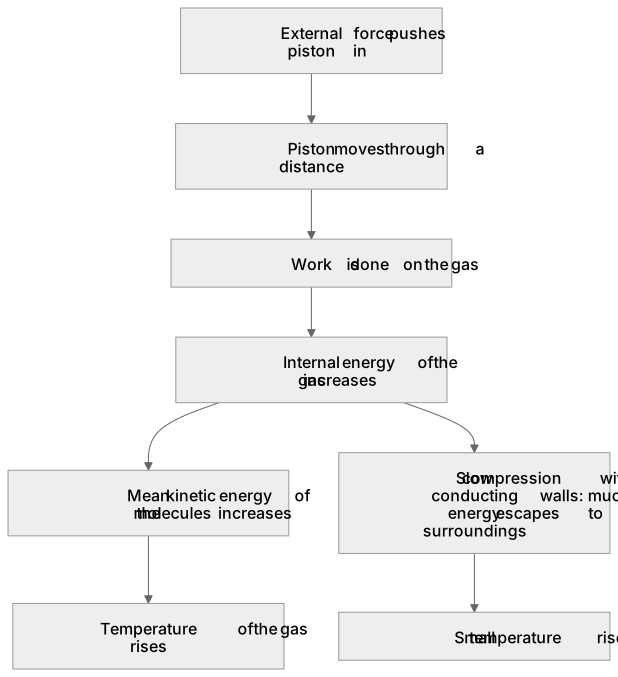
Internal energy is the total kinetic energy plus the total potential energy of all the particles in a system. When an external force pushes a piston in, it moves through a distance, so work is done on the gas and energy is transferred into that internal energy store. Molecules rebounding from an inward-moving piston come away faster, so the mean kinetic energy of the molecules rises, and since temperature is a measure of mean kinetic energy, the gas gets hotter. Nothing was heated: the energy came in mechanically. If the compression is slow and the walls conduct well, much of that energy escapes to the surroundings and the temperature rise is small, which is why fast compressions feel hottest.
What earns the marks
- Stating that the force compressing the gas moves through a distance, so work is done on the gas.
- Stating that the internal energy of the gas increases.
- Stating that the mean kinetic energy of the molecules increases.
- Linking the increase in mean kinetic energy to a rise in the temperature of the gas.
Common mistakes and how to put them right
Saying the gas gains heat from the pump, when the energy is transferred by doing work.
Attributing the whole temperature rise to friction between the piston and the barrel.
Treating internal energy and temperature as the same quantity.
Claiming energy is created by squashing the gas.
Exam tips
- Define internal energy as the total kinetic and potential energy of the particles if a question asks what it is.
- Set your answer out as a chain: work done, internal energy up, mean kinetic energy up, temperature up.
- Only the kinetic part of the internal energy changes here, because the gas stays a gas.
Try the lesson
The start of the Increasing the pressure of a gas (physics only) (HT only): Doing work on a gas increases the internal energy of the gas and can cause an increase in the temperature of the gas. lesson, made from checked teaching notes for this specification point.
Have a go first
A bicycle pump is pushed in quickly, compressing the air inside. What happens to the internal energy of the air and why?
Listen
Internal energy is the total kinetic energy plus the total potential energy of all the particles in a system. When an external force pushes a piston in, it moves through a distance, so work is done on the gas and energy is transferred into that internal energy store. Molecules rebounding from an inward-moving piston come away faster, so the mean kinetic energy of the molecules rises, and since temperature is a measure of mean kinetic energy, the gas gets hotter. Nothing was heated: the energy came in mechanically. If the compression is slow and the walls conduct well, much of that energy escapes to the surroundings and the temperature rise is small, which is why fast compressions feel hottest. A strong answer earns marks for these points. stating that the force compressing the gas moves through a distance, so work is done on the gas. stating that the internal energy of the gas increases. stating that the mean kinetic energy of the molecules increases. linking the increase in mean kinetic energy to a rise in the temperature of the gas. Exam tip: Define internal energy as the total kinetic and potential energy of the particles if a question asks what it is.
See it
Label the diagram
Some boxes have lost their names. Pick the right name for each number.
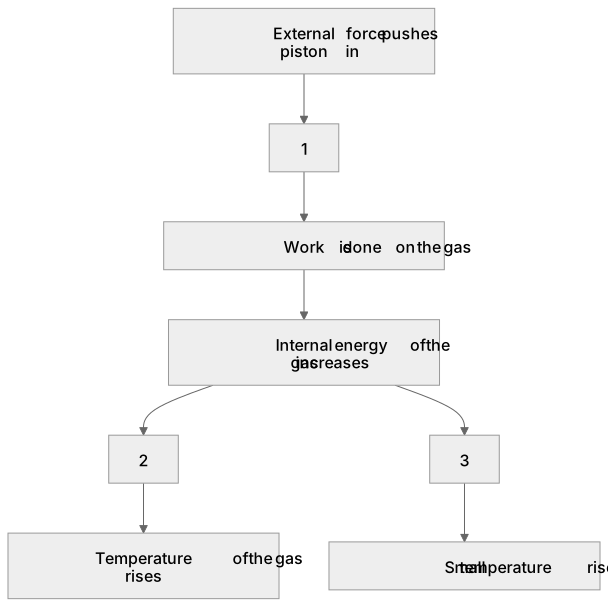
1Box 1
2Box 2
3Box 3
There is more to this lesson
The full lesson goes on to check your understanding and help you earn the marks. Create a free account to carry on, with your progress saved.
A week of Premium from your first lesson · Then the free plan continues · No card, no charge
Test your understanding of Increasing the pressure of a gas (physics only) (HT only): Doing work on a gas increases the internal energy of the gas and can cause an increase in the temperature of the gas.
Active recall beats re-reading. Take an instant quiz now to test what you’ve learned and lock it into long-term memory.
A week of Premium from your first lesson · Then the free plan continues · No card, no charge