AQA · GCSE · Physics
Course version: 8463 · Version from Sept 2016
Work is the transfer of energy by a force.
Full specification wording
Increasing the pressure of a gas (physics only) (HT only): Work is the transfer of energy by a force.
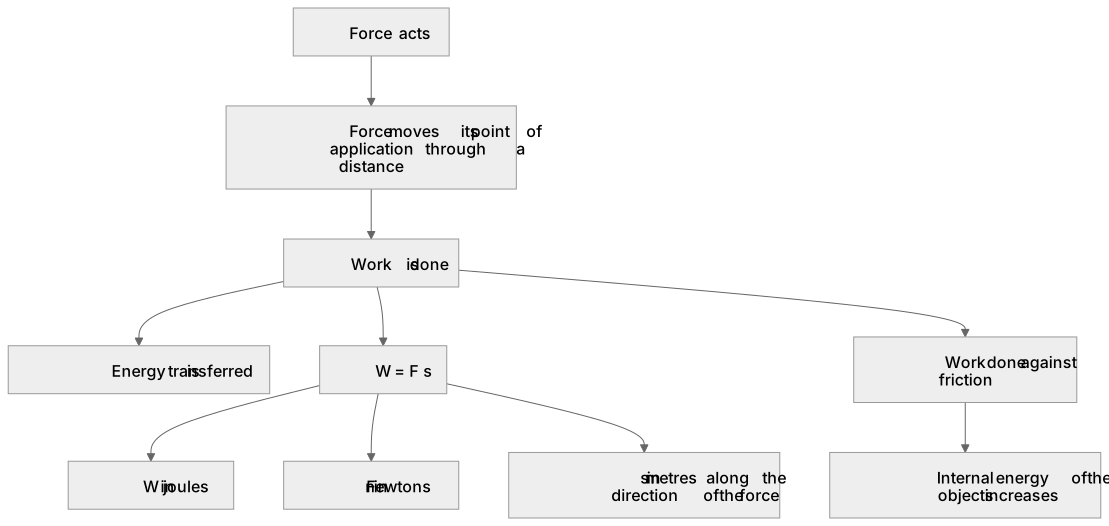
Work done is energy transferred by a force moving its point of application through a distance, W = F s, with W in joules, F in newtons and s in metres measured along the direction of the force.
Checked against the AQA 8463 specification (opens in a new tab) on .
- Point 1 of 3
- 4 key terms
Study notes
From the checked teaching notes for this specification point.
The idea
Work done is energy transferred by a force moving its point of application through a distance, W = F s, with W in joules, F in newtons and s in metres measured along the direction of the force. One joule is the energy transferred when a force of one newton moves an object one metre. Naming a force is not enough for an explanation: energy only moves when that force acts through a distance. Pushing a syringe plunger in does work on the gas inside it. Braking does work against friction and raises the internal energy of the brakes, which is why examiners refuse answers that simply say friction and stop there.
What earns the marks
- Work done = force × distance moved along the line of action of the force.
- Stating that one joule is transferred when a force of one newton moves through one metre.
- Identifying the force that does the work in the situation described, such as the piston pushing on the gas.
- Stating that work done against friction increases the internal energy of the objects, rather than simply naming friction.
Common mistakes and how to put them right
Writing that friction causes heating without saying that work is done.
Using the total path length rather than the distance moved in the direction of the force.
Treating work and power as the same quantity.
Giving work done in watts instead of joules.
Exam tips
- Use the phrase work is done in any explanation about heating by compression or by friction; it is often the marking point.
- Quote W = F s and name the force and the distance separately when you are asked to explain rather than calculate.
- Remember that energy transferred and work done are the same quantity, so the unit is always the joule.
Try the lesson
The start of the Increasing the pressure of a gas (physics only) (HT only): Work is the transfer of energy by a force. lesson, made from checked teaching notes for this specification point.
Have a go first
A person uses a hand pump to compress the air inside a bicycle tyre. They apply a downward force of 50 N to move the pump handle a distance of 0.20 m. How much energy is transferred to the gas by this force?
Listen
Work done is energy transferred by a force moving its point of application through a distance, W = F s, with W in joules, F in newtons and s in metres measured along the direction of the force. One joule is the energy transferred when a force of one newton moves an object one metre. Naming a force is not enough for an explanation: energy only moves when that force acts through a distance. Pushing a syringe plunger in does work on the gas inside it. Braking does work against friction and raises the internal energy of the brakes, which is why examiners refuse answers that simply say friction and stop there. A strong answer earns marks for these points. work done = force × distance moved along the line of action of the force. stating that one joule is transferred when a force of one newton moves through one metre. identifying the force that does the work in the situation described, such as the piston pushing on the gas. stating that work done against friction increases the internal energy of the objects, rather than simply naming friction. Exam tip: Use the phrase work is done in any explanation about heating by compression or by friction; it is often the marking point.
See it
Key words
Say what each word means before you turn the card.
work done
Try answering aloud or in your head before turning the card.
W = F s
Try answering aloud or in your head before turning the card.
the joule
Try answering aloud or in your head before turning the card.
friction and internal energy
Try answering aloud or in your head before turning the card.
See every definition
- work done
- The transfer of energy by a force moving its point of application through a distance.
- W = F s
- The equation linking work done, force and distance, with W in joules, F in newtons and s in metres measured along the direction of the force.
- the joule
- The energy transferred when a force of one newton moves an object one metre.
- friction and internal energy
- Work done against friction raises the internal energy of the objects, so naming friction alone is not enough.
Label the diagram
Some boxes have lost their names. Pick the right name for each number.
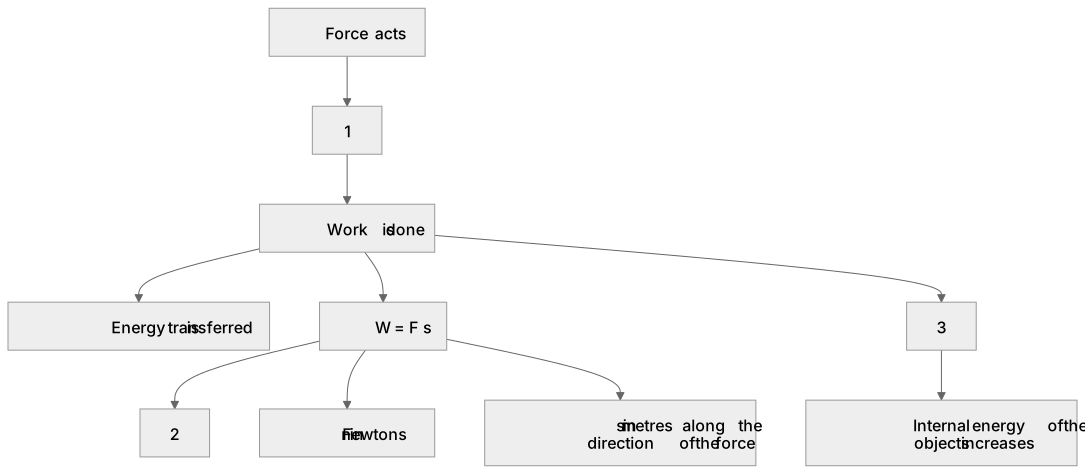
1Box 1
2Box 2
3Box 3
There is more to this lesson
The full lesson goes on to check your understanding and help you earn the marks. Create a free account to carry on, with your progress saved.
A week of Premium from your first lesson · Then the free plan continues · No card, no charge
Test your understanding of Increasing the pressure of a gas (physics only) (HT only): Work is the transfer of energy by a force.
Active recall beats re-reading. Take an instant quiz now to test what you’ve learned and lock it into long-term memory.
A week of Premium from your first lesson · Then the free plan continues · No card, no charge