AQA · GCSE · Physics
Course version: 8463 · Version from Sept 2016
An induced current generates a magnetic field that opposes the original…
Full specification wording
Induced potential (HT only): An induced current generates a magnetic field that opposes the original change, either the movement of the conductor or the change in magnetic field.
An induced current is not free.
Checked against the AQA 8463 specification (opens in a new tab) on .
- Point 4 of 7
- 4 key terms
Study notes
From the checked teaching notes for this specification point.
The idea
An induced current is not free. It makes a magnetic field of its own, and that field always opposes whatever caused it, so pushing a north pole into a coil makes the near end of the coil behave as a north pole and push back. You must do work against that opposition, and it is the work you do that ends up as electrical energy in the circuit. The neatest exam version is a dynamo with a lamp. With the lamp connected there is an induced current, that current produces a magnetic field, and that field opposes the movement of the coil, so the handle is hard to turn. Disconnect the lamp and the circuit is broken, so there is no current, no field produced by the coil and no opposing force, and the dynamo spins easily. Energy is conserved either way.
What earns the marks
- The induced current producing a magnetic field of its own.
- That field opposing the change that produced it, whether a movement or a change in field.
- The resulting force opposing the motion of the conductor.
- Linking the extra work done against that force to the electrical energy generated.
Common mistakes and how to put them right
Saying the induced field helps the motion along, which would make energy out of nothing.
Explaining that a disconnected dynamo spins easily by friction, rather than by there being no induced current.
Saying no potential difference is induced when the lamp is removed, when only the current stops.
Forgetting that the opposition applies to a changing field as well as to a moving conductor.
Exam tips
- A question phrased explain why it is harder to turn is always this idea; name the current, its field and the opposing force.
- Use conservation of energy as a check: a generator must be hard to turn, or you would be making energy for free.
- Keep to the order current, field, force, opposition, because each step tends to carry a mark.
Try the lesson
The start of the Induced potential (HT only): An induced current generates a magnetic field that opposes the original change, either the movement of the conductor or the change in magnetic field. lesson, made from checked teaching notes for this specification point.
Have a go first
A bar magnet is pushed north pole first into a coil connected to a sensitive ammeter. The ammeter shows a current. Which statement describes the magnetic field produced by this induced current?
Listen
An induced current is not free. It makes a magnetic field of its own, and that field always opposes whatever caused it, so pushing a north pole into a coil makes the near end of the coil behave as a north pole and push back. You must do work against that opposition, and it is the work you do that ends up as electrical energy in the circuit. The neatest exam version is a dynamo with a lamp. With the lamp connected there is an induced current, that current produces a magnetic field, and that field opposes the movement of the coil, so the handle is hard to turn. Disconnect the lamp and the circuit is broken, so there is no current, no field produced by the coil and no opposing force, and the dynamo spins easily. Energy is conserved either way. A strong answer earns marks for these points. the induced current producing a magnetic field of its own. that field opposing the change that produced it, whether a movement or a change in field. the resulting force opposing the motion of the conductor. linking the extra work done against that force to the electrical energy generated. Exam tip: A question phrased explain why it is harder to turn is always this idea; name the current, its field and the opposing force.
See it
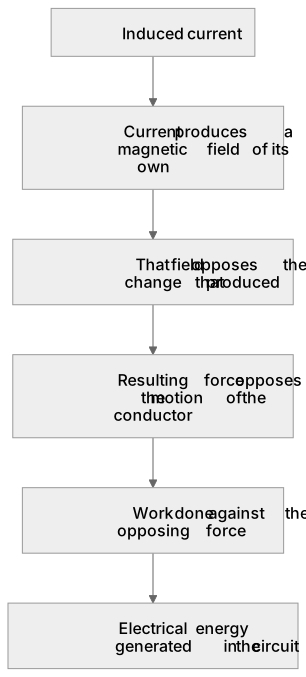
Put it in order
Put these steps in the order they happen.
- 1. That field opposes the change that produced it
- 2. Current produces a magnetic field of its own
- 3. Induced current
- 4. Electrical energy generated in the circuit
- 5. Work done against the opposing force
- 6. Resulting force opposes the motion of the conductor
Key words
Say what each word means before you turn the card.
opposing the change
Try answering aloud or in your head before turning the card.
field of the induced current
Try answering aloud or in your head before turning the card.
work done against the force
Try answering aloud or in your head before turning the card.
conservation of energy
Try answering aloud or in your head before turning the card.
See every definition
- opposing the change
- An induced current generates a magnetic field that opposes the original change, either the movement of the conductor or the change in magnetic field.
- field of the induced current
- The induced current makes a magnetic field of its own, and that field always opposes whatever caused it.
- work done against the force
- You must do work against the opposition, and it is the work you do that ends up as electrical energy in the circuit.
- conservation of energy
- Energy is conserved either way, and a generator must be hard to turn or you would be making energy for free.
Label the diagram
Some boxes have lost their names. Pick the right name for each number.
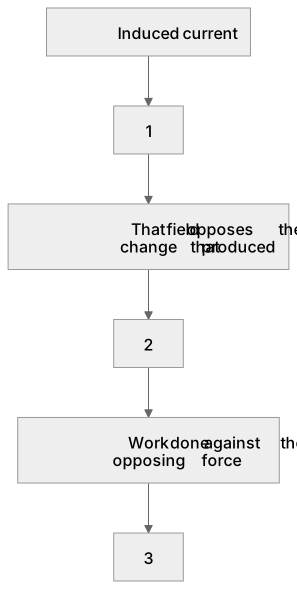
1Box 1
2Box 2
3Box 3
There is more to this lesson
The full lesson goes on to check your understanding and help you earn the marks. Create a free account to carry on, with your progress saved.
A week of Premium from your first lesson · Then the free plan continues · No card, no charge
Test your understanding of Induced potential (HT only): An induced current generates a magnetic field that opposes the original change, either the movement of the conductor or the change in magnetic field.
Active recall beats re-reading. Take an instant quiz now to test what you’ve learned and lock it into long-term memory.
A week of Premium from your first lesson · Then the free plan continues · No card, no charge