AQA · GCSE · Physics
Course version: 8463 · Version from Sept 2016
Students should be able to recall the factors that affect the size of the…
Full specification wording
Induced potential (HT only): Students should be able to recall the factors that affect the size of the induced potential difference/induced current.
Three things set the size of what you induce, and all three are the same idea in different clothes: how fast field lines are being cut.
Checked against the AQA 8463 specification (opens in a new tab) on .
- Point 5 of 7
- 4 key terms
Study notes
From the checked teaching notes for this specification point.
The idea
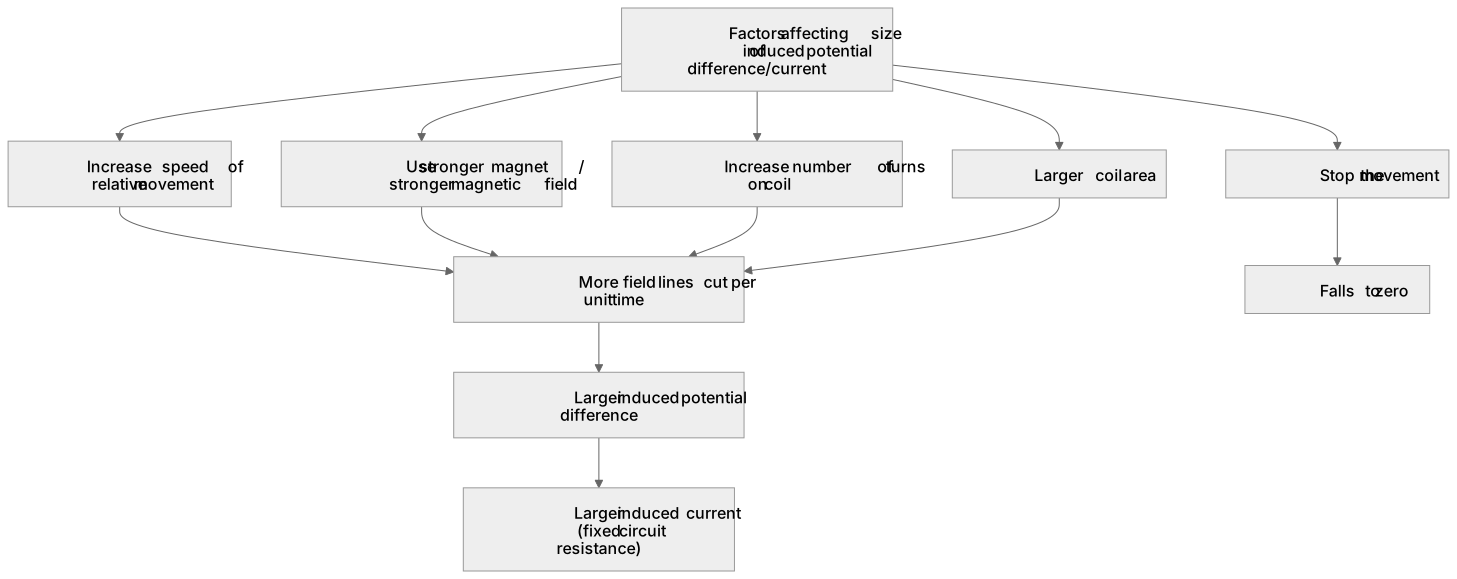
Three things set the size of what you induce, and all three are the same idea in different clothes: how fast field lines are being cut. Move the magnet or the coil faster and the induced potential difference rises. Use a stronger magnet, so there are more field lines to cut in the same space, and it rises. Wind more turns onto the coil, so each field line is cut once per turn, and it rises again; a larger coil area does the same. Stop the movement and it falls to zero, which is why a generator has to keep turning. The induced current follows the induced potential difference, so anything that increases one increases the other, provided the resistance of the circuit stays the same.
What earns the marks
- Increasing the speed of the relative movement, or the rate at which the field changes.
- Using a stronger magnet or a stronger magnetic field.
- Increasing the number of turns on the coil.
- Stating that the induced current rises with the induced potential difference for a fixed circuit resistance.
Common mistakes and how to put them right
Writing a bigger magnet when what matters is a stronger field.
Suggesting that reversing the direction of movement makes the induced potential difference larger, when it only reverses it.
Quoting the number of turns on a transformer primary in an answer about a magnet moved into a coil.
Saying that holding the magnet inside the coil keeps a steady reading, when a stationary magnet induces nothing.
Exam tips
- Give each factor a direction of change: write increase the speed, not just the speed.
- If a graph is supplied, read off two points and quote the numbers when you describe the effect.
- In a described experiment, change one variable at a time and say what you kept the same.
Try the lesson
The start of the Induced potential (HT only): Students should be able to recall the factors that affect the size of the induced potential difference/induced current. lesson, made from checked teaching notes for this specification point.
Have a go first
A student moves a bar magnet into a coil of wire connected to a voltmeter. Which change would increase the size of the induced potential difference?
Listen
Three things set the size of what you induce, and all three are the same idea in different clothes: how fast field lines are being cut. Move the magnet or the coil faster and the induced potential difference rises. Use a stronger magnet, so there are more field lines to cut in the same space, and it rises. Wind more turns onto the coil, so each field line is cut once per turn, and it rises again; a larger coil area does the same. Stop the movement and it falls to zero, which is why a generator has to keep turning. The induced current follows the induced potential difference, so anything that increases one increases the other, provided the resistance of the circuit stays the same. A strong answer earns marks for these points. increasing the speed of the relative movement, or the rate at which the field changes. using a stronger magnet or a stronger magnetic field. increasing the number of turns on the coil. stating that the induced current rises with the induced potential difference for a fixed circuit resistance. Exam tip: Give each factor a direction of change: write increase the speed, not just the speed.
See it
Key words
Say what each word means before you turn the card.
rate of cutting field lines
Try answering aloud or in your head before turning the card.
speed of movement
Try answering aloud or in your head before turning the card.
strength of the field
Try answering aloud or in your head before turning the card.
number of turns
Try answering aloud or in your head before turning the card.
See every definition
- rate of cutting field lines
- How fast field lines are being cut, which sets the size of what you induce.
- speed of movement
- Moving the magnet or the coil faster raises the induced potential difference.
- strength of the field
- A stronger magnet gives more field lines to cut in the same space, so the induced potential difference rises.
- number of turns
- Winding more turns onto the coil means each field line is cut once per turn, so the induced potential difference rises again.
Label the diagram
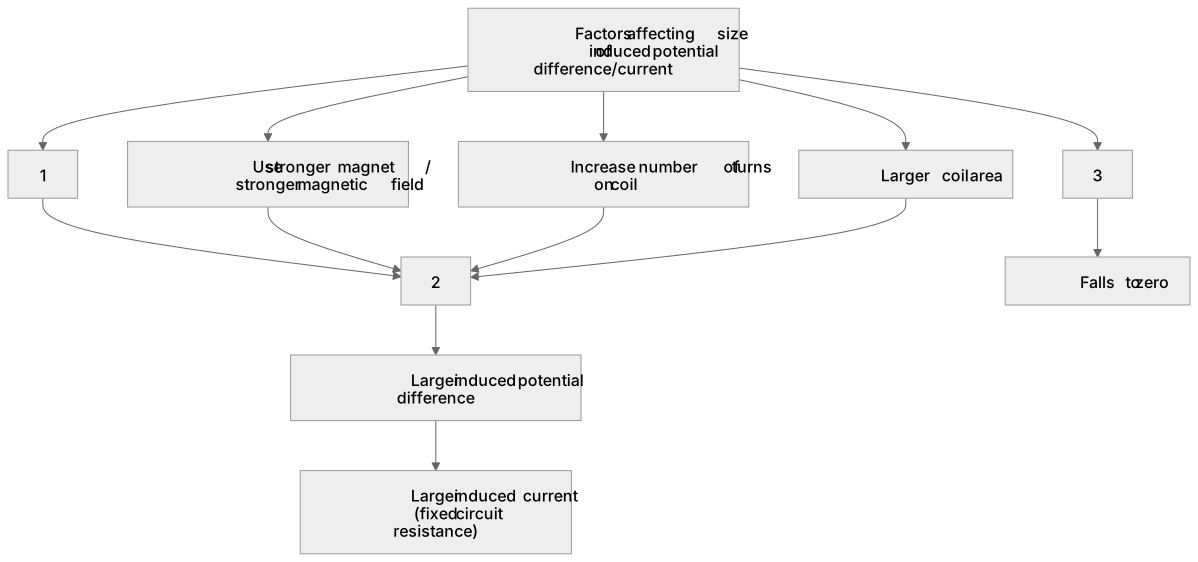
Some boxes have lost their names. Pick the right name for each number.
1Box 1
2Box 2
3Box 3
There is more to this lesson
The full lesson goes on to check your understanding and help you earn the marks. Create a free account to carry on, with your progress saved.
A week of Premium from your first lesson · Then the free plan continues · No card, no charge
Test your understanding of Induced potential (HT only): Students should be able to recall the factors that affect the size of the induced potential difference/induced current.
Active recall beats re-reading. Take an instant quiz now to test what you’ve learned and lock it into long-term memory.
A week of Premium from your first lesson · Then the free plan continues · No card, no charge