AQA · GCSE · Physics
Course version: 8463 · Version from Sept 2016
If an electrical conductor moves relative to a magnetic field or if there…
Full specification wording
Induced potential (HT only): If an electrical conductor moves relative to a magnetic field or if there is a change in the magnetic field around a conductor, a potential difference is induced across the ends of the conductor.
There are two ways to get a potential difference for nothing: move a conductor across a magnetic field, or hold the conductor still and change the field around it.
Checked against the AQA 8463 specification (opens in a new tab) on .
- Point 1 of 7
Study notes
From the checked teaching notes for this specification point.
The idea
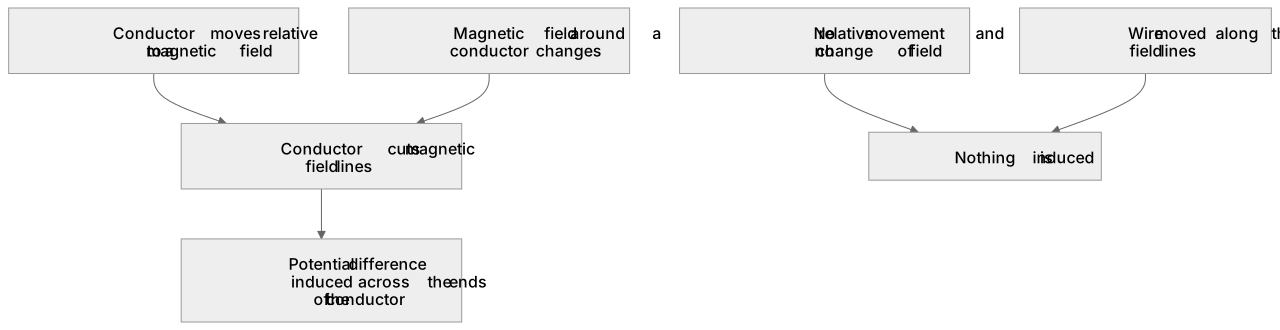
There are two ways to get a potential difference for nothing: move a conductor across a magnetic field, or hold the conductor still and change the field around it. Both amount to the same thing, the conductor cutting magnetic field lines. Push a wire down between the poles of a magnet and a potential difference appears across its ends; hold it still and the reading drops to zero, because nothing is being cut. Move the wire along the field lines rather than across them and again nothing is induced. A coil carrying an alternating current does the second job with nothing moving at all: its field grows, collapses and reverses, and any conductor sitting in that changing field has a potential difference induced across it. The word induced matters, because nothing is connected to the conductor.
What earns the marks
- The conductor and the magnetic field moving relative to one another, or for the field around the conductor changing.
- The conductor cutting magnetic field lines.
- A potential difference being induced across the ends of the conductor.
- Stating that with no relative movement and no change of field, nothing is induced.
Common mistakes and how to put them right
Saying a current is induced when the circuit is open, since only a potential difference appears until the circuit is complete.
Moving the wire along the field lines and still expecting a reading, when no field lines are being cut.
Describing a steady magnetic field near a stationary coil as inducing a potential difference.
Writing that the magnet gives the wire charge, rather than that a potential difference is induced.
Exam tips
- Look for the word change; if nothing about the field or the position changes, nothing is induced.
- State clearly which is moving, the conductor or the magnet, because only the relative motion matters.
- Use the phrase a potential difference is induced across the ends, which is the wording the mark scheme prints.
Try the lesson
The start of the Induced potential (HT only): If an electrical conductor moves relative to a magnetic field or if there is a change in the magnetic field around a conductor, a potential difference is induced across the ends of the conductor. lesson, made from checked teaching notes for this specification point.
Have a go first
A straight metal rod is moved through a uniform magnetic field. The rod is not connected to any other components. What is the electrical effect of this motion?
Listen
There are two ways to get a potential difference for nothing: move a conductor across a magnetic field, or hold the conductor still and change the field around it. Both amount to the same thing, the conductor cutting magnetic field lines. Push a wire down between the poles of a magnet and a potential difference appears across its ends; hold it still and the reading drops to zero, because nothing is being cut. Move the wire along the field lines rather than across them and again nothing is induced. A coil carrying an alternating current does the second job with nothing moving at all: its field grows, collapses and reverses, and any conductor sitting in that changing field has a potential difference induced across it. The word induced matters, because nothing is connected to the conductor. A strong answer earns marks for these points. the conductor and the magnetic field moving relative to one another, or for the field around the conductor changing. the conductor cutting magnetic field lines. a potential difference being induced across the ends of the conductor. stating that with no relative movement and no change of field, nothing is induced. Exam tip: Look for the word change; if nothing about the field or the position changes, nothing is induced.
See it
Label the diagram
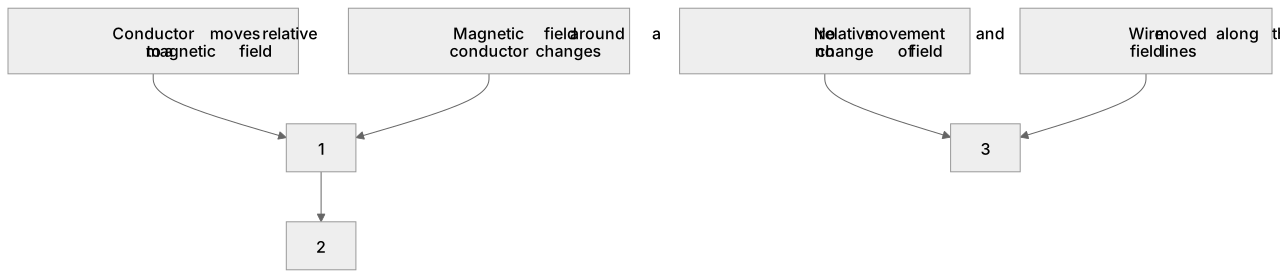
Some boxes have lost their names. Pick the right name for each number.
1Box 1
2Box 2
3Box 3
There is more to this lesson
The full lesson goes on to check your understanding and help you earn the marks. Create a free account to carry on, with your progress saved.
A week of Premium from your first lesson · Then the free plan continues · No card, no charge
Test your understanding of Induced potential (HT only): If an electrical conductor moves relative to a magnetic field or if there is a change in the magnetic field around a conductor, a potential difference is induced across the ends of the conductor.
Active recall beats re-reading. Take an instant quiz now to test what you’ve learned and lock it into long-term memory.
A week of Premium from your first lesson · Then the free plan continues · No card, no charge