AQA · GCSE · Physics
Course version: 8463 · Version from Sept 2016
If the conductor is part of a complete circuit, a current is induced in…
Full specification wording
Induced potential (HT only): If the conductor is part of a complete circuit, a current is induced in the conductor.
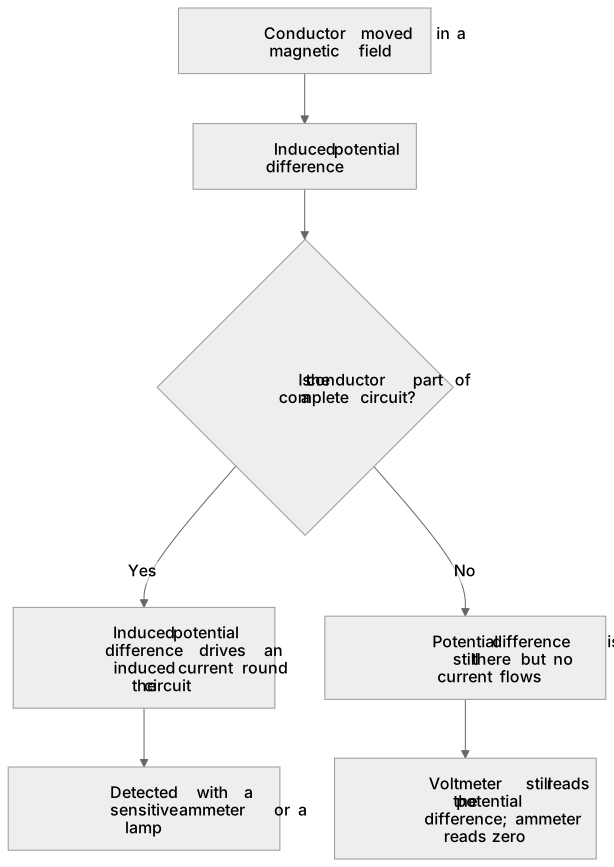
An induced potential difference is a push; a current only flows if there is somewhere for the charge to go.
Checked against the AQA 8463 specification (opens in a new tab) on .
- Point 2 of 7
Study notes
From the checked teaching notes for this specification point.
The idea
An induced potential difference is a push; a current only flows if there is somewhere for the charge to go. Connect the ends of the moving conductor into a complete loop, through a sensitive ammeter, a lamp or a resistor, and the induced potential difference drives a current round it. Break the loop and the potential difference is still there, and a voltmeter will still read it, but the ammeter reads zero. That distinction earns marks, because questions ask what is induced and the right answer depends on whether the circuit is closed. It also explains a familiar observation: a dynamo is easy to spin with nothing plugged into it and much harder once a lamp is connected, because only then is there an induced current to oppose the movement.
What earns the marks
- The conductor being part of a complete circuit.
- The induced potential difference driving an induced current round that circuit.
- Stating that an open circuit gives a potential difference but no current.
- A suitable way of detecting the current, such as a sensitive ammeter or a lamp.
Common mistakes and how to put them right
Using induced current and induced potential difference as though they meant the same thing.
Claiming a current flows when the ends of the conductor are not joined.
Reading a diagram with a break in the circuit and still answering that a current is induced.
Saying the magnet supplies the current, when the source is the induced potential difference.
Exam tips
- Check the diagram for a break in the circuit before deciding whether to write current or potential difference.
- If the question says a lamp lights, you can safely write about an induced current.
- Name the meter you would use; a sensitive ammeter or a galvanometer scores where a meter may not.
Try the lesson
The start of the Induced potential (HT only): If the conductor is part of a complete circuit, a current is induced in the conductor. lesson, made from checked teaching notes for this specification point.
Have a go first
A straight metal rod is moved at a constant speed through a uniform magnetic field. A potential difference is induced across the rod, but no current flows. Which statement explains why there is no induced current?
Listen
An induced potential difference is a push; a current only flows if there is somewhere for the charge to go. Connect the ends of the moving conductor into a complete loop, through a sensitive ammeter, a lamp or a resistor, and the induced potential difference drives a current round it. Break the loop and the potential difference is still there, and a voltmeter will still read it, but the ammeter reads zero. That distinction earns marks, because questions ask what is induced and the right answer depends on whether the circuit is closed. It also explains a familiar observation: a dynamo is easy to spin with nothing plugged into it and much harder once a lamp is connected, because only then is there an induced current to oppose the movement. A strong answer earns marks for these points. the conductor being part of a complete circuit. the induced potential difference driving an induced current round that circuit. stating that an open circuit gives a potential difference but no current. a suitable way of detecting the current, such as a sensitive ammeter or a lamp. Exam tip: Check the diagram for a break in the circuit before deciding whether to write current or potential difference.
See it
Label the diagram
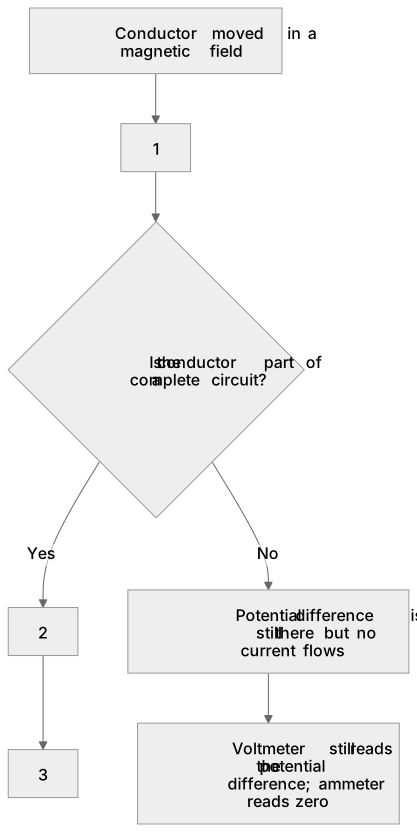
Some boxes have lost their names. Pick the right name for each number.
1Box 1
2Box 2
3Box 3
There is more to this lesson
The full lesson goes on to check your understanding and help you earn the marks. Create a free account to carry on, with your progress saved.
A week of Premium from your first lesson · Then the free plan continues · No card, no charge
Test your understanding of Induced potential (HT only): If the conductor is part of a complete circuit, a current is induced in the conductor.
Active recall beats re-reading. Take an instant quiz now to test what you’ve learned and lock it into long-term memory.
A week of Premium from your first lesson · Then the free plan continues · No card, no charge