AQA · GCSE · Physics
Course version: 8463 · Version from Sept 2016
Image height and object height should both be measured in either mm or cm.
Full specification wording
Lenses (physics only): Image height and object height should both be measured in either mm or cm.
Magnification = image height / object height, so it is a ratio of two lengths and has no unit, but only if both heights are measured in the same unit.
Checked against the AQA 8463 specification (opens in a new tab) on .
- Point 8 of 9
- 4 key terms
Study notes
From the checked teaching notes for this specification point.
The idea
Magnification = image height / object height, so it is a ratio of two lengths and has no unit, but only if both heights are measured in the same unit. Measure both in millimetres or both in centimetres; mixing them makes the answer ten times too big or too small. In a diagram question you measure the arrows with a ruler, for example an image 2.0 cm tall and an object 0.8 cm tall, giving a magnification of 2.5. Rearranging lets you find either height, since image height = magnification × object height, so a symbol 1.6 mm tall magnified 3.5 times gives an image height of 5.6 mm. One special case is worth knowing: when the object height is exactly 1 cm, the image height in centimetres is numerically equal to the magnification.
What earns the marks
- A correct substitution into magnification = image height / object height.
- A correct rearrangement when a height is the unknown, such as image height = magnification × object height.
- The final value, with a unit for a height and no unit for a magnification.
Common mistakes and how to put them right
Measuring the object in millimetres and the image in centimetres, so the magnification is out by a factor of ten.
Giving the magnification a unit such as cm or times.
Inverting the ratio by dividing object height by image height.
Measuring the object and image arrows inconsistently, including the arrow head on one but not the other.
Exam tips
- Write the unit next to each measured height before you divide, because that makes a mismatch obvious.
- Magnification has no unit, so leave the answer as a bare number.
- Measure with a ruler to the nearest millimetre and quote the values you used in your working.
Try the lesson
The start of the Lenses (physics only): Image height and object height should both be measured in either mm or cm. lesson, made from checked teaching notes for this specification point.
Have a go first
A student measures an object height as 30 mm and the matching image height as 6 cm. Which statement about these two measurements is correct?
Listen
Magnification = image height / object height, so it is a ratio of two lengths and has no unit, but only if both heights are measured in the same unit. Measure both in millimetres or both in centimetres; mixing them makes the answer ten times too big or too small. In a diagram question you measure the arrows with a ruler, for example an image 2.0 cm tall and an object 0.8 cm tall, giving a magnification of 2.5. Rearranging lets you find either height, since image height = magnification × object height, so a symbol 1.6 mm tall magnified 3.5 times gives an image height of 5.6 mm. One special case is worth knowing: when the object height is exactly 1 cm, the image height in centimetres is numerically equal to the magnification. A strong answer earns marks for these points. a correct substitution into magnification = image height / object height. a correct rearrangement when a height is the unknown, such as image height = magnification × object height. the final value, with a unit for a height and no unit for a magnification. Exam tip: Write the unit next to each measured height before you divide, because that makes a mismatch obvious.
See it
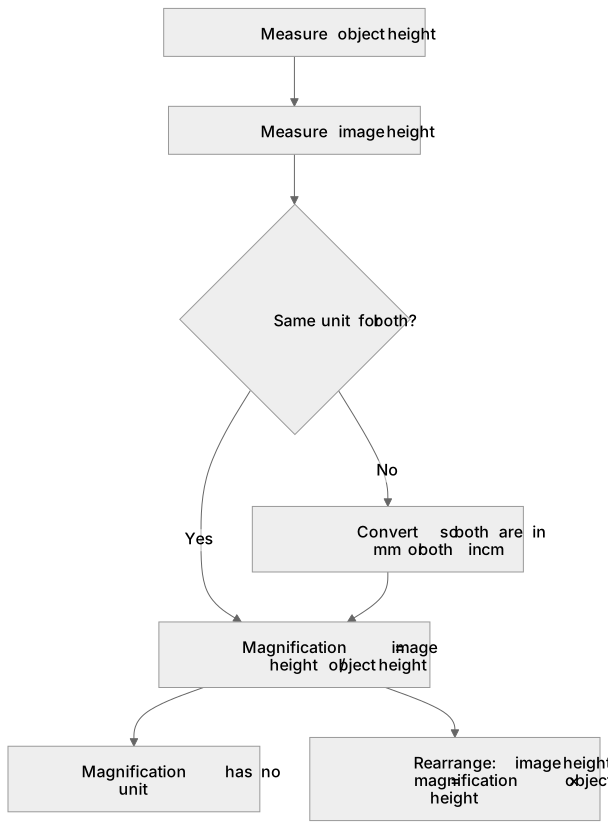
Key words
Say what each word means before you turn the card.
magnification ratio
Try answering aloud or in your head before turning the card.
same unit for both heights
Try answering aloud or in your head before turning the card.
no unit for magnification
Try answering aloud or in your head before turning the card.
rearranging the equation
Try answering aloud or in your head before turning the card.
See every definition
- magnification ratio
- A ratio of two lengths, image height divided by object height, which has no unit.
- same unit for both heights
- Image height and object height should both be measured in either mm or cm, because mixing them makes the answer ten times too big or too small.
- no unit for magnification
- The final value has a unit for a height and no unit for a magnification, so the answer is left as a bare number.
- rearranging the equation
- Rearranging lets you find either height, since image height = magnification × object height.
Label the diagram
Some boxes have lost their names. Pick the right name for each number.
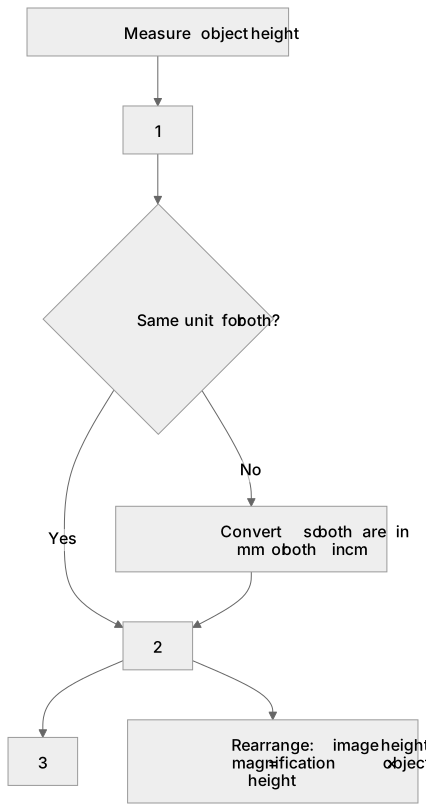
1Box 1
2Box 2
3Box 3
There is more to this lesson
The full lesson goes on to check your understanding and help you earn the marks. Create a free account to carry on, with your progress saved.
A week of Premium from your first lesson · Then the free plan continues · No card, no charge
Test your understanding of Lenses (physics only): Image height and object height should both be measured in either mm or cm.
Active recall beats re-reading. Take an instant quiz now to test what you’ve learned and lock it into long-term memory.
A week of Premium from your first lesson · Then the free plan continues · No card, no charge