AQA · GCSE · Physics
Course version: 8463 · Version from Sept 2016
In ray diagrams a convex lens will be represented by: A concave lens will…
Full specification wording
Lenses (physics only): In ray diagrams a convex lens will be represented by: A concave lens will be represented by:
The specification gives standard symbols so that a diagram cannot be misread.
Checked against the AQA 8463 specification (opens in a new tab) on .
- Point 9 of 9
- 4 key terms
Study notes
From the checked teaching notes for this specification point.
The idea
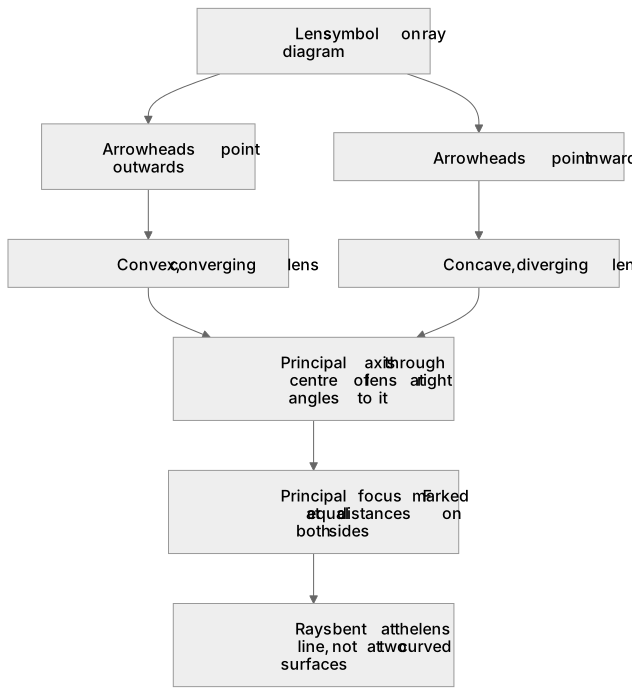
The specification gives standard symbols so that a diagram cannot be misread. A convex, converging lens is drawn as a vertical line with outward pointing arrowheads at both ends, like a double headed arrow. A concave, diverging lens is drawn as a vertical line with inward pointing arrowheads at both ends. In both cases the refraction is shown as a single bend at that line rather than at two curved glass surfaces, which is the standard simplification for GCSE ray diagrams. Draw the principal axis through the centre of the lens at right angles to the line, mark the principal focus F on each side at equal distances, and draw the object as an upright arrow standing on the axis.
What earns the marks
- The correct lens symbol, arrowheads outwards for convex and inwards for concave.
- The principal axis drawn through the centre of the lens at right angles to it.
- The principal focus marked at the same distance on both sides of the lens.
- The rays bent at the lens line rather than at two separate curved surfaces.
Common mistakes and how to put them right
Drawing the lens as a shaped piece of glass and then refracting at both curved surfaces.
Using outward pointing arrowheads for a concave lens.
Marking F at different distances on the two sides of the lens.
Drawing the object arrow off the principal axis, so the construction rays no longer work.
Exam tips
- Copy the two symbols into your notes and practise them until the arrow directions are automatic.
- Whatever symbol the question prints, use the same one in your own answer.
- Keep the diagram large, since a small diagram makes the crossing point hard to read and loses position marks.
Try the lesson
The start of the Lenses (physics only): In ray diagrams a convex lens will be represented by: A concave lens will be represented by: lesson, made from checked teaching notes for this specification point.
Have a go first
Which pair of symbols correctly represents a convex lens and a concave lens in ray diagrams?
Listen
The specification gives standard symbols so that a diagram cannot be misread. A convex, converging lens is drawn as a vertical line with outward pointing arrowheads at both ends, like a double headed arrow. A concave, diverging lens is drawn as a vertical line with inward pointing arrowheads at both ends. In both cases the refraction is shown as a single bend at that line rather than at two curved glass surfaces, which is the standard simplification for GCSE ray diagrams. Draw the principal axis through the centre of the lens at right angles to the line, mark the principal focus F on each side at equal distances, and draw the object as an upright arrow standing on the axis. A strong answer earns marks for these points. the correct lens symbol, arrowheads outwards for convex and inwards for concave. the principal axis drawn through the centre of the lens at right angles to it. the principal focus marked at the same distance on both sides of the lens. the rays bent at the lens line rather than at two separate curved surfaces. Exam tip: Copy the two symbols into your notes and practise them until the arrow directions are automatic.
See it
Key words
Say what each word means before you turn the card.
standard lens symbols
Try answering aloud or in your head before turning the card.
arrowheads in or out
Try answering aloud or in your head before turning the card.
single bend at the lens line
Try answering aloud or in your head before turning the card.
principal axis
Try answering aloud or in your head before turning the card.
See every definition
- standard lens symbols
- A convex, converging lens is drawn as a vertical line with outward pointing arrowheads at both ends, and a concave, diverging lens as a vertical line with inward pointing arrowheads at both ends.
- arrowheads in or out
- Outward pointing arrowheads at both ends show a convex, converging lens, while inward pointing arrowheads show a concave, diverging lens.
- single bend at the lens line
- The refraction is shown as a single bend at that line rather than at two curved glass surfaces, which is the standard simplification for GCSE ray diagrams.
- principal axis
- A line drawn through the centre of the lens at right angles to the line representing the lens.
Label the diagram
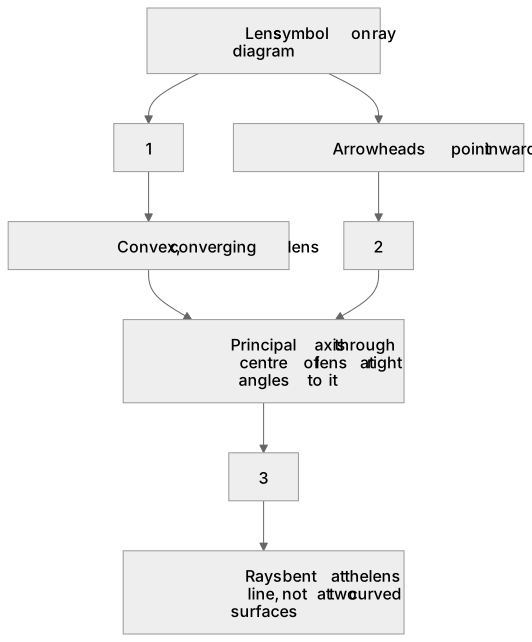
Some boxes have lost their names. Pick the right name for each number.
1Box 1
2Box 2
3Box 3
There is more to this lesson
The full lesson goes on to check your understanding and help you earn the marks. Create a free account to carry on, with your progress saved.
A week of Premium from your first lesson · Then the free plan continues · No card, no charge
Test your understanding of Lenses (physics only): In ray diagrams a convex lens will be represented by: A concave lens will be represented by:
Active recall beats re-reading. Take an instant quiz now to test what you’ve learned and lock it into long-term memory.
A week of Premium from your first lesson · Then the free plan continues · No card, no charge