AQA · GCSE · Physics
Course version: 8463 · Version from Sept 2016
A force or a system of forces may cause an object to rotate.
Full specification wording
Moments, levers and gears (physics only): A force or a system of forces may cause an object to rotate.
A force makes an object turn when its line of action does not pass through the pivot.
Checked against the AQA 8463 specification (opens in a new tab) on .
- Point 1 of 7
- 3 key terms
Study notes
From the checked teaching notes for this specification point.
The idea
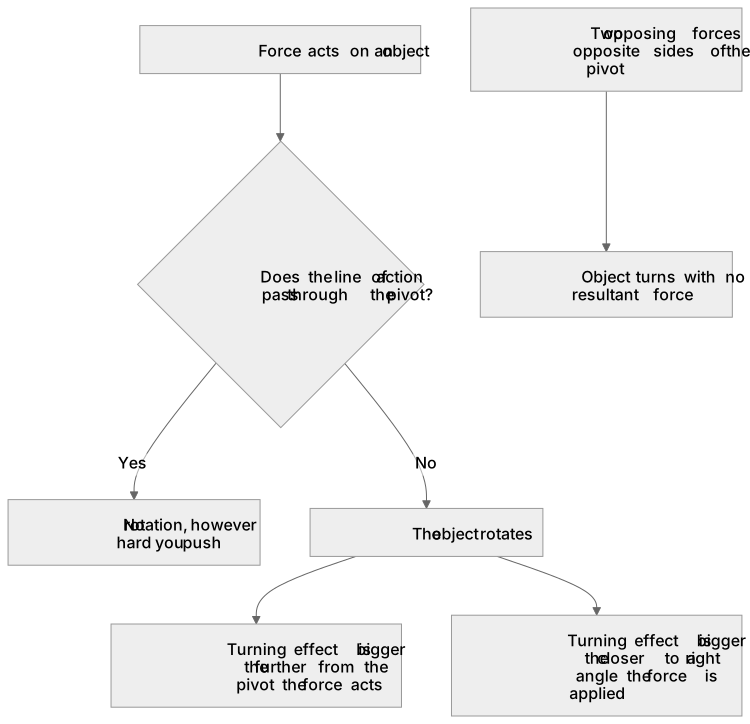
A force makes an object turn when its line of action does not pass through the pivot. Push a door at the handle and it swings; push it exactly on the line running through the hinges and it will not turn at all, however hard you push. The further from the pivot the force acts, and the closer to a right angle it is applied, the bigger the turning effect. Two forces can also produce rotation with no overall push: the two hands on a steering wheel, or a force at each end of a spanner, act in opposite directions on opposite sides of the pivot, so they turn the object while the resultant force stays zero. That is why a system of forces, and not only a single force, is named here.
What earns the marks
- The force acting at a distance from the pivot, so its line of action misses the pivot.
- Stating that a force whose line of action passes through the pivot causes no rotation.
- A correct everyday example of a force causing rotation.
- Recognising that two opposing forces either side of a pivot can turn an object with no resultant force.
Common mistakes and how to put them right
Assuming any force on an object makes it rotate, whatever its line of action.
Measuring the distance from the pivot along the force itself rather than perpendicular to its line of action.
Saying a bigger force always gives a bigger turning effect without mentioning the distance.
Treating rotation as impossible unless there is a resultant force.
Exam tips
- Find the pivot before anything else; the geometry of the whole question follows from it.
- Push at right angles and as far from the pivot as possible is the standard way to maximise a turning effect.
Try the lesson
The start of the Moments, levers and gears (physics only): A force or a system of forces may cause an object to rotate. lesson, made from checked teaching notes for this specification point.
Have a go first
A spanner is used to turn a nut. Which effect does the force applied to the handle of the spanner have on the nut?
Listen
A force makes an object turn when its line of action does not pass through the pivot. Push a door at the handle and it swings; push it exactly on the line running through the hinges and it will not turn at all, however hard you push. The further from the pivot the force acts, and the closer to a right angle it is applied, the bigger the turning effect. Two forces can also produce rotation with no overall push: the two hands on a steering wheel, or a force at each end of a spanner, act in opposite directions on opposite sides of the pivot, so they turn the object while the resultant force stays zero. That is why a system of forces, and not only a single force, is named here. A strong answer earns marks for these points. the force acting at a distance from the pivot, so its line of action misses the pivot. stating that a force whose line of action passes through the pivot causes no rotation. a correct everyday example of a force causing rotation. recognising that two opposing forces either side of a pivot can turn an object with no resultant force. Exam tip: Find the pivot before anything else; the geometry of the whole question follows from it.
See it
Key words
Say what each word means before you turn the card.
pivot
Try answering aloud or in your head before turning the card.
line of action
Try answering aloud or in your head before turning the card.
turning effect
Try answering aloud or in your head before turning the card.
See every definition
- pivot
- The point about which a force makes an object turn, and which must be found before anything else.
- line of action
- The line along which a force acts; if it passes through the pivot, the force causes no rotation.
- turning effect
- The turning of an object, which is bigger the further from the pivot the force acts and the closer to a right angle it is applied.
There is more to this lesson
The full lesson goes on to check your understanding and help you earn the marks. Create a free account to carry on, with your progress saved.
A week of Premium from your first lesson · Then the free plan continues · No card, no charge
Test your understanding of Moments, levers and gears (physics only): A force or a system of forces may cause an object to rotate.
Active recall beats re-reading. Take an instant quiz now to test what you’ve learned and lock it into long-term memory.
A week of Premium from your first lesson · Then the free plan continues · No card, no charge