AQA · GCSE · Physics
Course version: 8463 · Version from Sept 2016
Students should be able to calculate the size of a force, or its distance…
Full specification wording
Moments, levers and gears (physics only): Students should be able to calculate the size of a force, or its distance from a pivot, acting on an object that is balanced.
When a beam balances, the product of force and distance on one side equals the product on the other, and any one of the four quantities can be found if the other three are known.
Checked against the AQA 8463 specification (opens in a new tab) on .
- Point 5 of 7
- 4 key terms
Study notes
From the checked teaching notes for this specification point.
The idea
When a beam balances, the product of force and distance on one side equals the product on the other, and any one of the four quantities can be found if the other three are known. A 4.0 N weight hung 0.60 m to the left of a pivot gives 2.4 N m anticlockwise, so a weight 0.30 m to the right must be 8.0 N. Distances can stay in centimetres provided both sides use centimetres, because the units cancel; the moment itself is only in newton-metres if the distance is in metres. Where several loads act, total each side first and then rearrange. Always sense-check the answer, because the load nearer the pivot must be the larger force.
What earns the marks
- Setting the total clockwise moment equal to the total anticlockwise moment.
- A correct substitution with matching distance units on both sides.
- Rearranging to make the unknown force or distance the subject.
- The answer with the correct unit, newtons or metres.
Common mistakes and how to put them right
Mixing centimetres on one side of the equation with metres on the other.
Multiplying where a division is needed in the rearrangement, giving an answer far too large.
Measuring the distance from the load to the end of the beam instead of to the pivot.
Producing an answer in which the load nearer the pivot is the smaller force.
Exam tips
- Write the moment equation out in full before rearranging; the equation itself is a mark.
- Sense-check the result: the closer a load sits to the pivot, the larger its force must be.
Try the lesson
The start of the Moments, levers and gears (physics only): Students should be able to calculate the size of a force, or its distance from a pivot, acting on an object that is balanced. lesson, made from checked teaching notes for this specification point.
Have a go first
A balanced beam is pivoted at one point. A 12 N force acts 0.50 m from the pivot on one side. A second force of 8 N acts on the other side. How far from the pivot must the 8 N force act to keep the beam balanced?
Listen
When a beam balances, the product of force and distance on one side equals the product on the other, and any one of the four quantities can be found if the other three are known. A 4.0 N weight hung 0.60 m to the left of a pivot gives 2.4 N m anticlockwise, so a weight 0.30 m to the right must be 8.0 N. Distances can stay in centimetres provided both sides use centimetres, because the units cancel; the moment itself is only in newton-metres if the distance is in metres. Where several loads act, total each side first and then rearrange. Always sense-check the answer, because the load nearer the pivot must be the larger force. A strong answer earns marks for these points. setting the total clockwise moment equal to the total anticlockwise moment. a correct substitution with matching distance units on both sides. rearranging to make the unknown force or distance the subject. the answer with the correct unit, newtons or metres. Exam tip: Write the moment equation out in full before rearranging; the equation itself is a mark.
See it
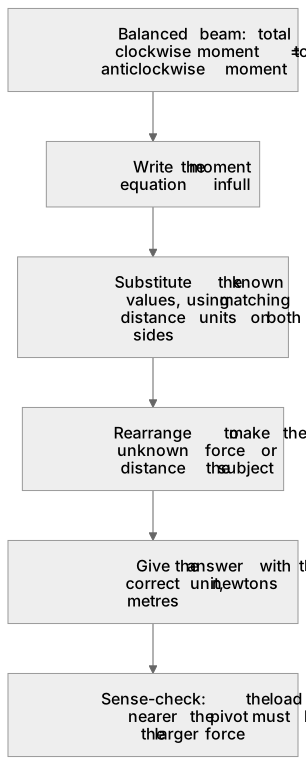
Put it in order
Put these steps in the order they happen.
- 1. Substitute the known values, using matching distance units on both sides
- 2. Write the moment equation in full
- 3. Balanced beam: total clockwise moment = total anticlockwise moment
- 4. Sense-check: the load nearer the pivot must be the larger force
- 5. Give the answer with the correct unit, newtons or metres
- 6. Rearrange to make the unknown force or distance the subject
Key words
Say what each word means before you turn the card.
balanced beam
Try answering aloud or in your head before turning the card.
rearranging moments
Try answering aloud or in your head before turning the card.
unit consistency
Try answering aloud or in your head before turning the card.
unknown force
Try answering aloud or in your head before turning the card.
See every definition
- balanced beam
- A beam on which the product of force and distance on one side equals the product on the other.
- rearranging moments
- Making the unknown force or distance the subject of the moment equation after setting the total clockwise moment equal to the total anticlockwise moment.
- unit consistency
- Using matching distance units on both sides, so distances can stay in centimetres because the units cancel.
- unknown force
- The force found by rearranging the moment equation when the other three quantities are known.
Label the diagram
Some boxes have lost their names. Pick the right name for each number.
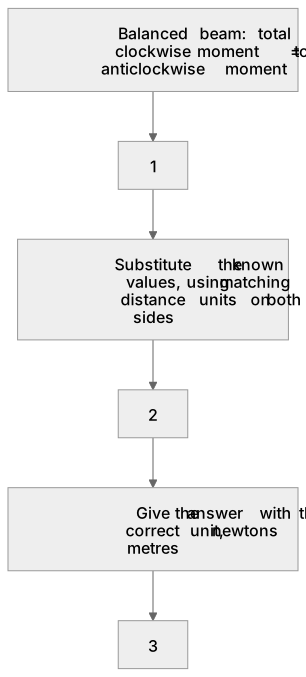
1Box 1
2Box 2
3Box 3
There is more to this lesson
The full lesson goes on to check your understanding and help you earn the marks. Create a free account to carry on, with your progress saved.
A week of Premium from your first lesson · Then the free plan continues · No card, no charge
Test your understanding of Moments, levers and gears (physics only): Students should be able to calculate the size of a force, or its distance from a pivot, acting on an object that is balanced.
Active recall beats re-reading. Take an instant quiz now to test what you’ve learned and lock it into long-term memory.
A week of Premium from your first lesson · Then the free plan continues · No card, no charge