AQA · GCSE · Physics
Course version: 8463 · Version from Sept 2016
If an object is balanced, the total clockwise moment about a pivot equals…
Full specification wording
Moments, levers and gears (physics only): If an object is balanced, the total clockwise moment about a pivot equals the total anticlockwise moment about that pivot.
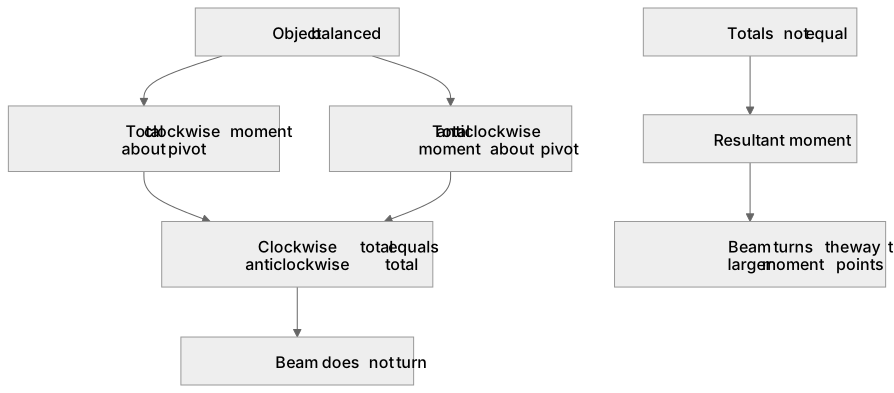
Balanced means the beam is not turning, requiring the sum of every clockwise turning effect about the pivot to match the sum of every anticlockwise one.
Checked against the AQA 8463 specification (opens in a new tab) on .
- Point 4 of 7
- 3 key terms
Study notes
From the checked teaching notes for this specification point.
The idea
Balanced means the beam is not turning, requiring the sum of every clockwise turning effect about the pivot to match the sum of every anticlockwise one. Each moment is worked out separately as force multiplied by perpendicular distance and then added to its own side. On a number balance, a 2-unit weight hung at position 3 on the right gives a clockwise moment of 6 units. To balance this, 6 units of anticlockwise moment must be restored on the left, for example by hanging one 1-unit weight at position 6, or one 2-unit weight at position 3. If the two totals are not equal there is a resultant moment and the beam turns the way the larger one points. The pivot supplies whatever upward force is needed to balance the downward forces.
What earns the marks
- Stating the total clockwise moment equals the total anticlockwise moment.
- Each moment worked out as force × perpendicular distance from the pivot.
- Summing all the moments on each side before comparing them.
- Stating the direction of the resultant moment where the totals differ.
Common mistakes and how to put them right
Adding forces instead of moments when more than one weight hangs on the same side.
Measuring distances from the end of the beam rather than from the pivot.
Assuming a balanced beam needs equal weights, ignoring their distances from the pivot.
Leaving out the moment of a second load on one side.
Exam tips
- Tabulate the force and the distance for every load before writing the balance equation.
- State which way the beam turns when the moments are unequal; it is usually a mark on its own.
Try the lesson
The start of the Moments, levers and gears (physics only): If an object is balanced, the total clockwise moment about a pivot equals the total anticlockwise moment about that pivot. lesson, made from checked teaching notes for this specification point.
Have a go first
A seesaw is balanced on a pivot. On the left, a force creates an anticlockwise moment of 30 Nm. What is the total clockwise moment about the pivot?
Listen
Balanced means the beam is not turning, requiring the sum of every clockwise turning effect about the pivot to match the sum of every anticlockwise one. Each moment is worked out separately as force multiplied by perpendicular distance and then added to its own side. On a number balance, a 2-unit weight hung at position 3 on the right gives a clockwise moment of 6 units. To balance this, 6 units of anticlockwise moment must be restored on the left, for example by hanging one 1-unit weight at position 6, or one 2-unit weight at position 3. If the two totals are not equal there is a resultant moment and the beam turns the way the larger one points. The pivot supplies whatever upward force is needed to balance the downward forces. A strong answer earns marks for these points. stating the total clockwise moment equals the total anticlockwise moment. each moment worked out as force × perpendicular distance from the pivot. summing all the moments on each side before comparing them. stating the direction of the resultant moment where the totals differ. Exam tip: Tabulate the force and the distance for every load before writing the balance equation.
See it
Key words
Say what each word means before you turn the card.
principle of moments
Try answering aloud or in your head before turning the card.
resultant moment
Try answering aloud or in your head before turning the card.
balanced beam
Try answering aloud or in your head before turning the card.
See every definition
- principle of moments
- If an object is balanced, the total clockwise moment about a pivot equals the total anticlockwise moment about that pivot.
- resultant moment
- What exists when the two totals are not equal, and the beam turns the way the larger one points.
- balanced beam
- A beam that is not turning, because the sum of every clockwise turning effect about the pivot matches the sum of every anticlockwise one.
Label the diagram
Some boxes have lost their names. Pick the right name for each number.
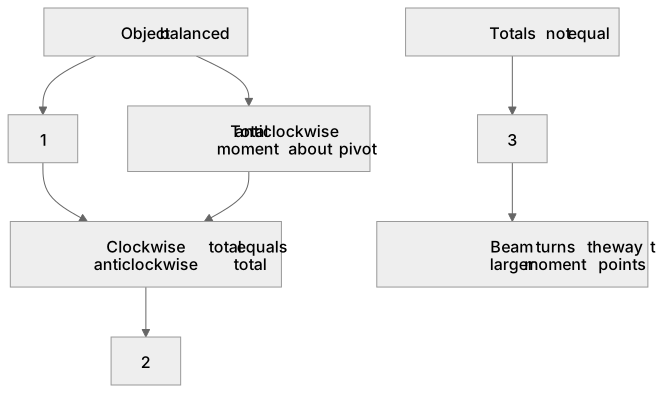
1Box 1
2Box 2
3Box 3
There is more to this lesson
The full lesson goes on to check your understanding and help you earn the marks. Create a free account to carry on, with your progress saved.
A week of Premium from your first lesson · Then the free plan continues · No card, no charge
Test your understanding of Moments, levers and gears (physics only): If an object is balanced, the total clockwise moment about a pivot equals the total anticlockwise moment about that pivot.
Active recall beats re-reading. Take an instant quiz now to test what you’ve learned and lock it into long-term memory.
A week of Premium from your first lesson · Then the free plan continues · No card, no charge