AQA · GCSE · Physics
Course version: 8463 · Version from Sept 2016
Students should be able to: consider the environmental issues that may…
Full specification wording
National and global energy resources: Students should be able to: consider the environmental issues that may arise from the use of different energy resources show that science has the ability to identify environmental issues arising from the use of energy resources but not always the power to deal with the issues because of political, social, ethical or economic considerations.
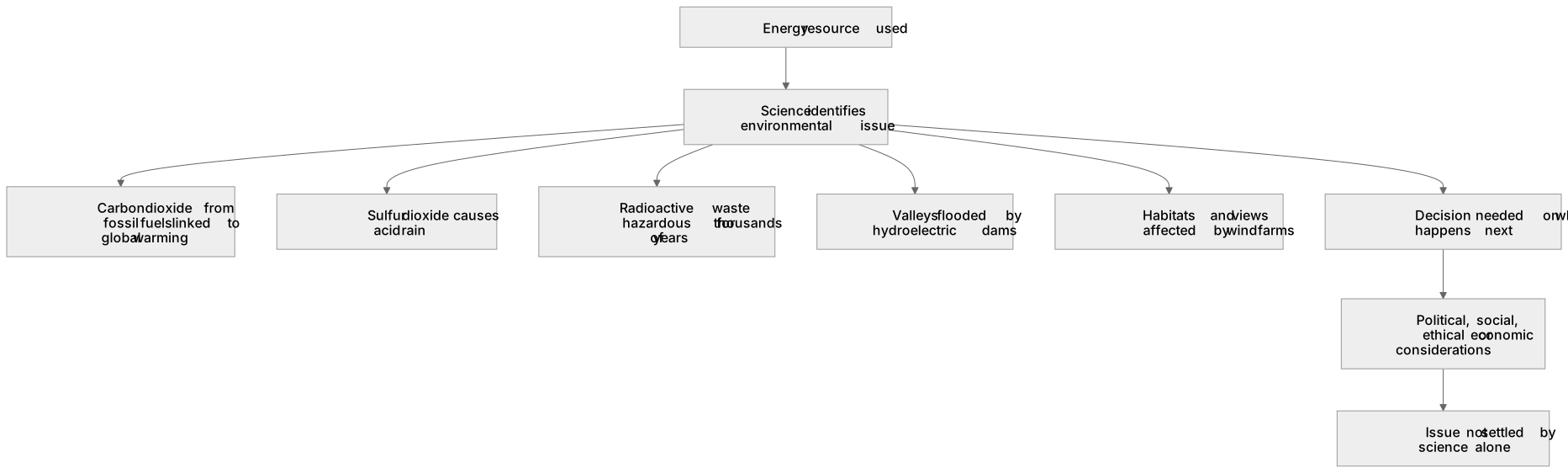
Science can measure and predict what an energy resource does to the environment: the carbon dioxide released when fossil fuels burn and its link to global warming, the sulfur dioxide that causes…
Checked against the AQA 8463 specification (opens in a new tab) on .
- Point 5 of 5
- 4 key terms
Study notes
From the checked teaching notes for this specification point.
The idea
Science can measure and predict what an energy resource does to the environment: the carbon dioxide released when fossil fuels burn and its link to global warming, the sulfur dioxide that causes acid rain, the radioactive waste that stays hazardous for thousands of years, the valleys flooded by hydroelectric dams, the habitats and views affected by wind farms. What science cannot do is decide what happens next, because that depends on politics, cost, ethics and public opinion. Closing coal stations raises bills and costs jobs; nuclear power divides opinion; wind farms meet local objections. So the National Grid still keeps fossil fuel stations running below full output to cover shortfalls, an economic and practical decision resting on scientific evidence but not settled by it.
What earns the marks
- Identifying an environmental issue with the resource named.
- Stating that scientists can identify or measure the issue.
- A political, social, ethical or economic reason why the issue is not resolved.
- A balanced conclusion that recognises evidence and decision making are different things.
Common mistakes and how to put them right
Arguing that scientists should simply ban a resource, which ignores the decision making part of the question.
Giving pollution as the issue without naming the pollutant or its effect.
Treating cost as a scientific objection rather than an economic one.
Listing only drawbacks when the question asks for a balanced evaluation.
Exam tips
- Use the four words from the specification, political, social, ethical and economic, to structure the second half of an answer.
- Name the pollutant and its effect together, such as sulfur dioxide causing acid rain.
- Finish with a judgement when the command word is evaluate, since a list of points alone stalls at the middle level.
Try the lesson
The start of the National and global energy resources: Students should be able to: consider the environmental issues that may arise from the use of different energy resources show that science has the ability to identify environmental issues arising from the use of energy resources but not always the power to deal with the issues because of political, social, ethical or economic considerations. lesson, made from checked teaching notes for this specification point.
Have a go first
Which environmental issue is most closely associated with burning coal to generate electricity?
Listen
Science can measure and predict what an energy resource does to the environment: the carbon dioxide released when fossil fuels burn and its link to global warming, the sulfur dioxide that causes acid rain, the radioactive waste that stays hazardous for thousands of years, the valleys flooded by hydroelectric dams, the habitats and views affected by wind farms. What science cannot do is decide what happens next, because that depends on politics, cost, ethics and public opinion. Closing coal stations raises bills and costs jobs; nuclear power divides opinion; wind farms meet local objections. So the National Grid still keeps fossil fuel stations running below full output to cover shortfalls, an economic and practical decision resting on scientific evidence but not settled by it. A strong answer earns marks for these points. identifying an environmental issue with the resource named. stating that scientists can identify or measure the issue. a political, social, ethical or economic reason why the issue is not resolved. a balanced conclusion that recognises evidence and decision making are different things. Exam tip: Use the four words from the specification, political, social, ethical and economic, to structure the second half of an answer.
See it
Key words
Say what each word means before you turn the card.
environmental issues
Try answering aloud or in your head before turning the card.
limits of science
Try answering aloud or in your head before turning the card.
political and economic factors
Try answering aloud or in your head before turning the card.
evaluating evidence
Try answering aloud or in your head before turning the card.
See every definition
- environmental issues
- Problems that may arise from the use of different energy resources, such as carbon dioxide released when fossil fuels burn and its link to global warming.
- limits of science
- Science has the ability to identify environmental issues arising from the use of energy resources but not always the power to deal with the issues.
- political and economic factors
- Political, social, ethical or economic considerations that mean science does not always have the power to deal with environmental issues.
- evaluating evidence
- Recognising that evidence and decision making are different things, since scientific evidence alone does not settle what happens next.
Label the diagram
Some boxes have lost their names. Pick the right name for each number.
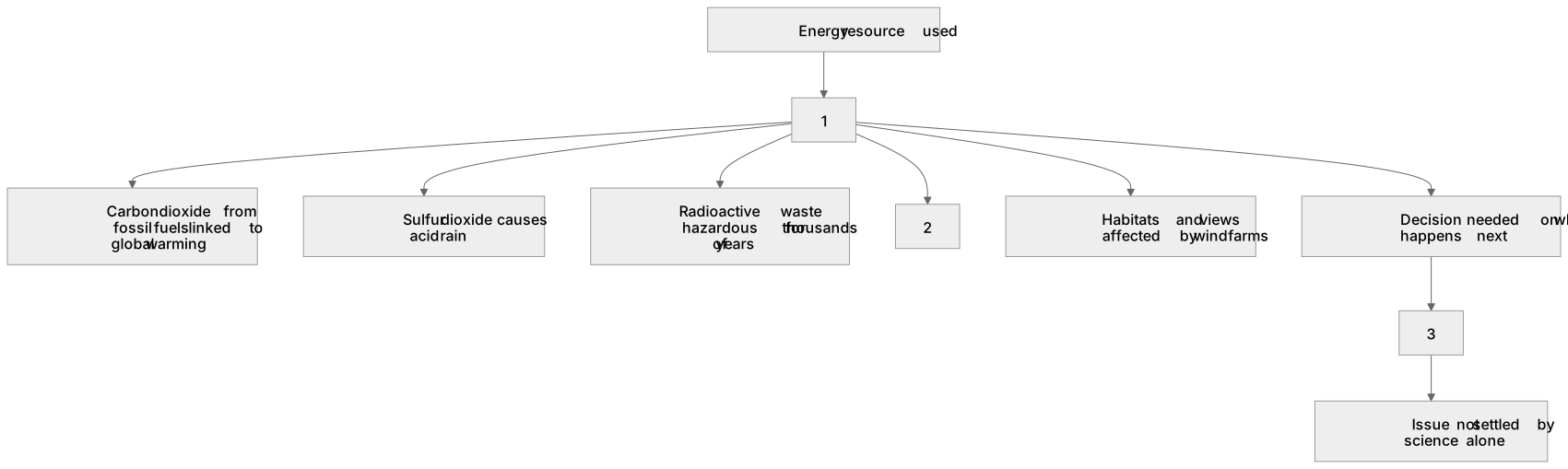
1Box 1
2Box 2
3Box 3
There is more to this lesson
The full lesson goes on to check your understanding and help you earn the marks. Create a free account to carry on, with your progress saved.
A week of Premium from your first lesson · Then the free plan continues · No card, no charge
Test your understanding of National and global energy resources: Students should be able to: consider the environmental issues that may arise from the use of different energy resources show that science has the ability to identify environmental issues arising from the use of energy resources but not always the power to deal with the issues because of political, social, ethical or economic considerations.
Active recall beats re-reading. Take an instant quiz now to test what you’ve learned and lock it into long-term memory.
A week of Premium from your first lesson · Then the free plan continues · No card, no charge