AQA · GCSE · Physics
Course version: 8463 · Version from Sept 2016
(HT only) The tendency of objects to continue in their state of rest or of…
Full specification wording
Newton's First Law: (HT only) The tendency of objects to continue in their state of rest or of uniform motion is called inertia.
Inertia is the name for an object's reluctance to change how it is moving.
Checked against the AQA 8463 specification (opens in a new tab) on .
- Point 5 of 5
- 2 key terms
Study notes
From the checked teaching notes for this specification point.
The idea
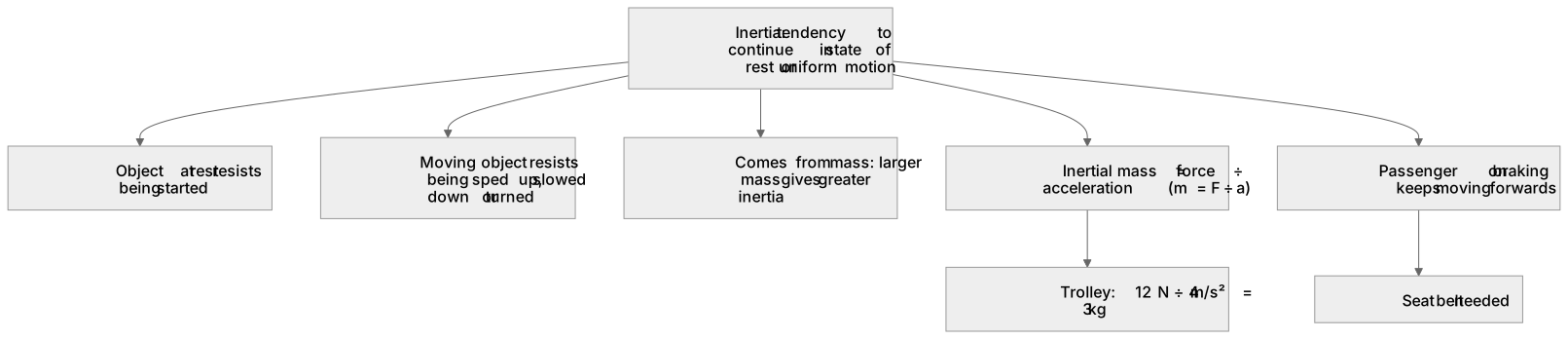
Inertia is the name for an object's reluctance to change how it is moving. An object at rest resists being started; an object already moving resists being sped up, slowed down or turned. Inertia is not a force and it does not push anything: it is a property that comes from mass. Because of it, a passenger on a braking bus keeps moving forwards while the bus slows beneath them. On Higher Tier the idea is made quantitative: inertial mass is a measure of how hard it is to change an object's velocity, and it is defined as the ratio of force to acceleration, m = F ÷ a. A trolley needing 12 N to accelerate at 4 m/s² has an inertial mass of 3 kg. Inertia is also why a seat belt is needed: the passenger keeps moving forwards at the original speed while the car stops around them.
What earns the marks
- Defining inertia as the tendency of an object to stay at rest or to keep moving at the same velocity.
- Stating that a larger mass gives a greater inertia.
- Defining inertial mass as the ratio of force to acceleration.
- A correct calculation of inertial mass from force ÷ acceleration, with the unit kg.
Common mistakes and how to put them right
Describing inertia as a force that throws passengers forwards when a vehicle brakes.
Confusing inertia with momentum, which also depends on how fast the object is going.
Claiming an object in space has no inertia because it has no weight.
Writing the inertial mass ratio upside down as acceleration divided by force.
Exam tips
- Say 'tendency to continue' rather than 'wants to keep going'; examiners reject answers that give objects intentions.
- For inertial mass, quote m = F ÷ a and show the substitution before the answer.
- Check the tier: inertia and inertial mass are Higher Tier only, so expect them late in the paper.
Try the lesson
The start of the Newton's First Law: (HT only) The tendency of objects to continue in their state of rest or of uniform motion is called inertia. lesson, made from checked teaching notes for this specification point.
Have a go first
A book is resting on a desk and is not moving. Which statement describes the inertia of the book?
Listen
Inertia is the name for an object's reluctance to change how it is moving. An object at rest resists being started; an object already moving resists being sped up, slowed down or turned. Inertia is not a force and it does not push anything: it is a property that comes from mass. Because of it, a passenger on a braking bus keeps moving forwards while the bus slows beneath them. On Higher Tier the idea is made quantitative: inertial mass is a measure of how hard it is to change an object's velocity, and it is defined as the ratio of force to acceleration, m = F ÷ a. A trolley needing 12 N to accelerate at 4 m/s² has an inertial mass of 3 kg. Inertia is also why a seat belt is needed: the passenger keeps moving forwards at the original speed while the car stops around them. A strong answer earns marks for these points. defining inertia as the tendency of an object to stay at rest or to keep moving at the same velocity. stating that a larger mass gives a greater inertia. defining inertial mass as the ratio of force to acceleration. a correct calculation of inertial mass from force ÷ acceleration, with the unit kg. Exam tip: Say 'tendency to continue' rather than 'wants to keep going'; examiners reject answers that give objects intentions.
See it
Key words
Say what each word means before you turn the card.
inertia
Try answering aloud or in your head before turning the card.
inertial mass
Try answering aloud or in your head before turning the card.
See every definition
- inertia
- The tendency of objects to continue in their state of rest or of uniform motion.
- inertial mass
- A measure of how hard it is to change an object's velocity, defined as the ratio of force to acceleration, m = F ÷ a.
Label the diagram
Some boxes have lost their names. Pick the right name for each number.
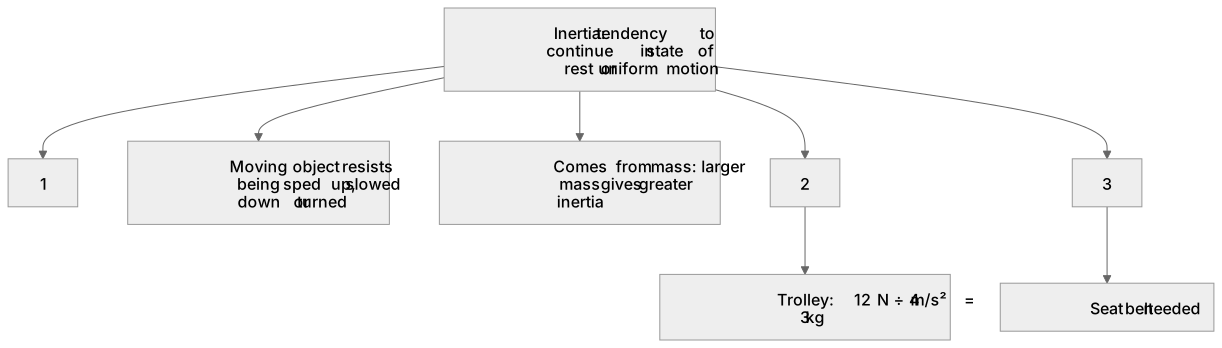
1Box 1
2Box 2
3Box 3
There is more to this lesson
The full lesson goes on to check your understanding and help you earn the marks. Create a free account to carry on, with your progress saved.
A week of Premium from your first lesson · Then the free plan continues · No card, no charge
Test your understanding of Newton's First Law: (HT only) The tendency of objects to continue in their state of rest or of uniform motion is called inertia.
Active recall beats re-reading. Take an instant quiz now to test what you’ve learned and lock it into long-term memory.
A week of Premium from your first lesson · Then the free plan continues · No card, no charge