AQA · GCSE · Physics
Course version: 8463 · Version from Sept 2016
Students should be able to apply Newton’s First Law to explain the motion…
Full specification wording
Newton's First Law: Students should be able to apply Newton’s First Law to explain the motion of objects moving with a uniform velocity and objects where the speed and/or direction changes.
Applying the first law means reading the motion, then deciding what the forces must be doing.
Checked against the AQA 8463 specification (opens in a new tab) on .
- Point 4 of 5
Study notes
From the checked teaching notes for this specification point.
The idea
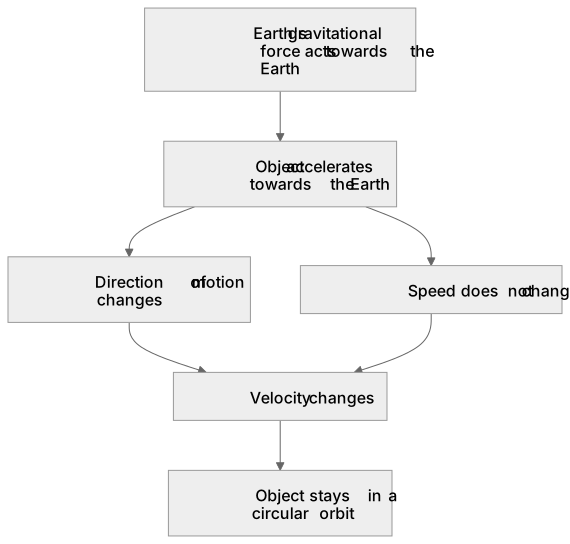
Applying the first law means reading the motion, then deciding what the forces must be doing. If the description says uniform velocity, steady speed or terminal velocity, the resultant force is zero and you name the balanced pair. If the description says speeding up, slowing down or turning, a resultant force acts and you say which force dominates and in which direction. The Hubble Space Telescope is the classic turning example: the Earth's gravitational force makes it accelerate towards the Earth, which changes its direction of motion but not its speed, so its velocity changes and it stays in orbit. A train rounding a curve at a fixed speed is accelerating for exactly the same reason.
What earns the marks
- The gravitational force causing the object to accelerate towards the Earth.
- Saying this changes the direction of motion but not the speed.
- Concluding that the velocity of the object therefore changes.
- Saying the gravitational force maintains the circular orbit, awarded only if no other marks are scored.
Common mistakes and how to put them right
Saying a satellite is weightless because there is no gravity in space.
Stating the telescope speeds up because a force acts, when that force is perpendicular to its motion.
Writing 'it accelerates' with no statement of what is changing, speed or direction.
Assuming distance travelled and displacement are the same along a curved route.
Exam tips
- Three-mark motion questions usually want force, then what changes, then the conclusion about velocity; write three separate sentences.
- Quote the direction of the force as well as its name; 'towards the Earth' is often a marking point.
- Check whether the object's speed is fixed before you claim it is accelerating or decelerating.
Try the lesson
The start of the Newton's First Law: Students should be able to apply Newton’s First Law to explain the motion of objects moving with a uniform velocity and objects where the speed and/or direction changes. lesson, made from checked teaching notes for this specification point.
Have a go first
A cyclist travels along a straight, level road at a steady 6 m/s. Which statement explains the motion of the cyclist?
Listen
Applying the first law means reading the motion, then deciding what the forces must be doing. If the description says uniform velocity, steady speed or terminal velocity, the resultant force is zero and you name the balanced pair. If the description says speeding up, slowing down or turning, a resultant force acts and you say which force dominates and in which direction. The Hubble Space Telescope is the classic turning example: the Earth's gravitational force makes it accelerate towards the Earth, which changes its direction of motion but not its speed, so its velocity changes and it stays in orbit. A train rounding a curve at a fixed speed is accelerating for exactly the same reason. A strong answer earns marks for these points. the gravitational force causing the object to accelerate towards the Earth. saying this changes the direction of motion but not the speed. concluding that the velocity of the object therefore changes. saying the gravitational force maintains the circular orbit, awarded only if no other marks are scored. Exam tip: Three-mark motion questions usually want force, then what changes, then the conclusion about velocity; write three separate sentences.
See it
Label the diagram
Some boxes have lost their names. Pick the right name for each number.
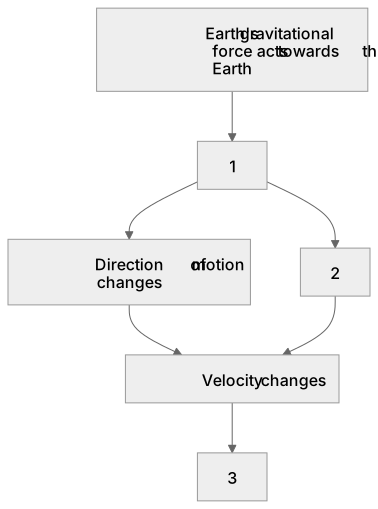
1Box 1
2Box 2
3Box 3
There is more to this lesson
The full lesson goes on to check your understanding and help you earn the marks. Create a free account to carry on, with your progress saved.
A week of Premium from your first lesson · Then the free plan continues · No card, no charge
Test your understanding of Newton's First Law: Students should be able to apply Newton’s First Law to explain the motion of objects moving with a uniform velocity and objects where the speed and/or direction changes.
Active recall beats re-reading. Take an instant quiz now to test what you’ve learned and lock it into long-term memory.
A week of Premium from your first lesson · Then the free plan continues · No card, no charge