AQA · GCSE · Physics
Course version: 8463 · Version from Sept 2016
So, the velocity (speed and/or direction) of an object will only change if…
Full specification wording
Newton's First Law: So, the velocity (speed and/or direction) of an object will only change if a resultant force is acting on the object.
Velocity is a vector, so it carries a size and a direction.
Checked against the AQA 8463 specification (opens in a new tab) on .
- Point 3 of 5
Study notes
From the checked teaching notes for this specification point.
The idea
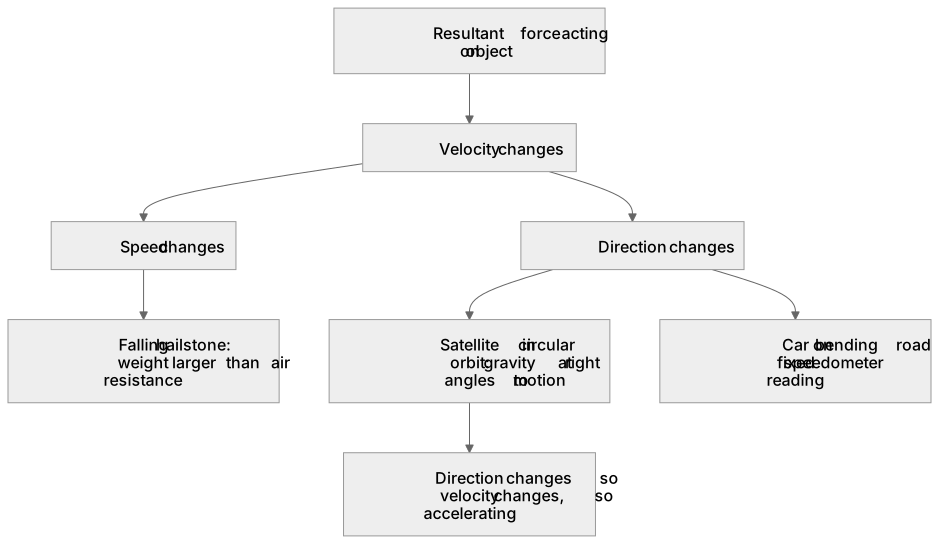
Velocity is a vector, so it carries a size and a direction. Changing either one counts as a change of velocity, and every change of velocity needs a resultant force. A falling hailstone accelerates because its weight is larger than the air resistance on it, so a resultant force acts downwards. A satellite in a circular orbit travels at a constant speed, yet gravity pulls it towards the Earth at right angles to its motion, continually turning it; the direction changes, so the velocity changes and the satellite is accelerating even though its speed never alters. A car following a bending road at a fixed speedometer reading has a changing velocity for the same reason. A resultant force can change the speed, the direction, or both at once, and the direction of the force tells you which.
What earns the marks
- Stating that a resultant force is acting on the object.
- Identifying which force is larger, for example weight greater than air resistance.
- Stating that velocity includes direction, so a change of direction is a change of velocity.
- Linking a force acting at right angles to the motion to a change of direction but not of speed.
Common mistakes and how to put them right
Assuming an object moving in a circle at a steady speed has zero resultant force.
Taking acceleration to mean speeding up only, so ignoring turning and slowing down.
Using the words speed and velocity interchangeably in an explain question.
Saying gravity pulls a satellite forwards along its orbit rather than towards the Earth.
Exam tips
- If the question mentions direction changing, say the word velocity, not speed, in your answer.
- State which force is bigger before you state that there is a resultant force; both usually earn marks.
- For circular motion write 'the direction changes so the velocity changes' as a separate sentence.
Try the lesson
The start of the Newton's First Law: So, the velocity (speed and/or direction) of an object will only change if a resultant force is acting on the object. lesson, made from checked teaching notes for this specification point.
Have a go first
A satellite moves through space far from any planet. Which condition must be true for the satellite's velocity to change?
Listen
Velocity is a vector, so it carries a size and a direction. Changing either one counts as a change of velocity, and every change of velocity needs a resultant force. A falling hailstone accelerates because its weight is larger than the air resistance on it, so a resultant force acts downwards. A satellite in a circular orbit travels at a constant speed, yet gravity pulls it towards the Earth at right angles to its motion, continually turning it; the direction changes, so the velocity changes and the satellite is accelerating even though its speed never alters. A car following a bending road at a fixed speedometer reading has a changing velocity for the same reason. A resultant force can change the speed, the direction, or both at once, and the direction of the force tells you which. A strong answer earns marks for these points. stating that a resultant force is acting on the object. identifying which force is larger, for example weight greater than air resistance. stating that velocity includes direction, so a change of direction is a change of velocity. linking a force acting at right angles to the motion to a change of direction but not of speed. Exam tip: If the question mentions direction changing, say the word velocity, not speed, in your answer.
See it
Label the diagram
Some boxes have lost their names. Pick the right name for each number.
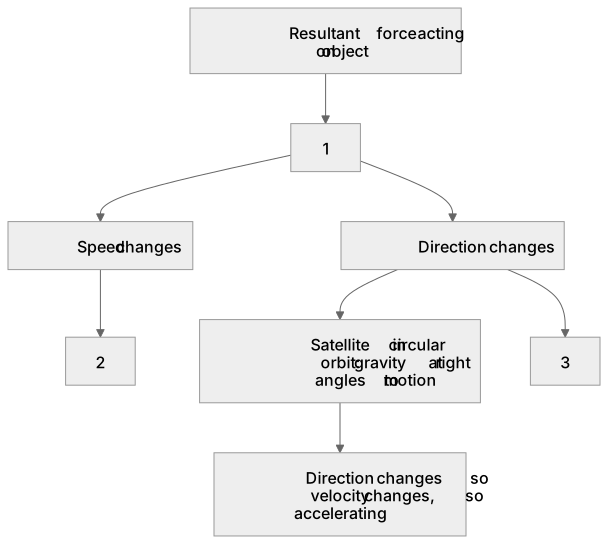
1Box 1
2Box 2
3Box 3
There is more to this lesson
The full lesson goes on to check your understanding and help you earn the marks. Create a free account to carry on, with your progress saved.
A week of Premium from your first lesson · Then the free plan continues · No card, no charge
Test your understanding of Newton's First Law: So, the velocity (speed and/or direction) of an object will only change if a resultant force is acting on the object.
Active recall beats re-reading. Take an instant quiz now to test what you’ve learned and lock it into long-term memory.
A week of Premium from your first lesson · Then the free plan continues · No card, no charge